
Useful tips
Hybrid solar station: reliable backup power 2026


Hybrid solar station: reliable backup power 2026
In 2026, the issue of energy autonomy for homes and businesses has become not just a convenience, but a practical necessity. Hybrid solar station allows you to use solar, grid, and battery power simultaneously, ensuring stable power supply even during outages. This solution is especially relevant for those who want to reduce electricity costs and keep critical systems running under any conditions.
Unlike a conventional stand-alone or grid-connected system, a hybrid configuration combines the advantages of both approaches. It stores excess generation during the day and uses it at night or during emergencies. That is why backup power from the sun has become one of the most effective solutions for private homes, offices, shops and small industries.
What is a hybrid solar station and how does it work?
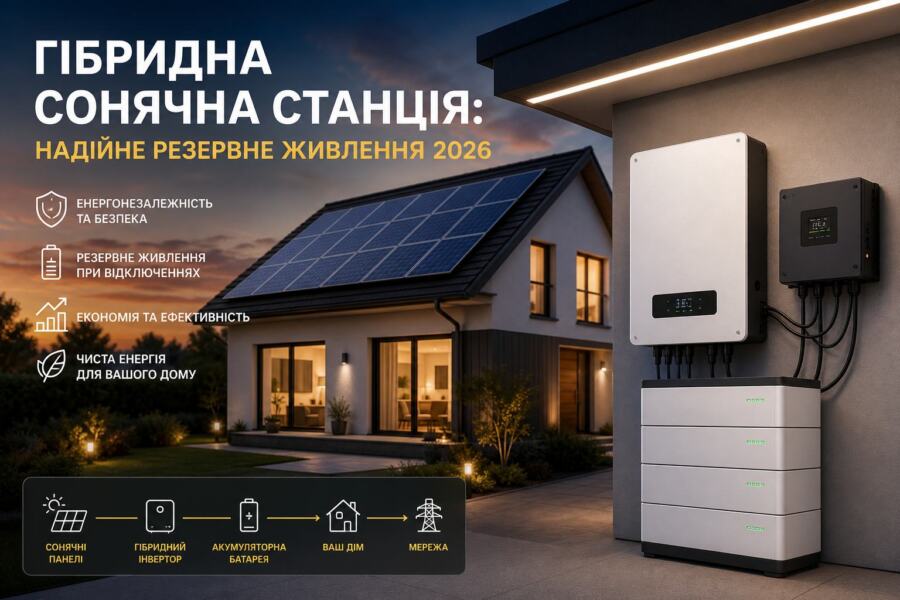
A hybrid solar station is a complex of equipment that simultaneously works with photovoltaic modules, a battery pack, and an external power grid. Its main feature is that the inverter automatically distributes energy flows between consumers, batteries, and the grid.
During the day, solar panels power the house and charge the batteries. If generation is insufficient, the system draws energy from the grid. During a power outage, the inverter quickly switches the load to the backup circuit, so sensitive equipment continues to operate without critical pauses.
- Solar panels generate electricity from daylight.
- Hybrid inverter controls energy flows and operating modes.
- Batteries accumulate surplus for later use.
- Chain acts as an additional power source and backup.
Why solar panels with batteries have become the standard for backup power
Demand for solar panels with batteries is growing due to the need for uninterrupted power supply. Such a system allows not only to save money, but also to avoid downtime, which can be costly. For refrigerators, server equipment, pumps, security systems and medical equipment, the stability of the electricity supply is of critical importance.
Another reason for its popularity is its flexibility. The station can be assembled for specific tasks: only for critical consumers or for the entire house. The correctly selected configuration provides the optimal balance between cost, autonomy and payback time.
UPS with solar panels: what is the practical advantage?
When it comes to sensitive equipment, many owners choose UPS with solar panels as part of a hybrid system. This approach combines redundant power, voltage stabilization, and the ability to operate from an alternative source. It is especially useful for systems that must not be powered down even for a few seconds.
In practice, this makes it possible to protect:
- routers, modems and network equipment;
- video surveillance and alarm systems;
- circulation pumps, boilers and heating automation;
- computers, cash registers and servers;
- refrigeration and commercial equipment.
Hybrid solar station in conjunction with a UPS, it accomplishes two tasks at once: it ensures continuity and reduces dependence on the network. This is especially important for facilities where even a short outage can cause losses.
Who is solar backup suitable for?
Solar-based systems are not only effective for large buildings. They also work well in compact facilities if the load priorities are correctly determined. Most often, such solutions are chosen by private household owners, entrepreneurs and facilities with unstable grids.
- Private houses — for autonomy and protection against outages.
- Offices — for continuous operation of IT infrastructure.
- Shops and cafes — for cash registers, refrigerators and lighting.
- Workshops and small productions — for tools and technological equipment.
- Agricultural facilities — for pumps, automation and control systems.
Comparison of the main options for backup power supply
| Decision | Advantages | Disadvantages | Best use |
|---|---|---|---|
| Conventional UPS | Instant switching, simple circuit | Limited operating time, no generation | Computers, routers, cash registers |
| Autonomous solar station | Complete independence from the network | Higher cost, more complex design | Remote houses, cottages, objects without a network |
| Grid-tied solar station | Savings on bills, easy operation | Does not work during accidents without backup | Facilities with a stable network |
| Hybrid solar station | Savings, reserve, flexible load management | Requires precise selection of equipment | Homes, businesses, critical consumers |
What to look for when choosing a system
For the system to truly work as a reliable backup power supply, it is necessary to evaluate not only the power of the panels. The capacity of the batteries, the type of inverter, the magnitude of the peak load and the priorities of consumers are also important. An error at the design stage often leads to the fact that the equipment is there, but the autonomy turns out to be lower than expected.
Before buying, you should consider the following parameters:
- Daily electricity consumption in kWh.
- Critical consumers, that must operate during an accident.
- Reserve duration, which needs to be provided.
- Solar panel power and seasonality of generation.
- Battery type and their cycle life.
- Availability of automatic switching to standby mode.
The best result is obtained by individual calculation. If the system is selected correctly, backup power from the sun can cover both emergency outages and part of daily consumption, reducing electricity bills.
Advantages of a hybrid solar power plant in 2026
In 2026, such systems look especially practical due to the growing tariff burden and instability of energy supply. The owner receives not only a source of savings, but also a tool for managing energy consumption. This is no longer just a “solar power plant”, but a full-fledged energy strategy for the facility.
- Business continuity critical systems during outages.
- Saving through the use of own generation.
- Flexibility in setting operating modes.
- Scalability for new needs.
- Reducing dependency from the external network.
For many objects, it is hybrid solar station is the optimal compromise between cost, reliability and operating comfort. It does not require you to choose between economy and reserve - both functions work simultaneously.
Frequently Asked Questions (FAQ)
Can a hybrid solar plant completely replace the grid?
Yes, but it depends on the power of the panels, the capacity of the batteries and the consumption of the facility. For full autonomy, an accurate calculation and a generation reserve are required, especially in winter.
How long do solar panels with batteries last during a power outage?
The battery life is primarily determined by the battery capacity and load. If only critical consumers are powered, the backup can last from a few hours to a day or more.
How is a UPS with solar panels different from a regular UPS?
A conventional UPS uses only the grid and a battery, while a hybrid solution can also be charged by the sun. This provides longer backup and less dependence on the grid.