
Useful tips
Electromagnetic lock and ACS: a reliable guide for the office and home


The electromagnetic lock has long ceased to be an "office exotic." Today, it is installed in private houses, apartments, on gates, in entrances, technical rooms and even on interior doors, where it is important to quickly control access without keys. For the owner, it is not just convenience, but control, statistics of passages and foreseeable security.
The essence of the system is simple: the door is held by an electromagnetic field, not a mechanical latch. As soon as the power is removed, the door opens. That is why the correct selection of equipment is critical: an error in 12 V or 24 V, weak power supply, poor installation or incompatible access controller quickly turn a reliable system into a source of daily problems.
For the office, fast access and user registration are often required, for the home, simplicity and backup opening in case of a power outage. This is where a combination works well: electromagnetic lock + exit button + ACS code keyboard or biometric lock. But each configuration has nuances that are important to consider before purchasing equipment.
Below is a practical technical guide without unnecessary theory, with an emphasis on selection, installation, power supply, and typical mistakes that most often have to be corrected after "trying to save money.".
How does an electromagnetic lock work and why is it chosen?
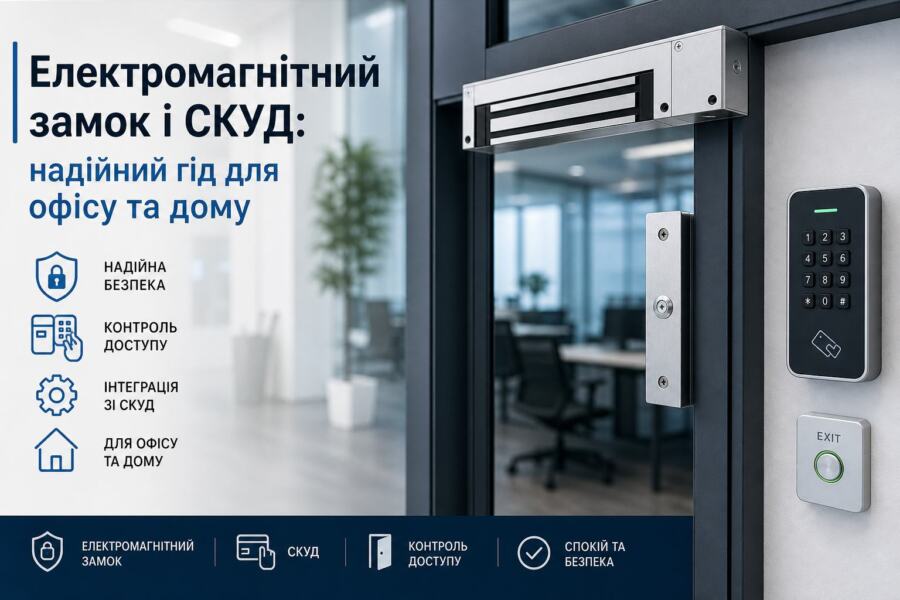
An electromagnetic lock consists of two main parts: an electromagnet that is mounted on the frame or box, and a metal plate that is fixed to the door leaf. When current passes through the coil, a strong magnetic attraction occurs, and the door is held closed. The holding force is measured in kilograms or pounds: for domestic doors, 100-200 pounds is usually sufficient. 180–280 kg, for heavier doors, gates or entrance groups — 280–500 kg and more.
The main advantage of this solution is the simplicity of the mechanics. There are no gears, springs, or complex tongues that wear out due to the skew of the door. If the door is set correctly, the lock will work stably for years. Another plus is quick unlocking: just remove the power and the door opens. This is important for emergency situations, but that is why the system must be designed correctly, in compliance with safety requirements.
In practice, electromagnetic locks are especially popular where there are many opening cycles. In a small office, the door can be opened dozens or hundreds of times a day. A mechanical lock wears out faster under such conditions, while a magnetic one does not, if you do not exceed the permissible load and do not skimp on the fastening. This is also convenient for the home: a child will not lose the key, and an adult will open the door with a PIN code, card or fingerprint.
There is another important point: the electromagnetic lock itself is not the «brain» of the system. It is only an executive element. All decisions — who has access, when to open, how to respond to an alarm or power outage — are made by access controller. It depends on it whether the system will be convenient or turn into a set of incompatible parts.
What elements does an ACS for a home or office consist of?
Basic access control system usually consists of several nodes. The first is the lock itself. The second is access controller, which reads the signal from the identifier and gives a command to lock or unlock. The third is an identification device: card, key fob, ACS code keyboard, fingerprint reader or a combination of several options. The fourth is an exit button, a door status sensor, a power supply and, if necessary, backup power.
In a simple apartment configuration, a magnetic lock, a keypad, and an exit button are often enough. In an office, it is desirable to add an event log, time slots, support for MIFARE or EM-Marine cards, as well as integration with an intercom or video surveillance system. In production facilities, a reed switch on the door and a siren in case of unauthorized opening are also important.
The weak point of many inexpensive systems is the power supply. If the lock consumes, for example, 0.3–0.5 A, and there is also a controller, reader and additional modules, a current reserve of at least 30–50%. Otherwise, at peak times, there will not be enough voltage, the lock will start to heat up, and the controller will reboot. This is a classic mistake in private homes, where they put «any 12V adapter» without calculation.
For facilities where electricity goes out at least several times a month, it is advisable to immediately install a backup power source or mini-UPS on 12 V or 24 V. This is especially true for locks on entrance doors and gates, where it is impossible to allow a situation where the door remains blocked or, conversely, is open all the time.
Which access method to choose: code, card, fingerprint or combination scheme?
The choice of identification does not depend on fashion, but on the usage scenario. ACS code keyboard suitable where simplicity is important and you don't want to hand out cards. For a home, this is a good option if the door is used by family members or several employees. The advantage is that you don't have to carry an additional key fob. The disadvantage is that the code can be spied on or passed on to others, so it needs to be changed and not made too simple.
Card access is convenient for an office, rented premises or entrance. A person simply holds a card to the reader, and the controller gives the command to open. It is fast, inexpensive and technically stable. But the card can be lost, and at facilities with increased security this is sometimes not enough.
Biometric lock or biometric reader - a solution that is appreciated for its convenience and personalization. You don't need to carry a fingerprint with you. This is very practical for an apartment, especially if there are children or elderly people in the family. However, biometrics requires a high-quality sensor, stable power supply and correct installation. Cheap models do not read wet, dirty or worn fingers well, and in winter they can work unstable outside.
| Decision | Pros | Cons | Where appropriate |
| ACS code keyboard | No cards, quick access, simple logic | The code can be viewed or transmitted | House, apartment, small office |
| Card/keychain | Fast, inexpensive, easy to administer | Can be lost or transferred | Office, entrance, warehouse |
| Biometric lock | Convenience, personal access | Demanding on sensor quality and power supply | Apartment, house, managed office |
| Combined scheme | Maximum flexibility and redundancy | More expensive and more difficult to install | Objects with increased requirements |
Practice shows: the most convenient scheme is a combined one. For example, in a private house, a code keypad is placed outside, and an exit button is placed inside. For children and the elderly, a card or fingerprint is added. If one of the technologies is temporarily out of order, there is a backup method of access.
How to choose the right electromagnetic lock, controller and power supply
The first criterion is the weight and type of door. Light interior doors do not require a super-powerful magnet, while metal doors or heavy doors require a margin of holding force. If the door opens into the wind or is skewed, it is advisable to take a model with a margin, because the real effectiveness of the magnetic pressure depends not only on the number in the passport, but also on the geometry of the installation.
The second criterion is the supply voltage. The most common systems operate from 12 V or 24 V. In everyday life, they often choose 12 V, because it's easier to find compatible power supplies, controllers, and accessories. But for longer lines and higher loads 24 V sometimes more profitable due to lower cable losses. It is important that all components have the same power logic - you cannot mix them without checking.
The third criterion is the type of controller. Good access controller must support the required reader format, have a normal relay, protection against false alarms, and preferably the ability to connect a door sensor and an exit button. If expansion is planned, look for a model with a margin for the number of users and events. For a small office, this is often enough, but for a large business, a network controller with software control is needed.
The fourth criterion is the power source. It should not be "sticky", but with a margin. For example, if the total system consumption is 0.8 A, it is worth putting the block on 1.5–2 A or higher, and for street doors - also take into account peak loads and cold. For the batteries work well in reserve, especially if the system is critical for entering a home or office.
The fifth criterion is the installation class. A simpler installation can be used indoors, while outdoor installation requires protection from moisture, dust, condensation, and temperature changes. If the lock is installed on a gate or outdoor frame structure, the cable must be routed so that it does not rub or kink when opened.
Error-free installation: what is important to consider in practice
The most common problem is uneven installation. The electromagnetic lock must tightly press the metal plate over the entire area. If there is a gap, skew or the door frame "plays", the holding force drops sharply. In words, the model can hold 280 kg, and in fact the door is easily opened by hand. Therefore, before installation, you should check the door geometry, hinges, and the rigidity of the fastening.
The second common mistake is improper fastening of the plate. It cannot be clamped tightly «tightly» if the door structure shifts slightly. A small amount of play is needed for the plate to self-center and fit better to the magnet. This is why manufacturers’ instructions include special washers, rubber gaskets or hinge assemblies.
The third mistake is the lack of cable protection. At the entrance to the apartment, especially if the cable passes through a metal profile, it must be protected from chafing. For outdoor facilities, it is advisable to use corrugated cable, sealed entries and a correct length margin so that the wire is not stretched when opening the door.
Another important point is the safety logic in the event of a power failure. An electromagnetic lock is a normally closed solution: without power, it releases the door. This is convenient for evacuation, but if the facility requires increased security, it is necessary to provide backup power, an alarm system and a clear opening scenario. In an apartment, a simple exit button is often installed, and in an office, integration with a fire system is also provided so that the door is unlocked automatically in the event of an alarm.
Compatible with intercom, security system and backup power
The electromagnetic lock works well in conjunction with an intercom. When a visitor calls, the owner from the apartment or office presses the opening button, and the controller removes power from the lock. This is one of the most common configurations for entrances and private entrances. But here it is important to check compatibility in terms of current, output type and control logic.
If the facility already has a security system, it is useful to provide notification scenarios. For example, when an unauthorized entry is attempted, the controller can send a signal to the siren or output an event to the monitoring system. For offices, this is also useful because you can control who entered the premises and when.
Backup power is not a luxury, but a practical necessity. If there is no electricity, and the input must work, a battery or UPS with the appropriate voltage is needed. For a small system, sometimes a battery with 12 V, but it is important to calculate the autonomy. For example, if the system consumes 0.4 A, battery 7 A·h theoretically will give several hours of work, but real (Incomplete: max_output_tokens)