
Useful tips
Car battery for UPS: why it is not suitable for a long time


A car battery for a UPS often seems like a simple and cheap solution when the power goes out at home or in the office. But in practice, such a replacement almost always ends in a short service life, a drop in capacity, overheating and a risk to the UPS itself. I have seen the same picture many times: people connect a car battery to a UPS, are happy that the “power reserve” has increased, and a few months later they receive a battery with sulfates, swelling or a completely dead bank. The problem is not in the “bad brand”, but in the fact that starter battery і batteries for uninterruptible power supplies operate in fundamentally different modes.
Why a car battery for a UPS is a compromise that breaks quickly
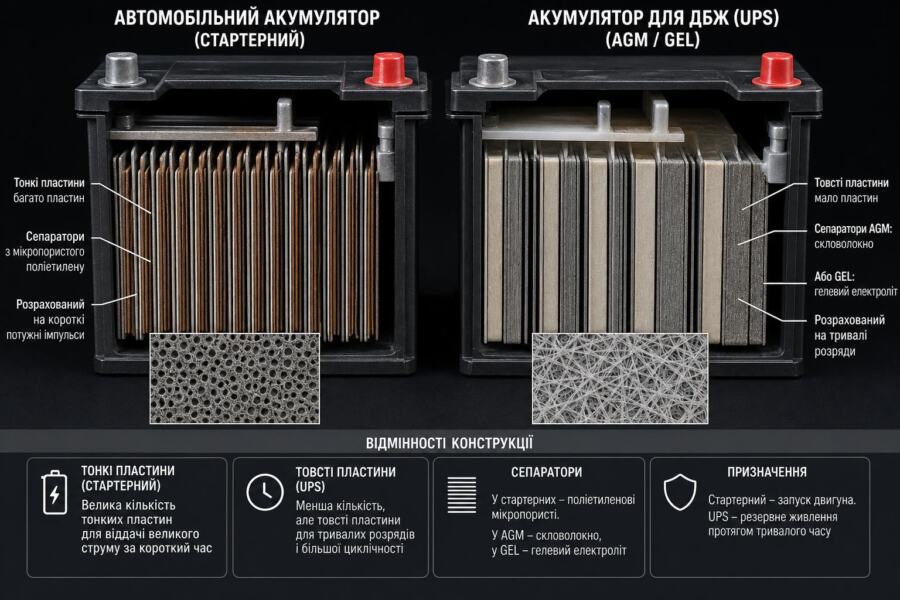
A car battery is not designed to provide long-term energy, but to short starting pulse. Its main task is to provide a large current for a few seconds, to start the motor. For this purpose, thinner plates with a large surface area are placed inside. This is good for starting current, but bad for long-term operation under load.
The UPS works differently. After a power outage, it switches to the inverter, which draws power gradually, but can do so tens of minutes or hours. For a starter battery, this mode is already unnatural.
What happens inside the battery
When the battery releases energy for a long time, a layer of lead sulfate. If the battery is regularly discharged deeper than the permissible level, the crystals become large and do not dissolve well during charging. This is one of the main reasons why the car battery battery for UPS dies early.
Especially harmful deep discharge:
– to 50% the starter battery can still tolerate capacity sometimes;
– to 80–100% — this is almost a guaranteed reduction in resource;
– several such cycles in a row – and the capacity drops noticeably.
In a regular car, the battery almost never works in this mode. The engine immediately recharges it with the generator. In a UPS, the battery often sits on sub-charge and waits for a breakdown for months, and then gives energy to low voltage. This is a completely different exploitation.
Starter, traction and UPS batteries: what's the difference?
In order not to make a mistake with your choice, you need to understand what types of batteries there are and what they are made for.
| Battery type | Main purpose | Strengths | Weaknesses | Behavior at UPS |
|---|---|---|---|---|
| Starter | Engine start | High starting current, low price | Poorly tolerated deep discharge, low cycle life | Doesn't work for long, degrades quickly |
| Traction battery | Continuous load power supply | Better discharge tolerance, longer cycle life | More expensive, heavier, requires correct charging | It may work, but you need to check the UPS charging mode |
| AGM/GEL battery for UPS | Backup power, standby mode | Optimal for recharging and short/medium outages | Does not like overcharging and too deep discharges | The best choice for a trouble-free life |
That's why batteries for uninterruptible power supplies are made with a different plate thickness, a different composition of the active mass, and better stability in the constant buffer charge mode. Their task is to be ready to work for years, not to give out the maximum current once.
Why UPS doesn't "like" car batteries
It is not only the plates themselves that are important here, but also the charging logic. Most household UPSs are designed for 12 V lead-acid battery with a capacity of approximately 7 A·h to 9 A·h, sometimes more. The charging node there is small, and the charging current is limited by the design.
Major technical issues
1. Incorrect charging current
A car battery is usually larger in capacity. The UPS charges it slowly, sometimes too long. The battery takes a long time to reach full charge, which reduces the actual available capacity.
2. Other voltage support mode
For lead-acid batteries in buffer mode, stable voltage is important 13.5–13.8 V depending on the type. If the UPS charging unit is designed for a small standard battery, the large battery may not receive a charge or, conversely, overheat in an unsuccessful mode.
3. Deep discharge during an accident
If the UPS is not configured with a large capacity external battery, it can pull the battery to low voltage for a long time. This is especially harmful for the starter battery.
4. Gaseous emission and ventilation
Lead-acid batteries emit gas when overcharged or exposed to high temperatures. In a garage, it's one thing, but in an apartment or communications closet, it's quite another. Hydrogen is explosive, and it's not something to ignore.
Practice: when a car battery can still work
I'm not going to say that a car battery can't be connected at all. It's possible. But it should be temporary solution, not “set it and forget it.”.
When is it permissible?
– for a one-time reserve for a few hours;
– when you need to urgently survive a power outage;
– if the UPS supports an external battery and you understand its charging parameters;
– if there is control of voltage, temperature and discharge time.
When it's a bad idea
– if A UPS stands as a constant backup source;
– if the battery is regularly discharged almost to zero;
– if the room is poorly ventilated;
– if the UPS is small and the battery is very large, the charging module may not be able to cope;
– if you want long service life without maintenance.
In practice, a starter battery can only function normally as a backup battery if the discharges are shallow, infrequent, and controlled. But this is no longer an economy, but an experiment.
What is better to choose instead of a car battery?
For normal operation of the UPS, I advise you to look at AGM or GEL batteries, or even better — on models specifically declared as batteries for uninterruptible power supplies. If greater autonomy and frequent cycles are required, then consider traction battery.
Benefits of making the right choice
– better tolerates frequent outages;
– less degraded by buffer charge;
– maintains voltage more stably under load;
– works safer at home;
– lasts longer with the correct charging mode.
What to check before buying
– capacity in A·h;
– permissible cyclic resource;
– battery type: AGM, GEL, less often classic lead-acid;
– maximum charge current;
– temperature regime;
– dimensions and weight;
– is the buffer charge voltage suitable for your UPS?.
How to understand that the battery is no longer suitable
There are a few typical symptoms that I see most often after trying to use a car battery for a UPS:
– autonomy has become noticeably shorter;
– the battery takes longer to charge, but gives off less energy;
– the case is warm or even hot after charging;
– UPS signals low charge earlier;
– there was a smell of electrolyte;
– voltage drops quickly under load;
– the battery loses capacity after 2–3 deep discharges.
Simple home test
If you want to assess the battery condition without complex equipment:
1. Fully charge the battery.
2. Let it stand 1–2 hours without load.
3. Measure the voltage with a multimeter.
4. Connect the real load through the UPS.
5. See how quickly the voltage drops.
If the voltage drops very quickly and the UPS goes into emergency mode early, the battery is either of poor quality or has already degraded.
Safety: what not to forget
Working with large lead-acid batteries is not only about autonomy, but also about risks.
Be sure to consider
– short circuit can give a very large current at the terminals;
– thin wires heat up and can melt;
– poor ventilation increases the risk of gas accumulation;
– incorrect polarity can cause the UPS to malfunction;
– placing the battery near heat sources reduces its service life;
– Do not place the battery on carpet, wood shavings, or near flammable materials.
As an engineer, I always advise: if you are going to install an external battery, use fuse near the positive terminal, sufficient cable cross-section and normal terminals. These are small things only at first glance.
A brief selection algorithm for the home
If you need backup power for a router, boiler, computer, or lighting, I would recommend the following order:
1. Determine the power consumption in Tue.
2. Calculate the desired autonomy time in hours.
3. Convert this to the required battery capacity, taking into account inverter losses.
4. Check if the UPS supports an external battery.
5. Select AGM, GEL or traction battery depending on the operating mode.
6. Make sure the UPS charging current is suitable for the battery capacity.
7. Provide ventilation and short circuit protection.
This is how you should approach backup power, not just taking the first battery you have on hand.
Conclusion
A car battery for a UPS may work as a temporary solution, but for a permanent backup it is almost always unsuccessful. The reason is simple: a starter battery is not designed for deep discharge, long cycles and the buffer mode in which they live batteries for uninterruptible power supplies. If you need reliability, safety and a normal resource, take a battery designed specifically for this mode. In my experience, it is cheaper to choose the right battery once than to buy a new one and repair the UPS twice.
Advice from Engineer Gennady: If you need backup power not for “surviving a power outage once”, but for system operation, do not skimp on the type of battery. For UPS, choose AGM/GEL or high-quality traction battery with the correct charging parameters, and leave the starter battery for the car.
Frequently Asked Questions (FAQ)
Can I connect a car battery to a UPS?
It is possible, but only as a temporary solution. For permanent operation it degrades quickly due to deep discharge and inappropriate charging mode.
Why is a traction battery better than a car battery?
Traction battery better tolerates frequent charge-discharge cycles and lives longer in backup systems.
Which batteries are best for an uninterruptible power supply?
Most often this AGM or GEL, that is, those batteries for uninterruptible power supplies, which are designed for buffer mode.
Why does the battery in a UPS lose capacity quickly?
The most common reasons are: deep discharge, overheating, incorrect charging mode and plate wear.