
Useful tips
UPS for router and ONU: why a regular UPS is not suitable


UPS for router and ONU is needed not just "just in case", but as a real way to save the Internet during power outages. When electricity goes out, in many homes the first to "go down" is the router, ONU or GPON terminal, and with them - communication, work, video surveillance, online payment and even access to a "smart" home. In practice, a regular office UPS, which perfectly saves a computer or server, often turns out to be inconvenient or even harmful for backup power to the Internet.
The reason is simple: Internet equipment has different requirements for voltage, consumption and battery life. The router, ONU, media converter and optical terminal operate on 12 V, 9 V or even 5 V, consume little, but must be fed steadily and continuously. A specialized diet is better suited for them mini UPS for ONU or a separate solution designed specifically for fiber optic power supply and home network.
Why a regular UPS is not always suitable for a router and ONU
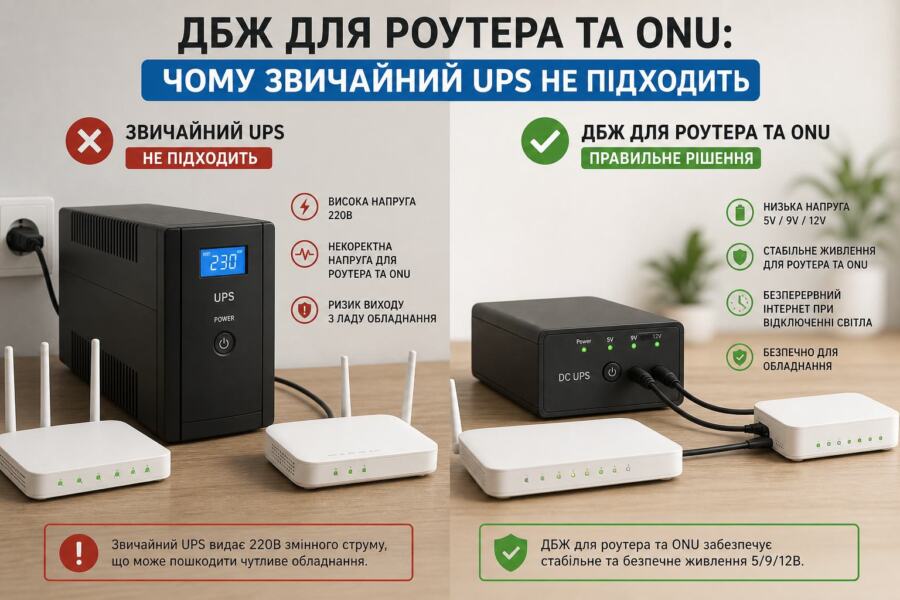
A classic UPS was created primarily for computers, monitors, servers, and office equipment. Its purpose is to give time for the correct completion of work, rather than powering low-power devices for hours. This is where the problem arises: for Internet equipment, such a format is often redundant, inconvenient, and expensive.
The main disadvantages of a regular UPS for home Internet:
- high power and, accordingly, excess cost;
- bulky dimensions and noisy fan in some models;
- suboptimal output voltage — 5 V, 9 V or 12 V are not always needed without additional adapters;
- energy loss due to excessive voltage conversion;
- short or ineffective autonomy for a small load;
- connection difficulty, if you need to power a router, ONU and, for example, a video camera at the same time.
There is another important nuance: some conventional UPSs operate with a so-called “modified sine wave” or have unstable characteristics at low load. For a computer, this is usually not critical, but some power supplies for routers and ONUs can heat up, make noise or behave unstable. As a result internet backup power formally it exists, but it does not work as reliably as expected.
What is the difference between a mini UPS for ONU and a regular UPS?
Mini UPS for ONU — is a compact backup power supply designed specifically for low-power network devices. Its main advantage is that it works without unnecessary conversions, but more “directly” and efficiently for a typical load of 5–30 W.
What does such a device usually provide:
- output 5 V, 9 V, 12 V or a combination of several voltages;
- automatic switching without a noticeable break in communication;
- compact body — can be placed next to the router;
- increased efficiency on low consumption;
- quiet work or the complete absence of fans;
- easy connection without complicated installation.
For the average user, the difference is very noticeable. A 1000–1500 VA UPS may be useful for a home PC, but for a single router and ONU it often looks like an armored car in a bicycle parking lot. Instead, a mini UPS for ONU creates just the right balance when the device is not overpaid, does not make noise, and gives enough time autonomous operation for the internet.
How Internet backup works in practice
To understand why a separate solution is needed, it is worth looking at a typical scheme. Fiber optic comes to an apartment or house, then the signal passes through an ONU or GPON terminal, after which it enters the router. If any link is de-energized, the Internet disappears. That is fiber optic power supply In everyday terms, it is the power supply of active equipment that “livens” the line.
When the lights are off, the correct diagram looks like this:
- The mains voltage disappears.
- Mini UPS or another backup source instantly takes over the load.
- The ONU and router continue to work without rebooting.
- The Internet remains active until the battery runs out.
If the power supply is organized correctly, the user will not notice the transition at all. This is especially important for those who work online, use IP cameras, alarms, smart sockets or VoIP telephony.
What voltage should you check before buying?
One of the most common mistakes is to buy a device “for a router” without checking the specifications. In fact, different models of Internet equipment can have completely different power supplies. This is where the problems begin if you rely only on the seller’s words.
Before choosing, check:
- adapter output voltage on the router and ONU;
- current consumption in amperes;
- plug polarity — “plus” in the center or outside;
- connector type — most often it is DC 5.5×2.1 mm or 5.5×2.5 mm;
- real total power all devices that will be connected.
For example, if an ONU consumes 12 V / 0.5 A, and the router — 12 V / 1 A, the total load will be about 18 W. In this case, a compact mini UPS for ONU with 24–30 W may be quite sufficient if there is a power reserve. But if you add a camera video surveillance or an additional switch, the load increases, and the margin is already becoming critical.
Comparison of backup power solutions
To understand which is best for your home network, it's helpful to compare several options. Below is a simplified table.
| Decision | Advantages | Disadvantages | What is it suitable for? |
|---|---|---|---|
| Regular UPS | Large capacity, suitable for many devices | Bulky, more expensive, does not always have the necessary 5/9/12 V outputs | PC, server, multi-component systems |
| Mini UPS for ONU | Compact, quiet, economical, fast switching | Limited power, does not power powerful equipment | Router, ONU, media converter, IP phone |
| Inverter with battery | Flexible scaling, long autonomy | Proper settings and protection are required | When you need to power several lines or the entire communication in the house |
| Generator | Long-lasting, high power | Noise, fuel, exhaust, manual start | Home, office, long-term backup power |
The table shows that if the task is simply not to lose the Internet during short and medium outages, then the best solution is usually DBJ for router in a mini UPS format. If you need to power an entire home network with cameras, an optical terminal, a switch, and an access point, then a different architecture may be required.
What to look for when choosing a UPS for a router
Not every device sold as a backup power supply for the Internet will be convenient and reliable. It is worth evaluating not only the price, but also the real technical parameters.
Here is a practical checklist:
- Supported voltage — is it the one your equipment uses?.
- Battery capacity — determines the time of operation without a network.
- Maximum output current — must be with a margin.
- Switching time — the smaller, the better for the ONU and router.
- Battery type — Li-ion, LiFePO4 or lead-acid, depending on the design.
- Overheating and short circuit protection — definitely.
- Ability to power multiple devices simultaneously — if necessary.
Special attention - autonomy. Many buyers are guided by “watt-hours” or advertising promises, but in practice, the operating time depends on the actual consumption. If the router and ONU together consume 15 W, and the battery has a useful capacity of 30–40 Wh, this does not mean that you will get exactly 2–3 hours of operation. Some of the energy is lost in conversion, heating and operation of the electronics. Therefore, a reserve is always needed.
Common errors when connecting backup power
Even a good mini UPS for ONU can be used incorrectly. Most often, problems arise not from the device itself, but from errors during connection or incorrect voltage selection.
The most common mistakes are:
- Connecting a 12-volt device to 9 V — the router may operate unstable or fail to start.
- Ignoring polarity — this may damage the equipment.
- Connecting too much load — The UPS starts to fail and the power supply becomes unstable.
- Using inappropriate adapters — poor contact causes voltage loss.
- Calculating autonomy “by eye” — in reality, the battery runs down faster than expected.
- Buying a device without checking the certification and quality of the cables — especially dangerous for electrical safety.
Another typical problem is the desire to “hang” everything on one compact UPS: router, ONU, camera, switch, phone charger. If there is not enough power, then internet backup power will become unstable, and sometimes the device will simply go into protection.
How to correctly calculate autonomy
To avoid making a mistake with your choice, it is useful to make a simple calculation. First, you need to know the total consumption of all devices that will be powered by backup power. Then, the useful battery capacity is estimated, taking into account losses.
The simplified logic is as follows:
- if the load 10 W — autonomy will be longer;
- if the load 20–25 W — working time will be reduced by approximately half;
- If the UPS is operating almost at the limit, the battery will discharge faster and the heating will increase.
Practical example: router consumes 9 V / 0.6 A, UN — 12 V / 0.5 A. Together it is close 10–12 W. If you use a quality mini UPS for ONU with a sufficient battery, you can get several hours of battery life. But if you add another device, the total load will be different, and the time will decrease noticeably.
The best advice is not to believe the figures of “up to 10 hours” without specifying the conditions. Always look at the load under which the device was tested, and whether the power of your router and ONU was taken into account.
When is it better to choose another solution than a mini UPS?
Mini UPS for ONU — this is a great option for an apartment, small office, or private home where you need to support one or two network devices. But there are situations when it no longer meets the task.
Choose another solution if:
You need to power several surveillance cameras: Outdoor cameras (especially PTZ models) consume significantly more energy when using infrared or LED lights at night. Power of the standard Mini UPS is simply not enough for simultaneous power supply of a router, ONU terminal, and several cameras — it will quickly discharge or go into protection due to overload.
Long-term autonomy required (more than 12–24 hours): The capacity of a standard Mini UPS (even 15,000–20,000 mAh) is enough for an average of 6–8 hours of operation of a standard «router + ONU» set. If the outages last for a day or more, you need more capacious power sources.
It is necessary to power devices that operate on 220V: A laptop, monitor, TV or gas boiler cannot be connected to the low-voltage outputs of the Mini UPS (which only output 5V, 9V or 12V DC).
Organization of centralized power supply in a low-current switchboard: If the cables from all your cameras, access points, and router are bundled into one switch cabinet, it is much more convenient and reliable to install one large power supply than to branch out a bunch of small devices.