
Useful tips
How to choose an inverter for your home: pure sine and backup power


A stable power supply at home is no less necessary today than water or the Internet. Power outages can stop the boiler, router, refrigerator, lighting, security system, and even the computer from working. That's why inverter for home has become one of the most practical solutions for the organization backup power. But for the device to truly work safely and efficiently, it is important to choose the right one in terms of power, output voltage form, connection type, and load compatibility.
In this guide, we will analyze how to choose an inverter for your home without unnecessary expenses, what to look for in the technical specifications, and what makes it different. pure sine from the modified waveform, when appropriate troublemaker, and when you need a full inverter with batteries, and why brands like Volt Poland often come into the eye of buyers.
What is an inverter for the home and why is it needed?
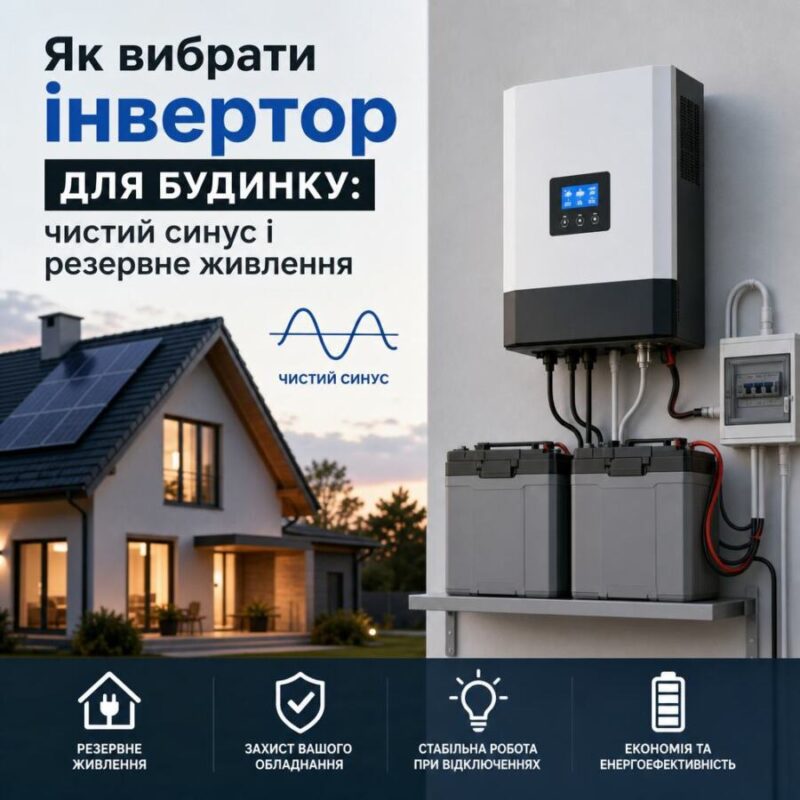
An inverter is an electronic device that converts direct current from a battery into 220 V alternating current, suitable for feeding household appliances. In essence, it is a “bridge” between the battery and the home network.
Main tasks of the inverter
- to provide backup power during emergency shutdowns;
- enable the boiler, pumps, lighting, router and other critically important equipment to operate;
- support the operation of an office or home workplace;
- in some systems, be part of a solar power plant or hybrid scheme;
- protect equipment from sudden power outages.
An inverter is often confused with a UPS or called a “regular uninterruptible power supply.” In fact, they are not always the same thing. Uninterruptible power supply The classic type is usually designed to support a PC or router for a short time, while an inverter with an external battery can power a house for much longer and work with a more serious load.
What are the types of inverters for the home?
Before buying, it's important to understand what type of device you need. This will affect your budget, ease of use, and set of features.
Main types of inverters
| Type inverter | Appointment | Advantages | Disadvantages |
|---|---|---|---|
| Off-line | Battery powered without mains connection | Simplicity, accessibility | Does not charge the battery on its own |
| Network | Working in tandem with solar panels and the grid | High efficiency, sometimes without a battery | Does not work during a power outage if there is no backup circuit |
| Hybrid | Combines grid, batteries and sometimes solar panels | The most versatile option | More expensive, more difficult to set up |
| Inverter-charger | Converts current and charges batteries from the mains | Very convenient for backup power | You need to choose the right batteries |
For everyday life, they most often choose either autonomous inverter with a battery, or an inverter-charger. If in The house has solar panels. panels or are planning to install them, you should look towards the hybrid model.
Clean Sine: Why It's Critical
One of the most important characteristics is the shape of the output voltage. This is where many beginners make mistakes.
What is pure sine?
Pure sine — is a form of electrical signal that is as close as possible to that provided by a regular city network. Such a signal is safe for sensitive equipment: boilers, pumps, refrigerators, medical equipment, audio systems, chargers, and modern televisions.
What is dangerous about modified sinus?
Cheaper models may not produce a pure signal, but an “approximate” one. In everyday life, this is often called a pseudo-sine or modified sine. For some devices, it is acceptable, but for others, it is undesirable or even harmful.
| Load | Modified sine | Pure sine |
|---|---|---|
| LED lamps | May work unstable | Works correctly |
| Router, smartphone charging | Usually works | Works without problems |
| Gas boiler | Errors often occur | The best choice |
| Refrigerator | The compressor may be heating up. | Safer for the engine |
| Pump | May buzz or not start | Suitable |
| Computer | Possible failures | Works stably |
If you need reliable backup power for sensitive household appliances, it is better to choose right away pure sine wave home inverter. It is more expensive, but much safer.
How to calculate inverter power
Power is a key parameter. It determines whether the inverter will “pull” all your appliances, especially when they start up simultaneously.
What to consider
- Constant power all devices that will operate simultaneously.
- Starting currents — some devices consume 2–5 times more power when starting up than when in operation.
- Power reserve — it is desirable to have 20–30% in reserve.
Simple calculation example
The house is planned to be powered by:
- boiler - 100 W;
- router — 15 W;
- lighting - 80 W;
- refrigerator - 150 W in operation;
- pump — 300 W.
Total in working mode: 645 W.
But the pump and the refrigerator have starting loads. If they start almost simultaneously, the short-term peak can exceed 1000–1500 W.
In this case, a 700–800 W inverter will be weak. It is wiser to take a model with at least 1500 W, or better yet, with a margin if you plan to expand the system.
Approximate power selection table
| Usage scenario | Recommended inverter power |
|---|---|
| Router, laptop, lighting | 300–600 W |
| Boiler, router, several lamps | 600–1000 W |
| Boiler, refrigerator, lighting, small appliances | 1000–2000 W |
| Partial backup power to the house with pumps | 2000–3000 W and more |
You shouldn't take the device "up close." An inverter that is constantly operating at its limit heats up faster, makes noise, goes into protection mode more often, and has a shorter lifespan.
Battery: the heart of a backup power system
The inverter itself without a battery will not provide anything during a power outage. Therefore, choosing the right battery is no less important.
What batteries are used?
Most often used for home:
- AGM — affordable, do not require complex maintenance;
- GEL — better tolerate deep discharge, but more expensive;
- LiFePO4 — a modern solution with a long service life and high efficiency;
- lead-acid — a budget option, but with a limited service life.
Comparison of battery types
| Battery type | Cycle life | Advantages | Disadvantages |
|---|---|---|---|
| AGM | Average | Affordable price, prevalence | More sensitive to deep discharge |
| GEL | Higher than AGM | Work well in backup systems | More expensive |
| LiFePO4 | Very high | Light weight, deep discharge, long life | Higher price, need for compatible charging mode |
How to calculate autonomy
The formula, simplified, looks like this:
Battery capacity (Wh) = Voltage × Amp-hours
For example, a 12 V 100 A·h battery has approximately 1200 W·h. But in reality, you can use not 100% of capacity, but less, because there are inverter losses and limitations on the depth of discharge.
If the load is 300 W, then such a battery will theoretically provide several hours of operation, but taking into account losses and permissible discharge, it is better to plan the system with a margin.
Practical guideline
- For short outages, 1–2 hours is often enough 1 battery 12 V 100 Ah.
- For 4–6 hours of autonomy, either a larger capacity or multiple batteries are needed.
- For long-term operation of the boiler, pumps and basic equipment, it is worth considering 24 V or 48 V system.
System voltage: 12 V, 24 V or 48 V
The choice of voltage affects current, wiring heating, and system efficiency.
When 12 V is suitable
- small load;
- simple backup power systems;
- one boiler, router, lighting.
When is 24 V better?
- average loads;
- several consumers at the same time;
- greater autonomy without excessive currents.
When is 48 V appropriate?
- powerful systems;
- long-term backup power;
- inverters from 3 kW and above;
- solar and hybrid systems.
The higher the voltage, the lower the currents for the same power. This means lower losses, less heating of the cables and better stability of operation.
What else to pay attention to when choosing
Power and waveform are just the basics. There are a number of parameters that directly affect convenience and reliability.
Useful technical specifications
| Parameter | What does it affect? | What is desirable for the home |
|---|---|---|
| Efficiency | How much energy is lost during the conversion? | High, preferably from 85–90% |
| Starting power | Will the inverter start motors and compressors? | With a margin of 2 to 3 times |
| Switching time | Will there be a pause when switching to battery? | The smaller, the better. |
| Overload protection | Safety in case of overload | Necessarily |
| Overheating protection | System durability | Necessarily |
| Cooling type | Noise and stability | Intelligent fan control is desirable |
| Availability of a charging module | Convenience of recharging batteries | Highly recommended |
| Display and indication | Condition monitoring | Useful for home use |
Also worth checking
- whether the inverter is suitable for your battery type;
- is there an automatic switching function;
- whether there is a connection to the network and battery charging;
- whether the device is compatible with the generator, if you have one;
- Are there enough terminals and connectors for your circuit?.
Volt Polska and other brands: how to evaluate the manufacturer
There are many inverter manufacturers on the market, and one of the popular ones is Volt Poland. This brand is often considered by buyers looking for a balanced solution for the home: not too complicated, with an acceptable price and understandable functionality.
Practical advice: If you are looking for a proven all-in-one solution for a boiler and a router, pay attention to the Volt Polska sinusPRO series (for example, 500E or 800E). They combine a pure sine wave inverter, a voltage stabilizer, and automatic battery charging. This eliminates the need to assemble a system from different blocks.
What is important when choosing a brand?
Don't just rely on the name. It's better to evaluate:
- real power, not marketing power;
- availability pure sine;
- warranty and service;
- availability of instructions in Ukrainian or English;
- build quality;
- feedback on stability under load;
- compatibility with the batteries you plan to use.
When is it appropriate to look at branded models?
- if predictable work is required;
- if you have a gas boiler or expensive equipment;
- if you don't want to experiment with little-known devices;
- if a clear connection diagram and service support are important.
Inverter or UPS: which is better for the home?
Many people are looking for a solution exactly how troublemaker, but do not always understand the difference between a UPS and an inverter.
An uninterruptible power supply is suitable if:
- you need to power the computer, router, and surveillance cameras;
- the reserve is only needed for 5–20 minutes;
- instant reaction without pause is important;
- the load is small.
An inverter for the home is better if:
- requires power for hours;
- there is a boiler, a pump, a refrigerator;
- it is planned to connect external batteries;
- more power is needed;
- I want to assemble a flexible backup power system.
Comparison of solutions
| Decision | Advantage | Drawback | Best use |
|---|---|---|---|
| Classic UPS | Fast switching | Short autonomy | PC, network equipment |
| Inverter with battery | Long work without network | Proper selection of components is required | House, boiler, refrigerator |
| Hybrid system | The greatest flexibility | Higher price | House with solar panels |
Common mistakes when choosing
To avoid losing money and nerves, it is important to know the most common mistakes.
Mistake 1. Buying an inverter without power reserve
When the power is selected “closely”, the inverter operates unstable and may turn off when the refrigerator or pump starts.
Error 2. Ignoring starting currents
Especially dangerous for engines, compressors and pumps. Operating power does not mean that the device will start easily.
Mistake 3. Choosing a modified sine for sensitive equipment
For boilers, pumps and parts of electronics, it is better to take them immediately. pure sine.
Error 4. Incorrect battery selection
Even a good inverter will not compensate for a weak battery. If the battery has a small capacity or is not designed for deep discharge, the autonomy will be low.
Mistake 5. Saving on cables and protection
Weak wires, missing fuses, poor-quality connections lead to overheating, energy loss, and the risk of an accident.
What does a practical scheme for a home look like?
Most often, a basic backup power system for a home includes:
- Inverter.
- Battery or battery pack.
- Automatic or manual network switch.
- Overload and short circuit protection.
- If necessary — charger or built-in charging module.
- Optional: solar panels or a generator.
Example for an apartment or small house
- inverter 600–1000 W;
- 12 V or 24 V battery;
- router, lighting, gas boiler;
- autonomy 2–6 hours depending on battery capacity.
Example for a private house
- inverter 1500–3000 W;
- 24 V or 48 V system;
- several batteries;
- boiler, pump, refrigerator, lighting, alarm system;
- the ability to scale the system.
What to look for when buying in a store
Before placing an order, check a few points.
Short checklist
- Does it have an inverter? pure sine?
- What is the nominal and peak power?
- Does it maintain the required battery voltage?
- Is there a built-in charger?
- Is it compatible with your battery type?
- Is there protection against overload, overheating and short circuit?
- Is the noise level low enough?
- Does the model have a normal warranty?
- Is there technical documentation?
If you plan to use a device for a boiler or refrigerator, check not only the wattage, but also the starting parameters. This often determines whether the system will operate stably.
Summary: how to choose an inverter without mistakes
To do it right choose an inverter for your home, first determine which devices need to be powered, and for how long you need it backup power. For sensitive equipment, gas boiler, pumps and refrigerators, it is advisable to take a model with pure sine. If the load is small, a more compact option will be suitable, but with a mandatory power reserve. If system autonomy is planned, it is better to immediately look at 24 V or 48 V solutions, which work more stably and efficiently.
Brands like Volt Polska could be a good start for home system, but the main thing is not the name, but the correspondence of the parameters to your scenario. A properly selected inverter will not only help you survive a power outage, but also make the home power system convenient, safe and predictable.