
Useful tips
Gasoline for a generator: which A-92, A-95 or alcohol to pour?


Gasoline for a generator must be stable in composition, clean and free of unnecessary chemicals. It is the fuel that determines whether the engine will start in frost, whether it will withstand the load and how long the carburetor, spark plug and valves will last. An error in one tank can turn a working unit into a problematic one after just a few starts.
Most often, owners ask whether it is possible to pour 95 into the generator if there is no A-92 at hand. The answer depends not on the desire to save time, but on the engine design, compression ratio, quality of the fuel itself and operating mode. For most household models, the optimal one remains gasoline for the generator grades A-92 or sometimes A-95 without impurities, but not just any "95th" from the gas station.
A separate topic is alcohol gasoline for a generator. Ethanol in the fuel changes the properties of the mixture, attracts moisture, provokes corrosion and worsens storage. For equipment that has been idle for weeks, this is critical. Many service calls start with trifles: stale fuel, a clogged nozzle, an acidified membrane or the wrong lubricant for the generator 10w40.
For a home, shop or office, it is important not only to buy a generator, but also to maintain it properly. Errors in fuel, oil levels, ventilation and load quickly lead to a situation where the generator does not start, the reasons for which are not simple, but expensive: wear of the piston group, overheating, breakdown of the ignition coil or failure of the automation.
What gasoline is suitable for most generators?
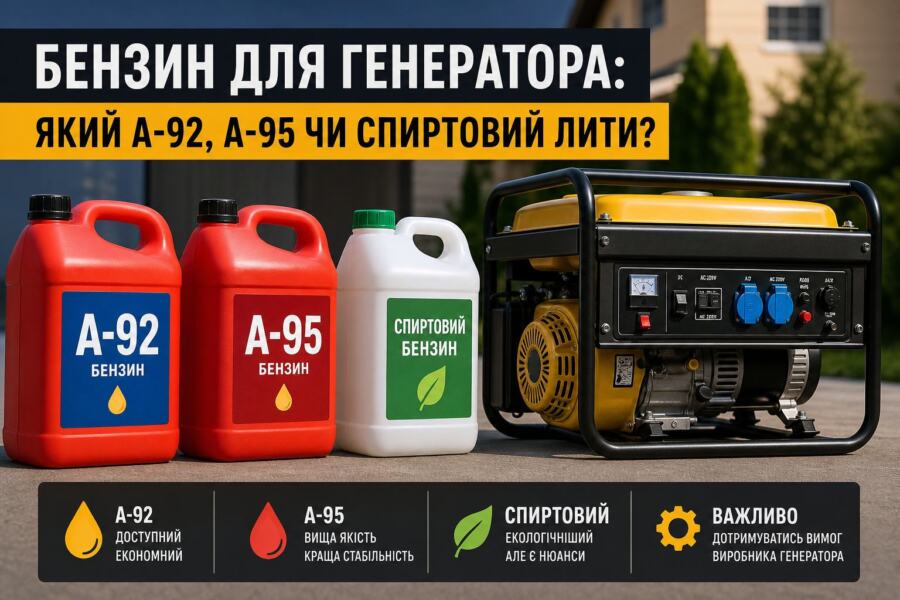
For most single-phase household generators with air cooling, A-92 is recommended. It is quite stable, burns normally in standard carburetor engines and does not create excessive heat load. If the engine is designed for high-octane fuel, the manufacturer directly indicates this in the passport. The guideline is simple: first look at the instructions, then at the canister.
A-95 is not always better. High octane does not mean more power. For an engine with a low compression ratio, excessive «octane» does not give an increase in power, and sometimes worsens cold start. That is why the question «is it possible to pour 95 into a generator» has an answer: it is possible only if it does not contradict the manufacturer’s recommendations and the fuel is of high quality, without excessive alcohol impurities.
In practice, services often see two extremes. The first is that people pour in the cheapest A-92 of dubious origin, after which the generator smokes and works unstable. The second is that they pour «premium» A-95 into an ordinary Chinese unit, and then are surprised by the increased heating and unstable idling. In most cases, the right gasoline is high-quality A-92 from a proven gas station.
After storage, gasoline ages. After a few weeks, the fractional composition in the canister changes, tars appear, and starting becomes worse. If the generator is used as a backup, keeping the tank full for months is irrational. It is better to have a supply in a clean metal or certified plastic container and renew it.
A-92, A-95 and alcohol gasoline: which is better in practice
The comparison for a household engine is simple: A-92 is the basic and often the most correct choice; A-95 is acceptable if required by the manufacturer or there is a problem with detonation; alcohol gasoline for a generator is undesirable for long-term storage and for equipment that is not used regularly.
| Fuel | Advantages | Disadvantages |
| A-92 | Stable operation, availability, optimal for most generators | You need quality from a reliable gas station |
| A-95 | Suitable for certain models, can reduce detonation | Does not give a gain in conventional motors, more expensive |
| Alcohol gasoline | Sometimes available on the market | Absorbs moisture, is less durable, and damages the carburetor |
Ethanol in gasoline is especially harmful to equipment that has been sitting for a long time. It binds water from the air, after which a water-fuel mixture appears in the tank and carburetor. The result is corrosion, unstable starting, air suction, deposits in the nozzles. If the generator is used as a backup in case of power outages, alcohol gasoline for the generator is a bad choice.
For facilities with frequent starts and regular operation, alcohol-containing fuel can sometimes still work without critical consequences, but only if the storage cycle is short. In a private house or apartment building, this rarely corresponds to reality: the unit is started once a week, or even once a month.
Low-quality fuel not only worsens starting. It changes the thermal regime, which increases the load on the spark plug, valves and oil. Over time, the owner observes that the generator "stutters" under load, the revolutions float, and then there is a need for carburetor cleaning and a full service.
Lubricant, resource and why oil is more important than it seems
For four-stroke gasoline generators Quality oil is as critical as fuel. The most common option for moderate temperatures is 10w40 generator oil, if it meets the manufacturer's specifications. It maintains viscosity in the operating range, reduces wear at startup, and protects the engine during extended periods of heavy duty operation.
Many users make the mistake of pouring the first car oil they come across or mixing different residues altogether. The generator operates under a long, stable load, often without pauses and without ideal cooling. Therefore, the oil level must be checked before each start, especially if the unit is at an angle or is being transported.
If the engine starts to consume oil, emits black exhaust fumes or is difficult to start after a long period of inactivity, the cause is not always fuel. Sometimes the problem is low oil level, old oil or overheating due to a dusty air filter. For normal operation, timely maintenance is essential. service gasoline generator: oil change, filter, spark plug check, tank and carburetor cleaning.
For an average household unit, maintenance is done by engine hours, not «once a season.» If the generator runs for 4–6 hours per shutdown, the oil resource is quickly exhausted. Savings on 1 liter of lubricant then turn into repairs to the cylinder-piston group.
What to do if the generator does not start
When generator no reason to start you need to look in order: fuel, oil, spark, air supply, compression. First, they check if there is gasoline, if it has stagnated in the tank, if the fuel tap is open, if the filter is clogged. Then they look at the spark plug: if it is wet, the engine is overheating; if it is dry, the fuel is not reaching it.
A typical scenario from practice: the generator has been standing for two months with a half-empty tank, the remains of old gasoline in the carburetor have turned into a sticky coating. After that, the starter turns, but there is no start. The solution is to drain the old fuel, clean the jets, check the float chamber and put in fresh fuel. In such cases, it is high-quality gasoline for the generator that solves half of the problems.
Another common mistake is starting under heavy load. If heaters, pumps or compressors are already connected to the generator, starting becomes difficult. First, the unit is started without consumers, warmed up for 1–2 minutes, and only then the load is applied. For inverter models, this is even more important: the electronics react to voltage drops and overloads.
If the engine starts and stalls, suspect poor-quality fuel, a clogged carburetor, or an incorrect oil level in the protection system. When the generator has not been serviced for a long time, it is worth immediately checking the air filter, spark plug, gap, tank ventilation, and the condition of the wiring. This is cheaper than replacing components at random.
Safe operation, installation and common user errors
The generator should only be installed outdoors or in a room with real forced ventilation and exhaust to the outside. The distance to walls, windows and doors should be sufficient for cooling and safe exhaust of gases. For backup power supply of the house, it is important to properly organize the connection through an input with a switch, and not through random extension cords.
A common mistake is to fill the tank "to the brim" before working in the heat. Fuel expands, can leak through the lid, and gasoline vapors increase the risk of ignition. The second mistake is to store the canister near the boiler, shield, or in a basement without ventilation. The third is to leave old gasoline in the tank for the entire season.
It is important to adhere to the rating for the cable and load. If the generator produces 220V, this does not mean that any consumer will safely withstand starting currents. Pumps, refrigerators and compressors can briefly consume 2–4 times more than the nominal. Therefore, a power reserve is necessary.
Maintenance is simple but regular: check fuel, change oil, clean filter, check spark plug, avoid overloading. If the unit is used in a shop or small production, it is advisable to keep a log of operating hours and refueling. This helps to track costs and see deviations in operation in time.
How to extend the life of a generator for years
A stable resource is not provided by "expensive gasoline", but by discipline. Pour in the recommended type of fuel, do not mix old and new gasoline unnecessarily, do not use questionable additives, change the oil on schedule and start the generator regularly, even without an emergency shutdown. This keeps the carburetor in working condition and prevents the seals from drying out.
If the equipment has been idle for more than 2–4 weeks, it is worth draining the fuel or at least running it under load for a run. This is especially important for a seasonal reserve at a dacha or in a private house. When the fuel is fresh, the oil is of the appropriate viscosity, and the components are clean, the generator starts confidently and maintains voltage without jerks.
In the catalog and service recommendations of the electro shop, it is always worth focusing not on the myth of the "best" gasoline, but on the requirements of a specific model. One generator works without problems on A-92, another needs A-95, and for the third it is critically important to avoid alcohol impurities. Exact adherence to the passport gives the greatest effect.
Practical conclusion
For most household models, the best gasoline for a generator is high-quality A-92 from a proven gas station. A-95 can be poured only when the manufacturer allows it or there is a technical need, but you should not expect a sharp improvement. Alcohol gasoline for a generator is undesirable for long-term storage and backup operation. Regular maintenance of a gasoline generator, the right lubricant for the generator 10w40, clean fuel and timely inspection of components significantly reduce the risk that the generator will not start, the reasons for which will be expensive repairs.