
Useful tips
Mini ups for router or UPS: which is better for backup power for the Internet


Recently, a friend asked me: “Geno, how do I choose a backup power supply for the Internet so that I don’t remain without communication when the lights go out?”
This question is asked to me all the time. People often confuse mini-UPS and regular uninterruptible power supplies, and these are completely different solutions. The choice depends on what exactly you want to “power up”: a regular router, a terminal from the provider (ONU/GPON) or a whole system with cameras and other equipment. If you make a mistake here, the Internet will disappear at the very moment when you count on it the most.
When the lights go out, mobile internet often goes down due to overload, so stable Wi-Fi is the only salvation. A mini UPS can keep you connected for several hours, but there is a caveat: not every device is universal. Some gadgets require a clearly defined voltage, others require a large power reserve, and for more complex equipment, you will need a classic UPS that outputs regular 220 volts.
What is the difference between a mini ups for a router and a UPS?
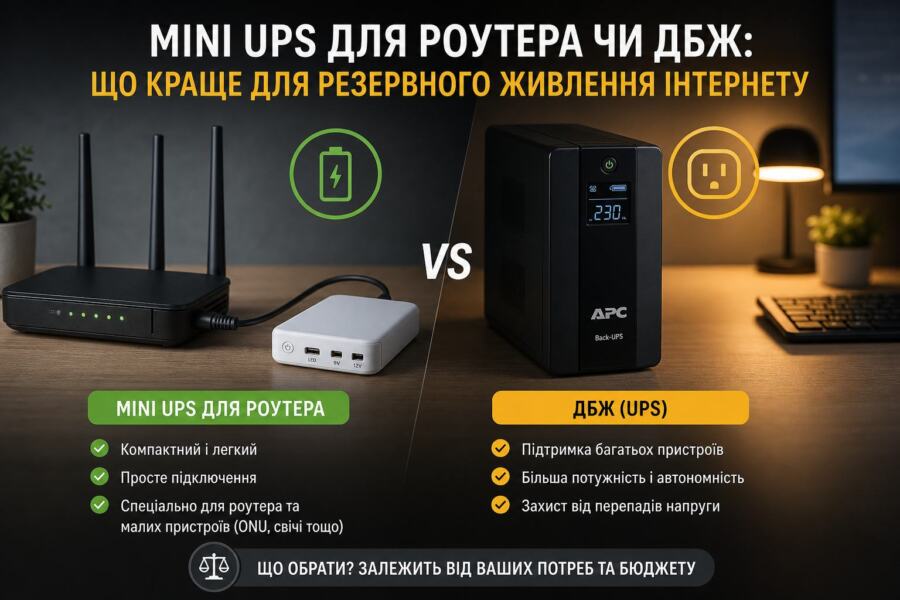
The main difference lies in the principle of operation. Mini ups for the router usually works with low-voltage equipment directly: supplies 9 V, 12 V or sometimes 5 V without conversion to 220 V. This is a compact battery module with a charge controller that automatically switches to backup mode when the network disappears.
UPS for router in the classical sense, it is already a full-fledged uninterruptible power supply with an output 220 V. It is designed primarily for computers, servers, cash register equipment, but is sometimes used for network equipment. If the router and ONU are powered by standard power supplies from an outlet, then this option can be convenient. However, it is larger, more expensive and less economical for low-power loads.
Practically the difference is this:
- mini UPS — compact, economical, autonomous for low-voltage devices;
- UPS — universal, but cumbersome and often redundant for a simple router;
- mini UPS for the router usually operates quietly and without fans;
- UPS for router with 220 V can be useful if you also need to power an optical terminal, media converter, or other equipment.
How Internet backup works in practice
To understand which is better, it is important to understand not the name of the device, but the power scheme. The Internet in an apartment or house usually consists of several elements:
- router — distributes Wi-Fi and routes traffic;
- ONU or GPON terminal - receives an optical signal from the provider;
- switchboard — if there are several lines or PoE devices in the network;
- cable modem or media converter — on some networks.
If the power goes out and even one element of the circuit is turned off, there will be no internet. That's why backup power The Internet needs to be built not only for the router, but for the entire critical link. A very common mistake is to buy mini UPS only for Wi-Fi router, and then wonder why the network is not working. The reason is simple: ONU also turned off.
For optical subscribers, the best option is often ups for onu or a shared backup power supply for the ONU and router. This scheme is most beneficial during outages.
When mini ups for a router are the best solution
Mini ups for the router It is worth choosing if you only need to power low-voltage equipment and compactness is important. This is especially true for apartments, small offices, retail outlets and private homes where the Internet is needed for work, video communication, online banking or security.
This option is well suited if:
- The router works from 12 V or 9 V;
- The ONU also has a corresponding input and can be powered directly;
- quiet operation without fans and noise is required;
- autonomy for 1–6 hours is important, not for a whole day;
- requires simple installation without a complex 220 V circuit.
For example, for a router with the need 12 V 1 A and ONU with 12 V 0.5 A A mini UPS with a battery of a few hundred watt-hours at low voltage may be sufficient. In real life, this means that the internet will continue to work during short to medium outages without having to run a large UPS.
When is it better to choose a UPS for a router?
UPS for router It makes sense when you need to backup not only your router, but also other devices from the 220 V network. For example, you already have a server, NAS, switch, video surveillance system or workstation. Then one universal UPS can support the entire infrastructure.
A classic UPS is appropriate if:
- compatibility with devices powered only by 220 V;
- there is a desire to reserve not only the Internet, but also the operation of a PC or other equipment;
- stable protection against short voltage dips, impulse interference and surges is required;
- there is a willingness to put up with larger dimensions and a higher price;
- You already have a UPS and just need to use it for your network equipment.
However, for just a router and ONU, this approach is often overkill. The UPS consumes its own energy, has inverter losses, and sometimes even makes noise with its fan. As a result, the autonomy may not be as effective as expected.
Comparison of mini UPS and UPS for network equipment
It is most convenient to compare these solutions by key parameters. Below is a practical table that helps you quickly understand the difference.
| Parameter | Mini UPS for a router | UPS for router |
|---|---|---|
| Output type | 5 V / 9 V / 12 V | 220 V |
| Dimensions | Compact | Bigger, heavier |
| Energy efficiency | Higher for low voltage devices | Lower due to double transformation |
| Autonomy | Depends on battery capacity and load | Depends on power and internal losses |
| Easy to connect | You need to select the voltage and plug. | Connection via standard power supplies |
| Best scenario | Only router, ONU, media converter | Multiple 220V devices or wider backup circuit |
| Price for a simple solution | Usually lower | Often higher |
How to choose the right mini ups for your router
Before buying, you need to check three things: voltage, current і connector type. This is where errors most often occur.
The algorithm is simple:
- Look at the router and ONU power supply.
- Write down the output voltage: 9 V, 12 V, 5 V or another.
- Check the current consumption in amperes.
- Calculate the total load of all devices.
- Choose a mini UPS with a current reserve of at least 20–30%.
For example, if the router consumes 12 V 1 A, and ONU — 12 V 0.5 A, then the total load is 1.5 A. For reliability, it is better to take a model designed for 2 A or more. If there is no reserve, the device may overheat, shut down, or lose capacity quickly.
Also pay attention to the following parameters:
- battery type — Li-ion, LiFePO4 or built-in battery;
- battery life — real, not advertising;
- availability of through-power supply — so that the device does not interrupt operation during switching;
- overload protection and short circuit;
- number of outputs and the ability to simultaneously power the ONU and router.
How to choose a UPS for a router without overpaying
If you still choose UPS for router, don't take a model "with a margin for everything" if you don't have such a load. A large UPS for a load of several tens of watts is an unnecessary expense and waste of energy.
Focus on the following points:
- real power connected equipment;
- output voltage quality — especially for sensitive equipment;
- battery type and the possibility of replacing them;
- output voltage waveform — pure sine wave or approximation;
- autonomy time at low load.
For a typical home router with an ONU, a UPS often becomes a «heavy artillery.» It will work, but not always efficiently. If you have several network devices and need to power some of your home electronics at the same time, then a classic UPS is justified.
I often see people assuming mistakes when choosing a backup power supply for the Internet. The problem is usually not the brand, but rather the ignoring of basic technical things. Here are the most common things that people «burn»:
Ignoring voltage: They connect a 12-volt router to a 9-volt output - as a result, the equipment works unstable or does not turn on at all.
Forgetting about ONU: Often, only the router is powered, forgetting about the optical terminal, without which the Internet simply won't "start".
Confusion between capacity and power: A large battery is not a guarantee that the device will provide the necessary current for stable operation of the equipment.
Belief in advertising "hours": The actual operating time always depends on the actual load, the room temperature, and how "alive" the battery itself is.
Bad cables: Cheap thin wires always cause voltage drops. Even a good UPS will work with them "once in a while.".
Mini UPS overload: Many people try to ask a small device to also provide a monitor or powerful charging, although it is absolutely not designed for this.
And most importantly, remember: if it says 12 V on the case, this is not a universal ticket for any device. Always check the required current, the polarity of the plug and the quality of the switching between the network and the battery.
What is better for ONU: mini UPS or separate UPS for ONU
If optical internet is the main source of communication, then ups for onu is often even more important than a UPS for a router. Without an ONU, the router itself will not receive a signal from the provider, so there will be no Internet in any case.
For GPON subscribers, the best scheme is usually this:
- separate backup power for ONU;
- separate or shared power supply for router;
- if necessary - also for media converter or switch.
In many cases, one quality mini UPS for the router with two outputs on 12 V allows you to power both the router and ONU at the same time. This saves space, simplifies installation, and reduces the number of separate adapters in the outlet.
What to choose in 2026: specific models and prices in Ukraine
To make it easier for you to navigate when making a purchase, below is an up-to-date list of reliable devices that Ukrainians most often buy to reserve their Internet, broken down by category and budget.
Category 1: Compact Mini UPS (Low Voltage, DC)
The most popular class of devices for apartments and offices. They operate silently, do not take up much space, and power the router and ONU directly.
WGP103 (10,400 mAh, 36W): A time-tested "classic". Has three separate outputs (5 V / 9 V / 12 V), which allows you to simultaneously connect both an optical terminal and a router from different brands. Provides autonomy of the standard kit on 4–6 hours.
Estimated price: 1,000 – 1,500 ₴
Marsriva KP3 (10,000 mAh, 18W): Stylish, modern option with smart protection system and passive cooling. Perfectly holds gigabit routers that consume more energy under load. Stable and honest 4–5 hours work.
Estimated price: 1,200 – 1,500 ₴
Trinix TRX-MUPS-1812 / Kraft (LiFePO4, 20,000 mAh): A professional solution based on lithium-iron-phosphate batteries. The main advantage is that the battery can withstand several times more charging cycles, almost does not degrade over the years and is completely fireproof. It has an expanded set of outputs, including a port PoE (15V/24V) for powering outdoor antennas or IP cameras. Autonomy — up to 8–10 hours.
Estimated price: 2,400 – 2,800 ₴
Category 2: Classic UPS (220V Output)
These devices are chosen if you need to protect equipment from power surges or if the router and other network elements are powered exclusively by 220 V and are scattered across different outlets.
LogicPower LPM-U650VA (390 W): Affordable line-interactive UPS. It has a built-in voltage regulator (AVR). If you connect only the router and ONU to it via their own power supplies, it will provide about 2 hours of autonomy (due to losses in the operation of the 220 V inverter itself).
Estimated price: 1,900 – 2,300 ₴
Eaton 3S 550 (330 W): Silent European UPS in the form of a network extension with 6 outlets (3 with battery backup, 3 simply with surge protection). Perfectly integrates into the home interior, a reliable protector for the router and work laptop.
Estimated price: 3,600 – 4,200 ₴
APC Back-UPS BX750MI (410 W): Premium segment from Schneider Electric. Perfect filtering of network interference, branded reliability of components and long service life of the internal battery. An option for those who build an uncompromising security and communication system in the home.
Estimated price: 4,400 – 5,200 ₴
Final cheat sheet for selection:
Advice from me: If you have a regular apartment and the provider has installed optics (GPON), don't overpay for large 220 V boxes. Compact Mini UPS costing up to 1,500 UAH will completely solve the problem, save space on the shelf and provide Internet for the entire duration of a typical power outage.