
Useful tips
Uninterruptible power supply for cameras: reliable backup power without light


When a video surveillance system is installed in a home or facility, it is the first to stop performing its function during a power outage. Cameras, a video recorder, a router, and a switch can work separately, but without backup power, all of this turns into a “dead” system at the most inopportune moment. For a private house, this is the risk of losing control over the perimeter, for an apartment, not being able to record an intrusion into the entrance or stairwell, for a store, not being able to save records of the incident.
That is why a camera uninterruptible power supply is not an additional accessory, but a practical element of security. In everyday life, this term often refers to a compact 12V uninterruptible power supply, which is capable of keeping cameras and network equipment in working condition for several hours. For small systems, it is especially popular Mini UPS for cameras: it is compact, easy to connect and does not require complicated setup.
At the same time, it is important to choose the right backup power supply. Some users buy the first module they come across and are surprised that it does not “pull” two cameras. Others focus only on the battery capacity, not taking into account the current consumption, starting peaks and voltage of the equipment. As a result, the system either turns off after a few minutes or works unstable. To avoid this, it is worth understanding how it works CCTV battery and which parameters really matter.
For electro-shop.com.ua, the topic of backup power is particularly relevant, because more and more owners of houses, apartments, offices and small shops are switching to autonomous solutions. A properly selected uninterruptible power supply for cameras allows you to save recordings, continue perimeter security, and avoid expensive downtime even during long outages.
Why do cameras need a backup power supply?
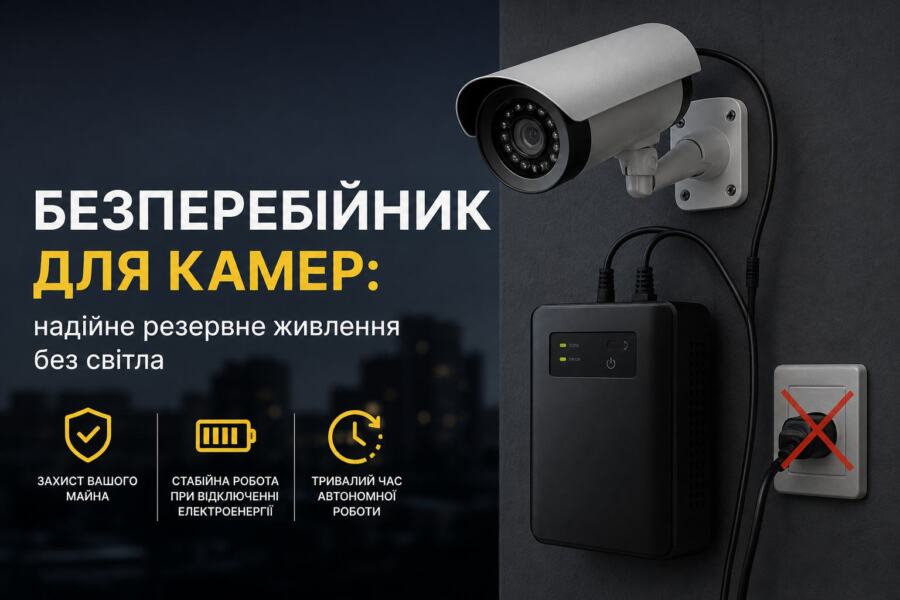
Most video surveillance systems are powered by 12V, sometimes from 5V or via PoE, but the 12 volt line is the most common for analog cameras, Wi-Fi cameras, cameras with infrared illumination and many DVRs. When the network disappears, the cameras don't just turn off - often the entire surveillance chain stops: the router loses the internet, the DVR/NVR stops recording, and remote access via phone becomes unavailable.
In real practice, backup power is most often needed not for a day, but for 2–8 hours. This is the period that covers most household scenarios: planned outages, emergency outages, short network “sags”. If the camera monitors the gate, parking lot or cashier area at the facility, even 15–20 minutes without power can become critical. Therefore, the backup unit must not only turn on the camera, but also stably maintain its operation without reboots.
Another important reason is protection against power surges. When power is restored, there are often pulses in the network that damage adapters and sensitive electronics. A quality uninterruptible power supply for cameras works as a buffer: it takes the shock, smooths out the fluctuations and provides a stable output to the equipment.
For compact apartment systems, a Mini UPS for cameras is often the best solution. It does not require a separate cabinet, is easily placed near the router or recorder, and usually has clear outputs for 12V and 5V. But its capabilities are limited, so for larger systems, a full-fledged inverter complex with a battery is sometimes needed.
What are the solutions: from Mini UPS to full-fledged UPS
Several types of backup power are used for video surveillance. The simplest option is a compact DC-UPS or Mini UPS for cameras, which supplies devices with direct DC voltage. It does not convert 12V to 220V and back, so it works more efficiently and with less loss. That is why it is often the optimal solution for cameras, routers and ONVIF devices.
The second option is a classic uninterruptible power supply with a 220V output. It is suitable if you need to simultaneously power an NVR, router, PoE switch, monitor, and additional equipment. However, for a small system, this approach is less efficient: you lose some of the energy on inverting, and the device itself takes up more space and costs more.
The third option is a hybrid scheme based on inverter with battery. It is appropriate if you need to backup not only video surveillance, but also lighting, internet, alarm or other critical lines. This is a full-fledged power system that can work for hours or even 24 hours, depending on the battery capacity.
To quickly get your bearings, here is a comparison of the most common solutions:
| Solution type | What is it suitable for? | Advantages | Limitation |
| Mini UPS for cameras | 1–4 cameras, router, small NVR | Compact, high efficiency, easy connection | Limited power and capacity |
| Classic UPS 220V | Systems with multiple 220V devices | Versatility, convenient for the office | Lower efficiency for 12V equipment |
| Inverter + battery | Home, shop, large systems | Long autonomy, flexible scaling | Requires installation and setup |
| Simple adapter with battery | The most budget-friendly solutions | Cheap, simple | Instability, weak protection |
In practice, for a home video surveillance system, a 12V uninterruptible power supply is most often the winner, rather than a “large” 220V UPS. It is more economical, more reliable, and better corresponds to the logic of cameras, which still consume direct current.
How to choose a UPS for cameras by power and capacity
The main mistake when choosing is to look only at the number of cameras. In fact, you need to calculate the total consumption of the entire system: cameras, recorder, router, PoE switch, 4G modem, sometimes even a separate Wi-Fi amplifier. Each device has its own current, and in night mode, consumption can increase due to infrared illumination.
For reference, one modern IP camera can consume from 4 to 10 W, and the model with IR illumination and heating - even more. A small NVR usually needs 10–20 W, router — 5–12 W. If you sum up even a modest home system of four cameras, a recorder and a router, it is easy to get 35–60 W constant load.
Here it is important not only whether the uninterruptible power supply for cameras can withstand peak current, but also how long it can work. Battery capacity is measured in A·hour, but in practice it is more important to calculate energy in watt-hours. For example, a 12V 7Ah battery has approximately 84 Wh, but the actual usable capacity will be less due to converter losses and deep discharge limitations.
A rough but useful formula for estimating autonomy is as follows: capacity Wh / consumption W = estimated operating time. If the system draws 24 W and the battery has 60 Wh of usable power, we get about 2.5 hours. This is not an exact engineering calculation, but it works well for preliminary testing.
If you need 4-6 hours of autonomy, a small Mini UPS is often not enough. In this case, it is better to get a device with the ability to connect an external battery or immediately switch to a larger capacity video surveillance battery. This is especially convenient for 12-volt systems, as there is no need for bulky converters.
Which battery is suitable for video surveillance?
Several types of batteries are used to power backup cameras: lead-acid AGM, gel, LiFePO4, and sometimes lithium-ion assemblies. In household systems, AGM and gel variants are most often found. They are affordable, relatively safe, and easy to connect.
AGM well suited for short and medium backup cycles. It is cheaper than lithium iron phosphate, but does not like deep discharge. If you regularly “put” it to zero, the resource decreases quickly. Gel The battery tolerates cyclic operation better, but is sensitive to incorrect charging mode. Both options work normally in video surveillance systems if there is a correct charge controller.
LiFePO4 — the best technical option for long-term autonomy. It is lighter, has a higher resource and better tolerates frequent charge-discharge cycles. But it requires compatible charging parameters, and the kit itself is more expensive. If the UPS for cameras is used daily or the facility has regular outages, LiFePO4 often becomes the most rational investment.
A typical mistake is to install a car starter battery. It is designed for a short high current to start the engine, and not for a long discharge with small currents. In a video surveillance system, such CCTV battery does not work for long and degrades quickly.
Another important point is temperature. In cold weather, the capacity of lead-acid batteries drops, so for outdoor cabinets or unheated rooms, you need to take into account the reserve. If the backup power supply is installed in a pantry, garage or technical niche, it is advisable to check whether the case is not overheating and whether there is normal ventilation.
What to pay attention to when connecting and installing
Connecting a backup power supply seems simple only at first glance. If the camera is designed for 12V, and the output of the UPS has unstable voltage or strong drops, the camera will start to reboot. Models with a Wi-Fi module are especially sensitive, which lose connection with each power failure and take a long time to reconnect.
The first rule is to check the polarity. Most cameras and routers use a standard round DC connector, but the “plus” and “minus” can be connected differently depending on the device. Incorrect polarity can instantly damage the camera or the backup unit itself. The second rule is not to exceed the permissible output current. If the Mini UPS for cameras is designed, for example, for 2A, you should not connect a complete set with a PoE switch and four night cameras to it.
Separately, you need to pay attention to the cable management. A thin and long cable causes a voltage drop, which means that the camera seems to receive 12V at the input, but in fact sees less. As a result, strange symptoms appear: the IR backlight turns on and off, the picture “floats”, the recorder starts to give errors. It is better to use a cable of normal cross-section to power the cameras, and not save on a few meters of wire.
If the system is large, it is worth separating the lines: separately power the cameras, separately - the router and NVR. This makes it easier to diagnose problems and choose the optimal autonomy mode. In the event of a short outage, it may be enough to power only the recorder and network equipment so that recordings from the cameras are not interrupted.
Common user mistakes and how to avoid them
The most common mistake is to buy an uninterruptible power supply for cameras without calculating the load. A person looks at the inscription “12V” and thinks that any such box will do. In fact, you need to know current in amperes, total power in watts and desired runtime. Without this, it's easy to make a double or triple mistake.
The second mistake is ignoring the starting current. Some cameras, especially those with infrared illumination, consume more power at startup or when switching to night mode than specified in the passport. If the UPS is working “closely”, it may turn off just at the moment the illumination starts or the switch is switched.
The third problem is underestimating the thermal regime. A compact Mini UPS for cameras, hidden in a tight niche without ventilation, can overheat. Overheating reduces the life of the battery and electronics.
It is also important to leave a power reserve of approximately 20–30% so that the UPS does not constantly operate at its limits. This is especially important if you plan to connect additional cameras, a router, or a network switch later.
Another common mistake is choosing the wrong battery. You shouldn’t focus only on its capacity in mAh. You need to consider the voltage, real energy consumption in Wh, converter efficiency, and actual equipment consumption. Two devices with the same declared capacity can provide different battery life.
It is equally important to check the compatibility of the connectors and the polarity of the connection. Even if the uninterruptible power supply has the required voltage of 12 V, this does not guarantee that it can be safely connected to a specific camera. Before buying, you need to check the type of plug, polarity and permissible output current.
You should also not forget about the condition of the battery. Over time, its capacity decreases, so a device that previously provided four hours of operation may discharge much faster after a few years. Periodic battery life checks will help to detect the problem in time.
To avoid these mistakes, before buying you should:
Calculate the total consumption of all cameras and network equipment.
Take into account possible short-term current surges during startup and turning on the infrared backlight.
Determine the required battery life.
Choose a UPS with a power reserve of 20–30%.
Check voltage, current, connectors and polarity.
Ensure normal ventilation of the device.
Test the battery periodically and check the actual operating time.
A properly selected uninterruptible power supply not only keeps cameras running during a power outage, but also helps avoid video surveillance system failures, loss of recordings, and premature equipment failure.