
Useful tips
Night Vision Cameras: IR or ColorVu - A Complete Guide


Night-time camera recording is not just about «seeing in the dark.» For the owner of a house, apartment, warehouse, or store, it is an opportunity to recognize a face, a license plate, a person’s movement at the gate, or the fact of an intrusion at night without blind spots. It is at night that events most often occur that are important to capture clearly, without noise or blur.
The most common question when choosing a video surveillance system is simple: which is better - infrared illumination or cameras with color night vision? The answer is not universal. A narrow yard, entrance, parking lot or storefront requires different modes, different cameras and different expectations from the picture.
The mistake many users make is that they only look at the resolution — 2 MP, 4 MP, 8 MP — and ignore the night sensitivity, type of backlight and real installation conditions. As a result, at night you get either a solid "white spot" from IR, or a beautiful color image, but with noise and blurred movements.
For proper nighttime camera shooting, it is important to understand how light works, how it reflects from surfaces, and why one outdoor IP camera in the center of a lit courtyard shows better than a more expensive model on a dark facade without any external light.
How night vision works: what the camera sees in the dark
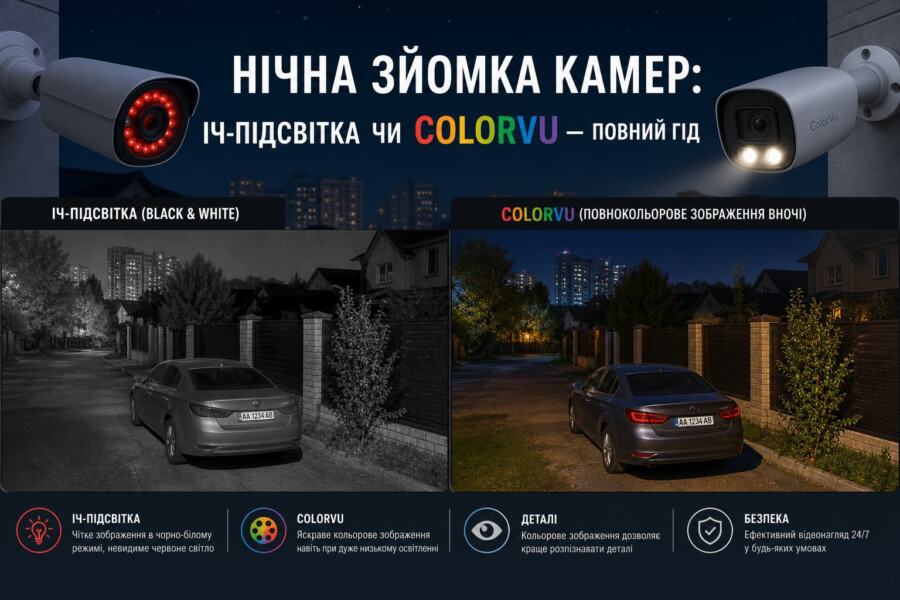
Any camera works at night in conditions of lack of light. If the lighting is insufficient, the sensor starts to increase sensitivity, increases the shutter speed and amplifies the signal. That is why noise, graininess and motion blur appear. The darker it is, the more difficult it is to get a detailed picture.
In classic video surveillance systems, two approaches are used for night mode: infrared illumination and sensors with high light sensitivity, which, when combined with white auxiliary light, produce a color image. In both cases, the camera doesn't magically "see in the dark" - it either illuminates the scene with invisible IR light, or uses weak visible light and special frame processing.
To understand the practice: if the yard is completely black, even a good camera will not show the license plate at a distance of 15–20 m without backlight. And if there is a lantern, light from a window or backlight of the facade, then even ordinary night-time camera shooting gives a much better result than an expensive model in complete darkness.
After the initial approach to system design, it is always worth evaluating not only the camera but also the environment: mounting height, viewing angle, reflective surfaces, presence of rain, fog and snow. These factors often determine whether the video will be suitable for identification.
MARKER
IR illumination: strengths, limitations and where it is indispensable
Infrared illumination is an LED that emits light in a range that is invisible to the eye, usually 850 nm or 940 nm. The camera sees this light as scene illumination, but a person does not. That is why IR solutions are popular for private homes, entrances, warehouses and technical areas where you do not want to have visible illumination constantly on.
The main advantage of this approach is stability. If you choose the right angle, power and distance, then even a simple outdoor IP camera with IR illumination will give the predicted result. In most household scenarios, IR works better at the entrance, near the gate, on the perimeter of the fence, in corridors and in parking lots with low lighting.
But IR also has its weaknesses. First, the picture becomes black and white. Second, objects closer than the minimum distance can be "shown through", especially if the camera is installed under a visor or looks at a wall, fence or bushes. Third, raindrops, snow and cobwebs in front of the lens with IR often "glow", creating false triggers or a "milky" picture.
In practice, IR is well suited where the main thing is event detection and control, rather than an aesthetic color image. For example, in a warehouse it is important to see the movement of a person between the racks or the direction of their movement. In this case infrared illumination works reliably, and color is not critical.
Another advantage is less dependence on external lighting. If the lights near the house are turned off, the IR mode still provides recording. That is why night shooting with cameras with IR is often considered a basic, «insurance» option.
Color Night Vision Cameras: When Color is More Important Than Black and White Stability
Color night vision cameras produce color images using a highly sensitive sensor, a fast lens, and minimal lighting. Some models use warm white LED lighting, while others use a hybrid mode, where the camera turns on invisible IR for detection and switches to color lighting when an event occurs.
The advantage is obvious: color helps to more quickly identify a person, clothing, car, direction of movement and even small details that are lost in black and white mode. This is especially useful for entering a private house: you can save information about the color of a car or courier van, which is often important in controversial situations.
However, there is an important caveat to color night mode: it requires at least minimal lighting or actual visible illumination. If the camera is operating in almost complete darkness, motion blur may appear at high shutter speeds, and warm light sometimes attracts unnecessary attention. Not everyone likes the camera shining white or yellowish light into the yard or facade.
In residential areas, cameras with color night vision are especially useful in areas with streetlights, under a canopy over an entrance, or where there is constant low light from a building. If the area is completely dark, it is best to either add separate lighting or choose a model that can operate in hybrid mode.
From the owner’s perspective, color is not just «prettier.» It increases the likelihood that the recording will help identify an event. But the price of such a result is greater dependence on lighting conditions and often higher cost of the cameras themselves.
Comparison of IR and ColorVu: what to choose for home, apartment and business
The choice between IR and color night vision should be made not by fashion, but by the task. For perimeter protection, surveillance and technical monitoring, IR is often more practical. For identifying people, machines and small parts, color night vision provides more valuable information.
Below is a brief comparison of the main parameters.
| Criterion | IR illumination | Cameras with color night vision |
| Image type | Black and white | Colored |
| Dependence on external light | Low | Medium or high |
| Car/clothing color identification | No | Yes |
| Visibility for humans | Minimum | Often visible through LED light |
| Working in complete darkness | Good | Depends on model and scene |
| Resistance to glare from nearby objects | Medium | Medium |
| Optimal application | Perimeter, warehouses, technical zones | Entrance, yard, parking, facade |
For an apartment, a camera at the front door or in the elevator hall with a color night mode is often enough, if the lighting there is at least minimal. For a private house, it is often better to combine: put a color camera at the gate, and IR on the far perimeter. This is how night shooting cameras work as efficiently as possible and without unnecessary costs.
If you need a «set it and forget it» scenario, IR is usually less demanding. If details are important for incident investigation, it is better to look at cameras with color night vision or hybrid models with switching modes.
What parameters are more important than brand and megapixels?
Resolution alone does not guarantee a quality night. The camera on 8 MP with weak optics and poor night mode may lose to the older model in 4 MP with a better sensor, larger aperture, and proper IR illumination. Therefore, you need to look at a set of characteristics.
The most important things are: sensor type, sensor size, lens aperture, backlight range, WDR, lux sensitivity, and noise reduction algorithms. For real nighttime camera shooting, a large sensor and a lens with a low f-number are very useful, for example f/1.0 or close to it when it comes to color vision.
The range of the backlight is also important, but not only its passport value. Inscription 30 m IR does not mean that the face will be equally clearly visible at 30 meters. Recognition requires not just the presence of light, but its uniformity and sufficient density on the target. That is why in real editing it is better to have a margin and not squeeze the backlight "to zero".
Another underestimated characteristic is the viewing angle. Too wide an angle «smears» details, and too narrow an angle does not cover the entire scene. For a courtyard and entrance, the optimal middle ground is often: a sufficiently wide view plus a separate camera for the identification point.
There is also a nuance for power supply. If the camera is powered via PoE or 12 V, it is worth considering the voltage drop on long cables. At night, when the IR illumination is turned on, consumption may increase, and a weak power supply will start to "sag". This leads to reboots, especially when the system is powered by a UPS or backup battery.
Typical errors when installing and configuring night video surveillance
The most common error — install camera too high and expect it to «see everything.» In fact, if the camera is viewed from above at too high an angle, a person’s face becomes a dark spot at night. For recognition, a lower but safe mount with the right angle to the passage area is better.
The second mistake is to point the IR illuminator at glass, a wall, or a glossy surface. In this case, the image is overexposed, and the camera starts to see its own reflections. This is especially common on balconies, in vestibules, and under canopies.
The third mistake is to mix cameras of different classes without a single logic. One outdoor IP camera with good night mode at the gate and two cheap models on a dark fence often create the illusion of complete control, but it is the weak cameras that leave gaps. For a security system, uniformity of coverage is important, not just one «hero» device.
The fourth mistake is to ignore stray light. A streetlight, an advertisement, a neighbor's window, a car's headlights - all of these can throw off the exposure. A camera with color night vision sometimes loses quality precisely because of excessive lighting in the frame, not because of a lack of light.
The fifth mistake is not testing the system at night after installation. Viewing the image during the day does not guarantee anything. You must definitely walk around in the dark, check the visibility range, the distance to face recognition, behavior in the rain, and motion detection errors.
Practical scenarios: which mode to choose in a specific situation
For a private house with a lit yard, the color mode works best at the entrance, near the gate and gate. There it is important to see who exactly approached, what color car drove up and whether there was an attempt to break in. If there is a far corner of the plot, a shed (Incomplete: max_output_tokens)