
Useful tips
Solar panels at the dacha: are they profitable in 2026 and how to choose


Solar panels at the cottage remain a practical solution for those who want to reduce their electricity bills, get backup power, or go completely autonomous. The decline in the cost of equipment, the development of battery systems, and the demand for energy independence make such systems especially relevant for country houses and seasonal residences.
For a summer residence, a solar system is beneficial not only because of its economy, but also because of its convenience: it provides light, powers a pump, refrigerator, router, tools, and small household appliances. If the power grid is unstable or the area is far from the connection, autonomous power supply for the cottage may be a more rational solution than expensive line installation or constant use of a generator.
When solar energy in the village is truly profitable
Solar energy in the village especially effective where consumption is moderate and most of the load falls on the daytime. In this case, the panels directly power the equipment, and the excess can be stored in batteries. This allows you to reduce dependence on the grid and stabilize the energy supply.
The economic feasibility depends on three factors: the amount of electricity consumed, the cost of connecting to the network, and the presence of frequent outages. For seasonal dachas, the payback may be longer, but the practical benefit remains from the first day of operation.
- Profitably, if the cottage is used regularly from spring to autumn.
- It is advisable, if backup power is needed during outages.
- Especially useful, if the house has only basic electricity consumers.
- Less profitable, if powerful heating or an electric stove is needed on a permanent basis.
Which solar power station to choose for a village?
When choosing, it is worth evaluating not only the power of the panels, but also the entire system package. Solar station for the village can be standalone, hybrid or networked. For summer cottages, the standalone or hybrid option is most often chosen, as they work better in places with weak infrastructure.
You need to start with an analysis of daily consumption. If the system is selected without calculation, there is a risk of overpaying for excess power or, conversely, experiencing a lack of energy in cloudy weather.
| System type | When is suitable? | Advantages | Disadvantages |
|---|---|---|---|
| Autonomous | Cottage without a stable network | Complete independence, operation without electricity grid | Batteries required, higher initial cost |
| Hybrid | There is a network, but there are outages. | Flexibility, backup power, savings | More complex scheme, more expensive than network |
| Network | Stable power supply | Simple design, lower price without batteries | Does not work during network outages |
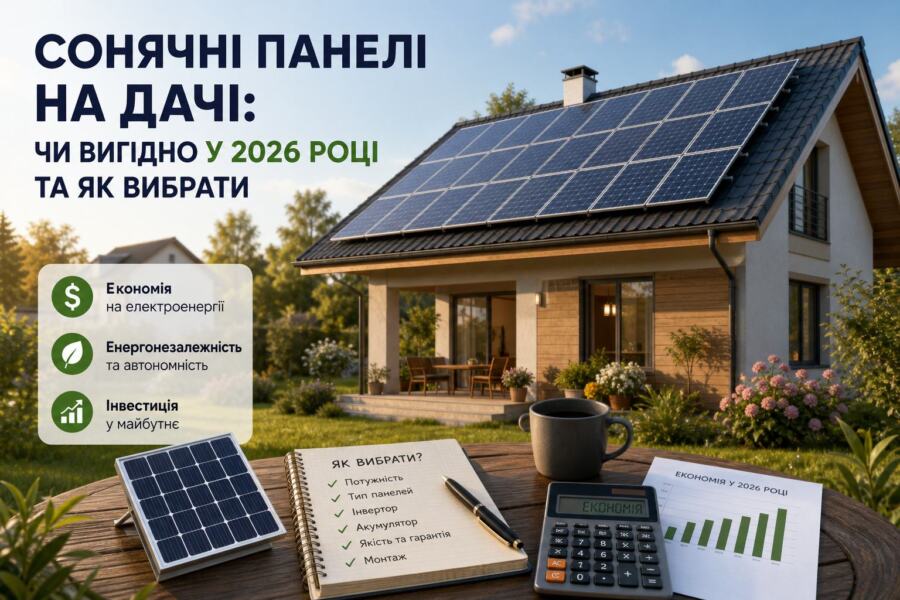
What does the system for giving consist of?
That solar panels at the cottage worked effectively, not only the module itself is needed, but also the accompanying equipment. It is the quality of the equipment that determines whether the system will be reliable, safe and easy to maintain. For seasonal use, it is important not to complicate the scheme unnecessarily.
- Solar panels — convert sunlight into electricity.
- Inverter — converts direct current to alternating current for household appliances.
- Batteries — store energy for the night and cloudy days.
- Charge controller — protects batteries from overcharging and deep discharge.
- Mounting, cables, protection — ensure safe and stable operation.
A small summer cottage doesn't always require a complex station with a large battery supply. If the main consumers are lighting, a laptop, charging gadgets, a TV, and a small pump, the system can be compact and relatively affordable.
How to correctly calculate power
The calculation starts with a list of all devices that will be operating simultaneously. Then, their power and average usage time are determined. This allows you to understand how much generation is needed during the day and what energy reserve the battery should provide.
In practice, a system of 1 to 3 kW is often sufficient for a summer residence, if there is no electric heating and heavy loads. However, if a pumping station, refrigerator, tools and household appliances with regular use are planned, the power should be increased taking into account peak loads.
- Estimate your daily intake — how many kilowatt-hours are needed daily.
- Consider seasonality — generation is lower in winter than in summer.
- Add stock 20–30% for cloudy weather and losses in the system.
- Don't forget about starting currents pumps, refrigerators and power tools.
What to look for when choosing panels
When buying, it is important to look not only at the price. For a summer residence, durability, stability in different weather conditions, and suitability for installation in small areas are important. High-quality modules last for years, but only if they are installed correctly and protected from overloads.
Key selection criteria:
- Type panels - monocrystalline usually more effective in a limited area.
- Efficiency — the higher it is, the more energy from the same area.
- Guarantee — is important for both productivity and degradation.
- Compatibility with inverter and batteries — without it, the system will operate unstable.
- Installation conditions — roof, ground structure, angle of inclination, shading.
Separately, it is worth considering the climate and location of the site. If there is shading from trees or buildings at the dacha, productivity drops. In this case, it is better to either change the installation location or provide a larger area of the panels.
When the payback will be best
The payback depends on how the system is used. If the cottage consumes little electricity and you have previously regularly paid for a generator or had problems with the connection, the investment seems justified. For many owners, comfort and stability are more important than a quick return on investment.
The best economic effect is achieved by combining own generation with battery backup and smart consumption mode. That is solar station for the village is the best works where equipment is turned on during the day, and energy-consuming devices are used in moderation.
Advantages and limitations for giving
Solar systems have their strengths, but they need to be evaluated realistically. They are not a one-size-fits-all solution, especially if the house is converted into a permanent residence with high consumption. In such cases, the budget should be significantly larger.
- Advantages: independence from outages, cost reduction, quiet operation, environmental friendliness.
- Limitation: weather dependence, need for batteries, initial investment.
- Practical benefit: comfort at the cottage, reserve for important appliances, less dependence on the network.
Frequently Asked Questions (FAQ)
Is it possible to completely provide a summer house with electricity from the sun?
Yes, if you correctly calculate the consumption, panel power, and battery capacity. For basic needs, this is a completely realistic scenario, but for electric heating or powerful kitchen appliances, the system will become more expensive.
Which solar panels are best for a summer residence?
Monocrystalline panels are most often chosen because they have higher efficiency and work better in a limited area. This is convenient for small roofs and compact areas.
Are they needed? batteries for a summer solar station?
If power is needed in the evening, at night, or during power outages, batteries are a must. Without them, the system will only work when the sun is out, which limits its practicality.
How long does a system last at the cottage?
Panels can last 20–25 years or longer if installed properly. Inverters and batteries have a shorter life, so they are usually changed earlier depending on the operating mode.
How much does a solar station for a summer residence cost in Ukraine?
The final cost of the system depends on whether you plan to live in the house full-time from spring to fall, or whether you just need an economical “day off” option for safety.
The three most popular configurations for summer cottages have been formed on the Ukrainian market.
Estimated budgets for equipment for various tasks
Useful installation tip: Unlike capital houses, ground-mounted metal structures are often chosen for summer cottages instead of roof-mounted ones. This simplifies seasonal maintenance (cleaning from dust or snow) and makes it easy to set the ideal angle of inclination of the panels to the south.
What brands to pay attention to: Expert recommendation
To ensure that the equipment works stably and does not require repair in the first season, it is worth choosing proven manufacturers with official service in Ukraine.
Solar panels (Modules): Look for Tier-1 manufacturers. They have the lowest percentage of silicon degradation over the years. They have proven themselves excellently. Longi Solar, JA Solar, Trina Solar and Jinko Solar. The price of one high-quality 500–600 W panel is on average 3,200 – 4,500 UAH.
Inverters:
For budget systems of 1–3 kW, stand-alone inverters will be a good choice. Must, PowMr or EASUN.
For reliable hybrid solutions of 5 kW and above, the market leaders are Deye, LuxPower and Victron Energy. A quality 5.6 kW hybrid inverter costs between 26,000 – 38,000 UAH.
Batteries (LiFePO4): It is best to buy ready-made factory blocks in metal cases with a built-in Smart-BMS board. Reliable brands in Ukraine — Dyness, Pylontech, FelicityESS or branded blocks from Deyeand Must. A basic 12V 100Ah battery will cost around 12,000 – 14,000 UAH, and a powerful 48V 100Ah (5.12 kWh) unit costs approximately 34,000 – 45,000 UAH.
How not to overpay
If the cottage is used exclusively in the summer, there is no point in investing in high-power battery packs “with a reserve for the winter”. The main thing is to find a balance: the generation of the panels should fully cover the daytime needs and have time to charge the lithium battery in a few hours, which will support the operation of the light and refrigerator at night. A preliminary accurate calculation of the starting currents of your equipment will save the budget and provide complete comfort far from the city noise.