
Useful tips
Wire cross-section for UPS battery: how to correctly calculate the cable


Correct wire cross-section for UPS battery determines not only voltage losses, but also inverter stability, terminal temperature, battery life and fire safety. Too thin a cable causes voltage drops under load, which can cause the inverter to shut down before the battery is discharged.
The most common mistake is to take «any thick wire» without calculation. For wire cross-section for 12V 24V 48V systems must be considered separately: at the same power, the current in a 12-volt circuit is 4 times greater than in a 48-volt circuit. That is why cable, which works normally on 48V, on 12V can heat up and lose voltage.
For connection, not only the cross-section is important, but also the length of the line, the method of laying, the quality of crimping the terminals and the type of insulation. If cable goes to the inverter in a technical room, in the attic or in a closet with other wires, the cross-section margin should be larger. This is what explains, Why are the inverter wires getting hot? even when the load seems "normal".
The practical approach is simple: for each system, the current, cable length, allowable voltage drop and actual inverter power are taken. If necessary battery connection cable to the inverter, are not oriented towards "approximately", but towards calculation. This is especially important for backup power for the house, server room, boiler, pumps, security systems and cash register equipment.
How to calculate current and load for UPS and inverter
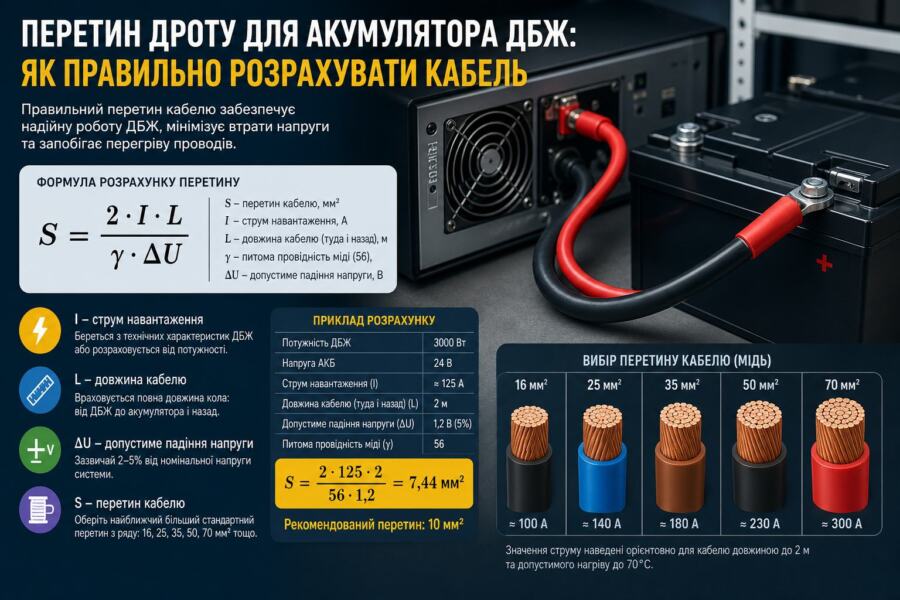
Basic formula: I = P / U, where I is the current, P is the power, U is the voltage of the battery circuit. For example, a 1000 W inverter on 12V consumes about 83 A without taking into account losses. If the inverter efficiency is 90%, the real current will be even higher - about 92 A.
For the same power on 24V the current decreases approximately by half, and at 48V — four times as much as a 12-volt system. Hence the conclusion: the lower the voltage, the thicker the wire needed. That is why cable calculation for battery always starts with system voltage.
Practical example: 2 kW inverter on 12V gives a current of more than 160 A. A thin 10 mm² cable is not suitable for this mode - it will heat up noticeably. For a short connection, much larger cross-sections are required, and on 24V This same inverter works more comfortably and with less losses.
Starting loads also affect the current. A refrigerator, pump, compressor, and power tool can briefly draw 2–5 times more current than the rated current. If there is no reserve in the cable, voltage drops and errors occur. inverter and overheating connections.
What wire cross-section should I use for 12V, 24V and 48V?
Below is a practical guide for copper cable for short lines to the inverter and low voltage drop. For longer runs, the cross-section should be increased. If precise cable calculation for battery, consider the "round trip" length, i.e. the full electrical path.
| System | Typical load | Approximate cross-section |
| 12V | up to 500 W | 10–16 mm² |
| 12V | 500–1500 W | 25–50 mm² |
| 24V | up to 1000 W | 10–16 mm² |
| 24V | 1000–3000 W | 25–35 mm² |
| 48V | up to 3000 W | 16–25 mm² |
| 48V | 3000–5000 W | 25–50 mm² |
For household UPS often use cables 16, 25, 35 and 50 mm². The choice depends on the current, but also on the length: at 1 m and at 3 m the same cross-section gives different losses. If the connection is made via terminal extensions or poor-quality ferrules, a larger margin is needed.
For power wires for UPS buy It is made of pure copper, not copper-plated aluminum. Cheap solutions have higher real resistance, higher heating, and worse mechanical reliability. This is critical for high currents.
Why do inverter wires heat up and where do losses occur?
Heating is always a consequence of resistance. When the current is high, even a small increase in resistance at the terminal, crimp or cable section gives noticeable overheating. If the cable is warm, not hot, this may still be acceptable. If the insulation heats up quickly, the cross-section is too small or there is a bad contact.
The most common places of loss: weak crimping of the tips, oxidized terminals, too long wire, sharp bends, twisting instead of a normal connection, using a wire "with a margin by eye" without checking for current. This is how the situation arises when the user asks, Why are the inverter wires getting hot?, although the inverter seems to be operating within capacity.
Another factor is the ambient temperature. In a closed niche, under a roof, or in a room without ventilation, the cable dissipates heat worse. At high temperatures, the permissible current for the wire decreases, so in such conditions the cross-section must be increased by one step.
Pay special attention to the fuse. It is placed as close as possible to the battery to protect the line in the event of a short circuit. Protection without the correct cable does not work properly: a thin wire can overheat before the automation is triggered.
How to choose a cable by length, installation method and contact quality
The battery cable should be as short as possible. For high currents, it is optimal to keep the length to the minimum necessary, without unnecessary loops. If the line is longer than 1–1.5 m in one direction, it is better to increase the cross-section. For inverters on 12V this is especially important.
The installation is carried out with a flexible copper cable, preferably multi-wire. A rigid wire tolerates vibrations worse and breaks more often at the terminals. Crimping of the tip should be done with crimping pliers, not pliers. For high currents, this is not a trifle, but a safety issue.
There should be no bare copper, twisted wires, or homemade «sandwiches» of washers at the connection point. The contact surface should be clean, and the nut should be tightened with adequate torque. After the first start-up, after 15–20 minutes of operation, it is worth checking the temperature of the terminals and cable by hand or with a thermal imager.
If needed cable for connecting the battery to the inverter in ready-made form, it is convenient to take complete power solutions with tips. For the buyer, this saves time and reduces the risk of error. In the catalog Electro Shop Dyunaivtsi It is advisable to look for those positions where the cross-section, length, core material and permissible current are indicated.
Common errors when connecting batteries to a UPS
The first mistake is underestimating the current at low voltage. A person sees a 1000–2000 W inverter and takes a regular car wire «because it is copper». But for 12V system this is often not enough.
The second mistake is mixing different lengths of wires on the «plus» and «minus». This changes the resistance of the circuit, provokes distortion and additional losses. The third is using cables that are too long without compensation by cross-section. The fourth is the lack of a fuse near the battery.
Common situation: 3 kW inverter on 24V connected with a 16 mm² cable for 3 meters. Formally everything works, but at peak load the wires become hot, and the voltage at the terminals sags. The solution is to reduce the length, increase the cross-section or switch to 48V system.
Also, don't skimp on terminals, circuit breakers, fuse holders, and normal cable tools. A cheap contact is often more expensive than a quality wire. If you already buy power wires for UPS buy If you plan to use it for a long time, it is better to choose a kit without compromises.
Practical conclusion for choosing a cable for a UPS
For reliable operation UPS and inverter, the cable is selected not "by eye", but according to the current, length and voltage of the system. The lower the voltage, the larger the cross-section is required. For 12V thicker wires are needed than for 24V and especially 48V.
If the cable is heating up, first check the terminals, crimping, line length and actual load. In most cases, the problem is not the inverter, but the wrong battery cable calculation or in weak contact. For a safe and stable system, it is better to immediately take copper wire with a margin in cross-section, high-quality tips and proper protection near the battery.