Useful tips
Grid-tie or hybrid inverter: the choice for the home

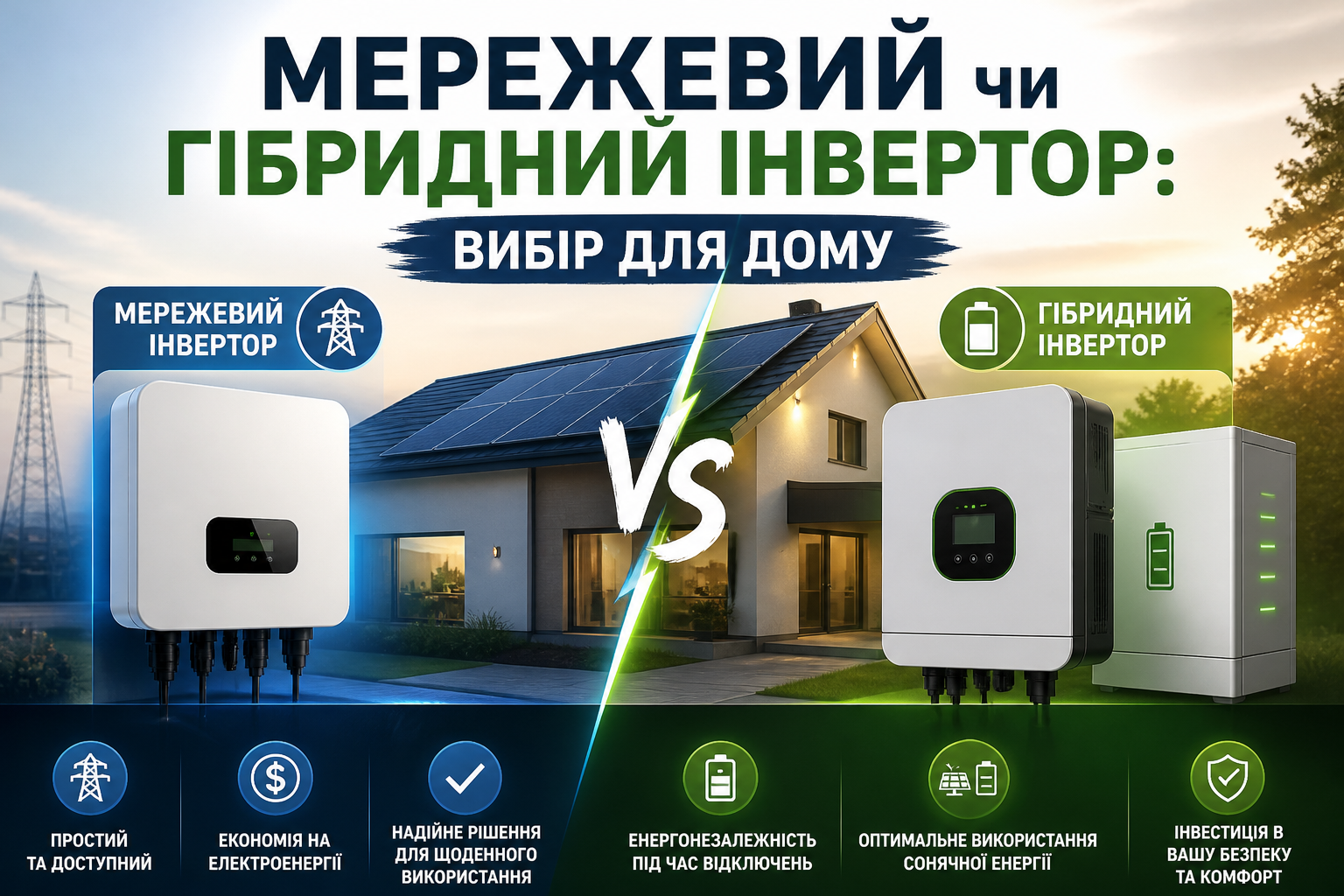
The question is which is better — grid-connected or hybrid inverter, — arises even at the design stage of a home solar power plant. The choice depends not only on the power of the panels, but also on the stability of the power grid, the need for backup power, the tariff model, and the planned budget.
Grid or hybrid inverter: the fundamental difference
A grid-connected inverter converts the direct current from solar panels into alternating current and synchronizes it with the external grid. The energy produced primarily powers household appliances, and the excess can be fed into the grid, subject to an appropriate metering scheme and applicable regulations.
An important feature: during an emergency shutdown, the grid inverter also stops working. This is a protection against supplying voltage to a de-energized line. Therefore, the solar panels themselves will not provide the house with electricity during a blackout.
The hybrid inverter combines the functions of a solar inverter, charger and battery management system. It can use energy from panels, grid and batteries, automatically switching sources according to set priorities. A separate backup output powers critical loads in the event of a power outage.
| Parameter | Grid-tie inverter | Hybrid inverter |
|---|---|---|
| Work without an external network | No | Yes, with battery or standby support |
| Connecting batteries | Usually not provided | By design |
| Initial cost | Lower | Higher |
| Difficulty of setup | Low | Requires precise selection of modes |
| Basic scenario | Savings and generation to the grid | Autonomy and backup power |
When is a grid-connected inverter appropriate?
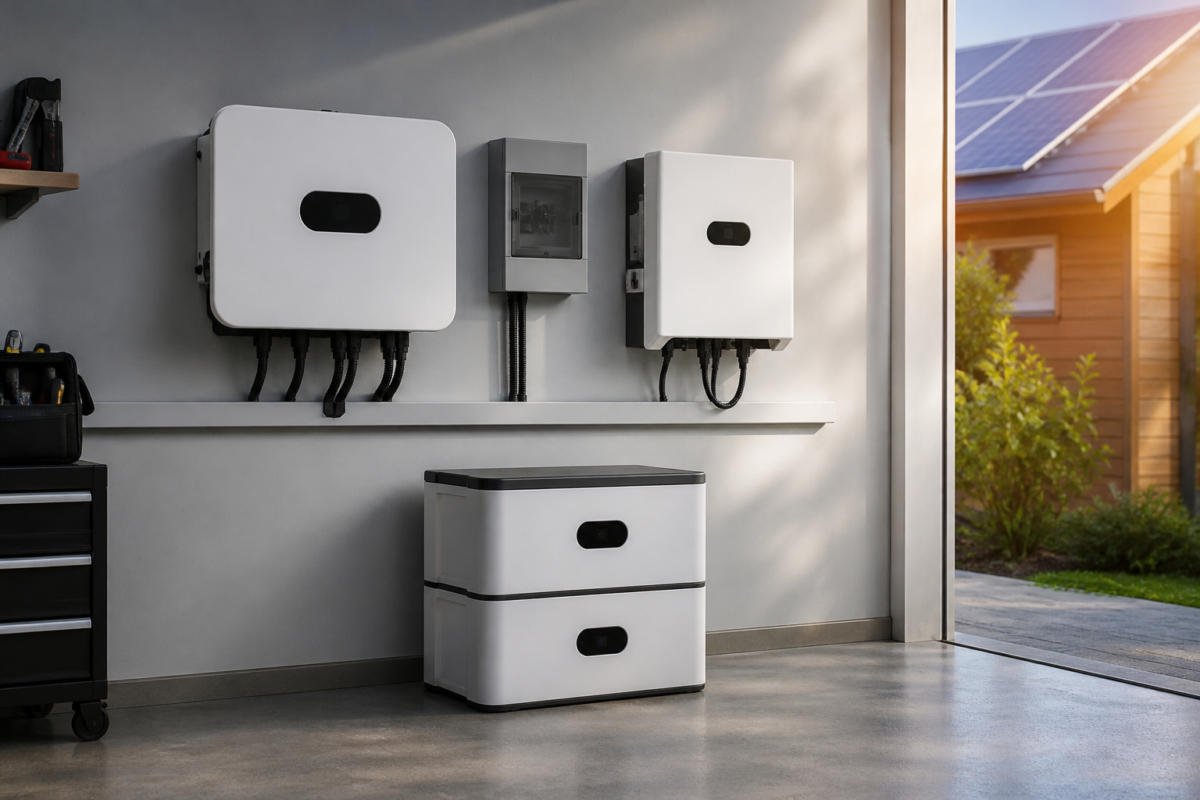
The grid model is a rational solution for a house with a stable electricity supply, where the main goal is to reduce daytime consumption from the grid or transfer excess generation. Such devices usually have high efficiency, simpler design and lower price.
At the same time, it is necessary to take into account the consumption profile. If most of the electricity is used in the evening, without a battery, a significant part of the daytime generation will not cover its own needs directly. The efficiency of the system is increased by transferring the operation of the boiler, washing machine or heat pump to sunny hours and using automatic load control.
When a hybrid system justifies the cost
A hybrid inverter is worth considering if you have frequent outages or a critical need for uninterrupted heating, cooling, well pump, lighting, or communications. It also allows you to store cheaper or excess energy and use it during high-tariff or peak-load hours.
The inverter power is determined by the total simultaneous load, and the battery capacity is determined by the required autonomy time. Approximate calculation:
| Critical load | Reserve time | Useful energy is needed |
|---|---|---|
| 500 W | 4 hours | 2 kWh |
| 1 kW | 5 hours | 5 kWh |
| 2 kW | 3 hours | 6 kWh |
To the obtained value, approximately 10–20% should be added for conversion losses and the permissible depth of battery discharge. The starting currents of pumps, compressors and motors are checked separately: for a short time they can exceed the rated power by several times.
Grid or hybrid inverter: selection criteria
- Network stability: In case of regular accidents, the hybrid model has the advantage.
- Consumption schedule: The daytime load is well coordinated with the grid system, the evening load is well coordinated with energy storage.
- Budget: You need to consider not only the inverter, but also the battery, protection, automation, and installation.
- Expansion capability: Compatibility with future batteries, the number of MPPT inputs, and the allowable power of the panels are important.
- Backup lines: It is better to move critical consumers to a separate panel rather than connecting the entire house without load analysis.
Practical advice: Before buying, record the hourly consumption and maximum simultaneous power for at least a few typical days. If backup is not needed, a grid-connected inverter is usually more economical; if autonomy is important, a hybrid system will provide much greater flexibility.