Useful tips
Video surveillance without light: battery and inverter

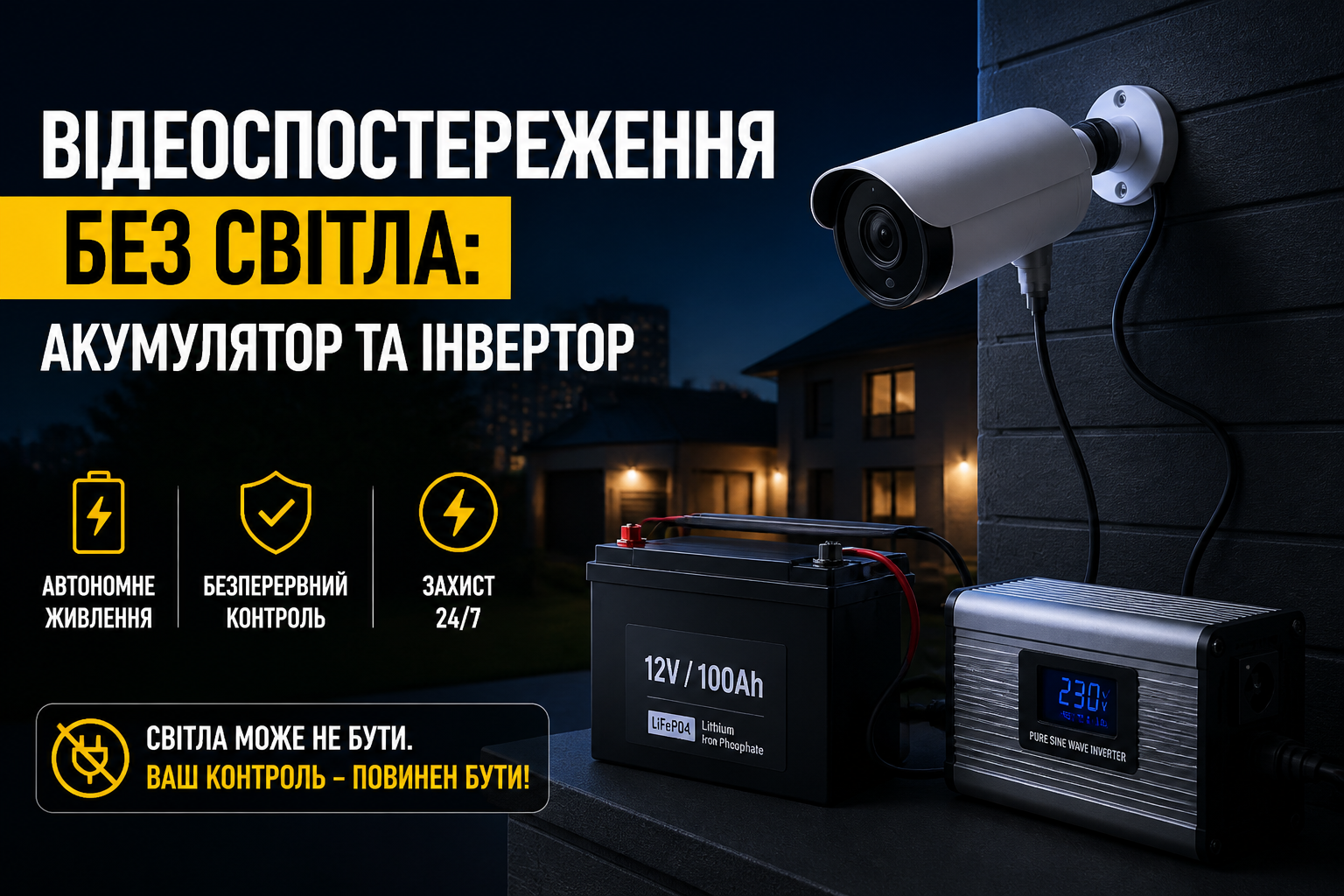
Video surveillance without light requires backup power, calculated according to the consumption of cameras, recorder, network equipment and monitor. For short outages, an uninterruptible power supply is usually sufficient, and for autonomous operation for several hours, a battery and inverter kit is more practical. The correct selection of components helps to avoid rebooting cameras, damaging recordings and premature battery wear.
How to organize video surveillance without light
First, you need to determine the system composition and its total power. A typical IP camera consumes 5–12 W, camera with active infrared illumination — up to 15–20 W. A network video recorder, a PoE switch, a router, and, if necessary, a monitor are added to the load.
| Equipment | Number | Average power | Total consumption |
|---|---|---|---|
| IP camera | 4 | 10 W | 40 W |
| NVR recorder | 1 | 25 W | 25 W |
| PoE switch | 1 | 15 W | 15 W |
| Router | 1 | 10 W | 10 W |
| Together | — | — | 90 W |
It is worth adding a margin of 20–30% to the calculated load. For the above system, it is advisable to choose an inverter with a continuous power of at least 150–200 W. If a monitor is powered at the same time, its consumption must also be taken into account. However, to increase autonomy, it is better to turn on the screen only when necessary.
Battery for video surveillance without light
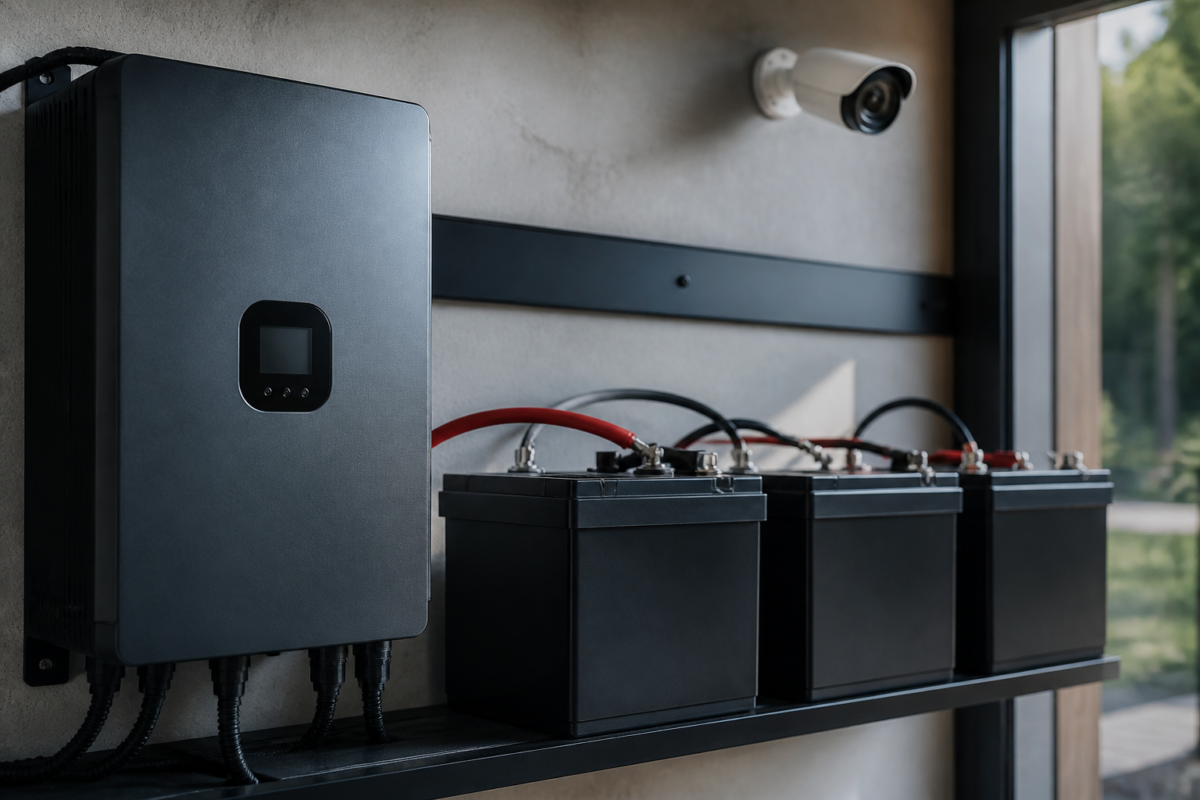
The battery capacity is selected according to the formula: operating time is approximately equal to the product of the voltage and the battery capacity, divided by the load power, taking into account the inverter efficiency and the permissible depth of discharge.
For example, a 12 V battery with a capacity of 100 A h theoretically accumulates 1200 W h. With the efficiency of the 90% inverter, about 1080 W h are available. For a lead-acid battery, it is advisable to use no more than 50–60% of capacity, so the practical reserve will be approximately 540–650 W h. At a load of 90 W, the system will operate for approximately 6–7 hours.
The following types of batteries are used for stationary backup power:
- AGM — affordable, hermetic and unpretentious, but sensitive to deep discharge;
- GEL — tolerate cyclic operation well, but require correct charging voltage;
- LiFePO4 — lighter, have a longer lifespan and allow for deeper discharge, but are more expensive and require a BMS.
Inverter selection and connection diagram
For cameras and recorders, it is advisable to use an inverter with a pure sine wave. Switching power supplies often operate on a modified sine wave, but they can heat up more, create noise, or operate unstable. Protection against overload, short circuit, overheating, and excessive battery discharge are critically important.
The most convenient scheme includes an inverter with a UPS function and a built-in charger. When the network is available, it charges the battery and supplies power to the equipment, and when it is disconnected, it automatically switches to the battery. The switching time should be short enough so that the NVR and PoE switch do not reboot.
The battery is installed in a dry, ventilated place, protected from frost and heat. A fuse of the appropriate rating must be installed between the battery and the inverter, and the cables should be as short as possible and selected according to the current. For a 12 V system, even a 200 W load creates a current of about 18–20 A, taking into account losses, so thin wires can overheat.
Practical advice: Before the outage season, conduct a test — fully charge the battery, turn off the grid, and record the actual system operation time. If the autonomy reserve is lower than the calculated one by more than 20%, check the battery condition, the camera load in night mode, and the inverter losses.