
Useful tips
Payback of LiFePO4 battery: service life and price


The payback period of a LiFePO4 battery in real conditions should be calculated not by the price tag in the store, but by how much useful energy you will receive for the entire term of the job. This is where most people make the mistake of looking at cost of LiFePO4 battery and compares it with a cheaper lead-acid battery, but does not take into account the number of cycles, depth of discharge, losses per charge/discharge and frequency of replacement. As Engineer Gennady, I will say it simply: if you count honestly, then in many scenarios battery payback on LiFePO4 turns out to be much better than it seems at first glance.
Why LiFePO4 is more expensive at the start, but more profitable in operation
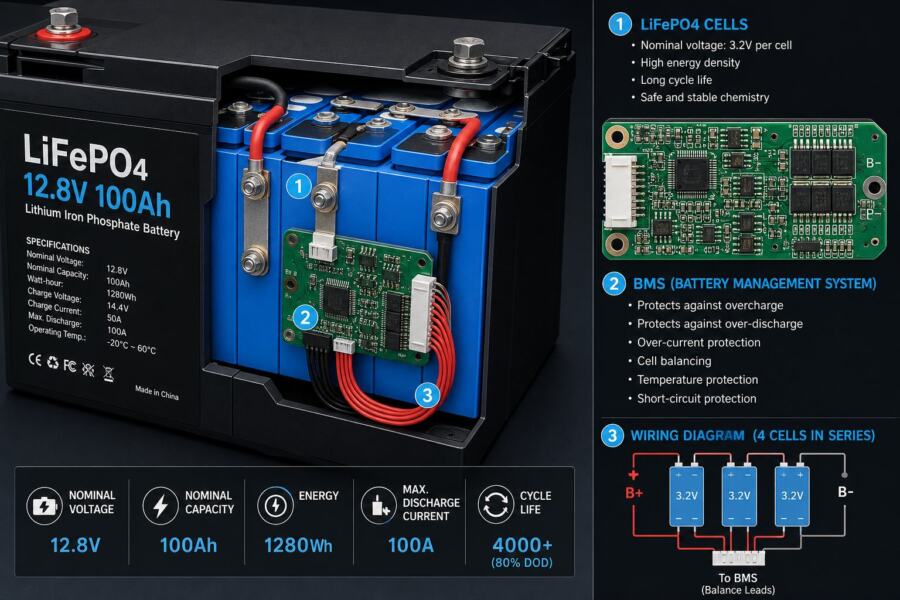
Lithium iron phosphate battery price is really higher than AGM or GEL. The reason is not only in the materials, but also in the design:
– more stable chemical processes inside the element;
– higher working life;
– possibility of deep discharge without rapid degradation;
– better charge/discharge efficiency;
– small voltage drop under load.
For the home user, this means a simple thing: one LiFePO4 can last several lead batteries. That's why looking only at the initial price is technically incorrect.
What shapes the real price?
In practice, the final amount is affected by:
1. Capacity у Ah and the real useful energy in Wh or kWh.
2. Availability of quality BMS.
3. Permissible discharge current.
4. Temperature range.
5. Cell quality and balancing.
6. Manufacturer's warranty and reputation.
If the battery is cheaper, but without a proper BMS and with questionable cells, its lifespan can drop significantly. Then the entire economy collapses.
LiFePO4 service life: what do the numbers from the passport mean?
When talking about LiFePO4 service life, usually called 2000–6000 cycles, and in good systems, even more. But these numbers only make sense if it is clear under what conditions they were obtained.
Important resource parameters
– When 80% DoD (depth of discharge) the resource is often 3000–5000 cycles.
– In a milder mode — up to 6000+ cycles.
– The service life decreases when the battery is overheated, overcharged, or deeply and systematically discharged.
– Storing in a discharged state also accelerates aging.
It is important to understand here: LiFePO4 ages not only by cycles, but also by time. Even if the battery is not used much, it still loses some of its capacity due to calendar aging. But under normal conditions, this happens slowly.
Practical meaning of the resource
For everyday life it looks like this:
– AGM/GEL often live 300–800 cycles during deep discharge.
– LiFePO4 — several times longer.
– If the battery is used daily, the difference in payback becomes very noticeable.
In other words, LiFePO4 service life — this is not marketing, but a real saving factor.
Comparing LiFePO4 to AGM: Where the payback occurs
Payback is calculated through cost of one useful cycle. This is the most honest approach.
The formula is simple.
Cost per cycle = battery price / number of useful cycles
But it is even more accurate to calculate this way:
Cost of 1 kWh from battery = total cost / all energy delivered over lifetime
Here you can see why LiFePO4 is advantageous. It is more expensive at the start, but it gives off more energy over its life.
Comparison table
| Parameter | LiFePO4 | AGM/GEL |
|—|—:|—:|
| Typical price for 12V 100Ah | higher | lower |
| Useful depth of discharge | 80–90% | 50% preferably |
| Number of cycles | 3000–6000+ | 300–800 |
| Charge/discharge efficiency | 95–98% | 80–90% |
| Voltage sag under load | minimal | noticeable |
| Weight | much smaller | bigger |
| Resistance to frequent cycles | very high | medium/low |
| Payback in the daily cycle | high | weak |
This table shows the main point: in systems where the battery is operated frequently, LiFePO4 almost always wins in terms of economy.
When the battery payback is really high
The best battery payback observed where there are regular charge/discharge cycles:
– backup power supply for the house;
– solar power plant;
– power supply for routers, servers, video surveillance;
– autonomous systems at the dacha;
– camping, motorhome, mobile solutions;
– medical or telecommunications backup.
In such cases, the battery does not just “lie on the shelf”, but works out its resource every day or every week. And here LiFePO4 pays for itself quickly, because it withstands many cycles without a sharp drop in capacity.
Where LiFePO4 may not pay for itself quickly
There are scenarios where overpayment may not be justified:
– rare power outages;
– use several times a year;
– budget system without a controller and a normal charger;
– equipment that consumes very little and does not require frequent cycles.
That is, if the battery is “in reserve” and almost does not work, the payback period is extended. In this case, reliability and safety become more important than economy.
Why LiFePO4 gives off more useful energy
There are two technical points that are often ignored.
1. Larger available capacity
Lead-acid batteries cannot be regularly discharged to zero. In order not to kill the resource, they are usually used only 50% capacity. LiFePO4 is safely available 80–90%.
That is, the battery is 100Ah in the lead version and LiFePO4 - this is not the same real return. Lithium iron phosphate gives much more useful Ah.
2. Less losses during the charging phase
LiFePO4 has a higher energy efficiency. Less energy is lost to heating and internal resistance. This is especially important in autonomous systems, because every extra percentage of losses must then be compensated by the sun or the network.
What to look for when buying LiFePO4 so as not to spoil the payback
Not every expensive battery is automatically profitable. Mistakes in selection can easily “kill” the economy.
Check these things
– BMS quality: is there protection against overcharge, overdischarge, short circuit and overheating.
– Real currents: not only the capacity, but also the allowable discharge current.
– Charging temperature: LiFePO4 cannot be charged normally in cold weather without special protection.
– Cell balancing: without it, the resource drops.
– Warranty conditions: especially in terms of cycles and residual capacity.
– Charger compatibility: An incorrect charging profile shortens battery life.
Common mistakes
1. Buy a battery without BMS testing.
2. Use a lead-acid charger without adjusting the parameters.
3. Leaving the battery fully discharged for a long time.
4. Operate in cold weather without protection against charging at low temperatures.
5. Compare only the price per case, not per kWh of resource.
How to calculate payback in practice
Here is a simple way for home.
Example of calculation logic
Let's assume:
– LiFePO4 is more expensive than AGM;
– but gives 3000 cycles instead of 500;
– and you use the battery every day.
Then:
– AGM will have to be changed approximately 6 times during the lifetime of one LiFePO4;
– plus AGM has less useful capacity;
– plus lower efficiency;
– plus more losses for replacement, logistics and installation.
In the end cost of LiFePO4 battery pays off not only in money, but also in convenience: fewer replacements, less downtime, less risk of failure at a critical moment.
When payback is measured in years
– with a daily cycle – often 2–4 years;
– at moderate load – 3–6 years;
– with infrequent use — it may not happen quickly financially, but there will be a margin of safety.
This is not a universal figure for everyone, but this is how an engineer thinks: not “how much does it cost now”, but “how much does one year of stable work cost”.
Practical conclusion from Engineer Gennady
If you need backup power or a stand-alone system that you will regularly discharge and charge, LiFePO4 is almost always more profitable in the long run. Its LiFePO4 service life much larger, the useful capacity is higher, and the risk of rapid degradation is lower. Yes, the initial price is higher, but battery payback comes from resource, stability and lack of constant replacements. My advice is simple: don't count the hryvnia at the entrance, but cost of one kWh over the entire life cycle — then the solution will become obvious.
Frequently Asked Questions (FAQ)
How long does a LiFePO4 battery last?
In normal mode — 3000–6000 cycles and more, depending on the depth of discharge, temperature and BMS quality.
Why is LiFePO4 more expensive than AGM?
Because it has a more complex design, better chemistry, higher efficiency, and a much longer lifespan. Lithium iron phosphate battery price reflects not only materials but also durability.
Will LiFePO4 pay for itself for home backup power?
Yes, if the outages are frequent or the battery is working regularly. In such conditions payback of LiFePO4 battery the best.
Can LiFePO4 be charged with a regular lead acid battery charger?
Sometimes it is possible, but it is not always correct. It is better if the charger has a mode specifically for LiFePO4, otherwise the resource may decrease.