
Useful tips
Solar panels for street lighting: how to choose the best 2026


Solar panels for street lighting: how to choose the best 2026
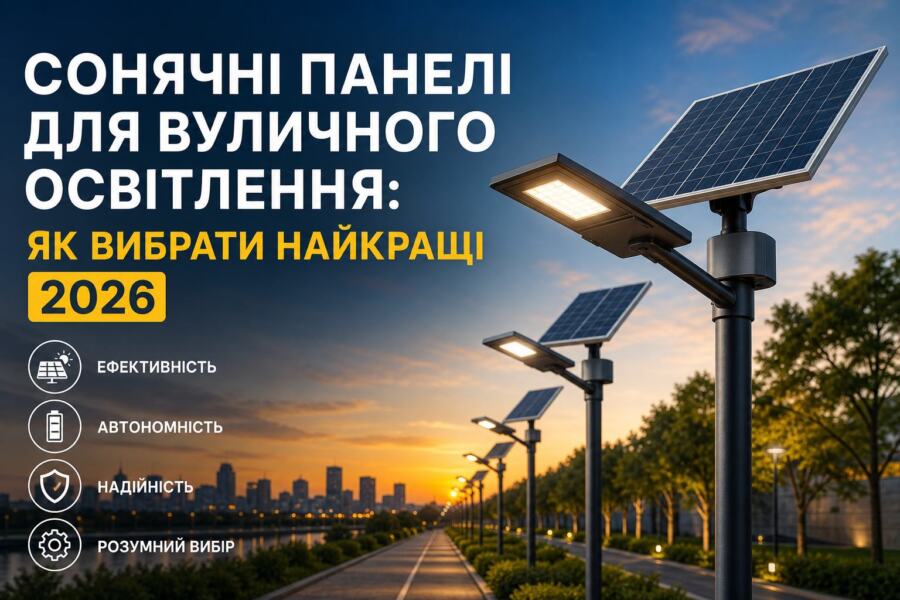
Solar panels for street lighting in 2026 are no longer just an economical alternative to networked lights, but a practical solution for private yards, parks, parking lots, estates, industrial areas and places without a stable power supply. A properly selected system provides stable autonomous lighting in the sun, reduces installation and operating costs and works without complex cabling.
However, the market has become much broader: there are compact solar lights for paths, powerful cantilever lights for streets, integrated models with motion sensors, as well as combined solutions such as cameras on solar panels. In order not to overpay and not get poor lighting, it is important to evaluate not only the price, but also the real technical parameters that affect autonomy and reliability.
How autonomous solar lighting works
The operating principle is simple: during the day, the photovoltaic cell charges the battery, and at night, the energy from the battery powers the LED module. For the user, this means no monthly electricity costs and less maintenance than in classic systems with a cable infrastructure.
The quality of work depends on three components: solar panel, battery і LED lamp. If even one element is selected incorrectly, the system will either shine too dimly or will not last until morning.
- Solar panel gathers energy throughout the day.
- Charge controller protects the battery from overcharging and deep discharge.
- Battery stores energy for night work.
- LED module forms the desired brightness level.
Key selection criteria in 2026
Before purchasing solar panels for street lighting, you need to assess the operating conditions. For southern regions with high insolation, the panel area requirements may be lower, and for shaded areas or northern regions, higher. It is also important to consider whether lighting is needed all night or only during peak hours.
The main rule: Don't just go by the watts on the box. Actual performance depends on the efficiency of the photovoltaic cells, battery capacity, installation angle, presence of a motion sensor, and the quality of the electronics.
- Panel power — must match the lamp's consumption and quickly restore the battery charge during the daylight hours.
- Battery capacity — determines how many hours the system will operate without the sun.
- Luminous flux — for the street, not only lumens are important, but also the correct scattering angle.
- Case protection — minimum IP65 for outdoor installation, preferably IP66 or higher.
- Temperature range — especially important for winter operation.
What types of solar lights are there?
In practice, all solutions can be divided into several categories. Some are suitable for decorative lighting, others for full-fledged street lighting of driveways, yards and industrial sites. The choice depends on the task, and not on the maximum power in the characteristics.
| Type | Appointment | Advantages | Limitation |
|---|---|---|---|
| Solar road lights | Paths, flower beds, garden, yard | Easy installation, low consumption, aesthetic appearance | Small luminous flux, not suitable for large areas |
| Powerful console lights | Streets, parking lots, driveways | High brightness, long battery life, motion sensors | Requires high-quality installation and precise panel orientation |
| Integrated 2-in-1 models« | Private areas, small areas | Compact, fewer cables, quick installation | More difficult to maintain battery and controller |
| Solar panel cameras | Video surveillance without electricity | Autonomy, convenience for remote sites, mobility | Power reserve is required, especially for night recording and data transmission |
What to look for in technical specifications
To choose a quality system, not only the panel power is important, but also how it is combined with the battery and the lamp. If the panel is too weak, the battery will not have time to charge, and if the lamp is too powerful, the autonomy will decrease sharply. That is why you need to look at the system as a single complex.
Practical guideline: The best models of 2026 use highly efficient monocrystalline panels, lithium iron phosphate batteries, and intelligent controllers with lighting scenarios.
- Panel type: Monocrystalline modules are usually more efficient and work better in limited space.
- Battery type: LiFePO4 is more durable, has a longer cycle life, and tolerates deeper discharges better.
- Light temperature: 3000–4000 K is suitable for comfortable street lighting, 5000 K for technical areas.
- Sensors: Motion, twilight and timers help save battery.
- Housing materials: Aluminum and impact-resistant polycarbonate provide better durability.
Advantages and disadvantages of solar lighting
Solar solutions have their strengths, but they are not universal. They are especially beneficial to use where it is expensive or difficult to extend the power grid. At the same time, facilities with critical requirements for continuous operation need a reserve of power and autonomy.
Advantages:
- no electricity costs;
- quick installation without complex cable infrastructure;
- possibility of installation in remote locations;
- environmental friendliness and low maintenance;
- scalability for private and commercial facilities.
Disadvantages:
- dependence on weather and seasonal insolation;
- limited energy supply at night and in winter;
- low-quality cheap models quickly lose capacity;
- requires proper installation without shading the panel.
How to choose the power for a specific object
For a small yard, compact lights with moderate brightness and a motion sensor are sufficient. For a parking lot, entrance group or production area, more powerful solutions with a higher luminous flux and a battery for 1–2 days of backup are required.
To avoid mistakes, focus on the usage scenario:
- Decorative lighting — low power, emphasis on autonomy and design.
- Functional lighting — average power, stable operation until the morning.
- Security lighting — high brightness, motion sensor, power reserve.
- Integrated systems with video surveillance — consider the consumption of the camera, modem, and backlight separately.
Mistakes to avoid when choosing
Most often, buyers take a system "with a margin", but without calculating. As a result, they get either an excessive cost, or weak light, or a battery that does not survive the cold season. Competent selection always begins with operating conditions, and not with advertising promises.
- Ignoring shading: even partial shading can significantly reduce the charge.
- Wrong battery selection: A cheap battery degrades quickly.
- Excess power without need: unnecessary expenses without real benefit.
- Weak protection class: Moisture and dust reduce the system's lifespan.
- Installation without taking into account the angle of inclination: the panel loses part of its daily output.
Frequently Asked Questions (FAQ)
Do solar panels for street lighting work in winter?
Yes, they work, but with less efficiency due to shorter days and lower insolation. For winter operation, it is better to choose models with a reserve of battery capacity and a highly efficient panel.
Which is better: a separate lantern or an integrated solar light?
Integrated models are convenient for small areas because they are easier to install. For large areas and streets, separate models are usually more effective. systems with a larger panel and a powerful battery.
Can solar panel cameras be used with lighting?
Yes, but you need to separately consider the camera's power consumption, especially when recording at night, transmitting data, and operating 24/7. In such projects, it is important to make an energy calculation with a margin.
For stable operation of the street system, choose not the "cheapest" model, but a balanced solution with sufficient panel power, a resourceful battery, a sealed housing and a lighting scenario for your facility. This approach provides reliable autonomous lighting in the sun without unnecessary costs and problems in real operation.