
Useful tips
Connecting batteries: how to connect correctly for 24V and 48V


Connecting batteries is not just about «twisting wires together,» but a normal engineering task where a mistake in one contact can ruin the entire power reserve. In short: for 24V usually connect two 12v batteries consistently, for 48V — four 12v batteries consistently. But in practice, it is not only volts that are important, but also battery capacity, quality of cables, uniformity of batteries, charging method and overload protection. This is where most people make expensive mistakes.
How battery connection works: in series and in parallel
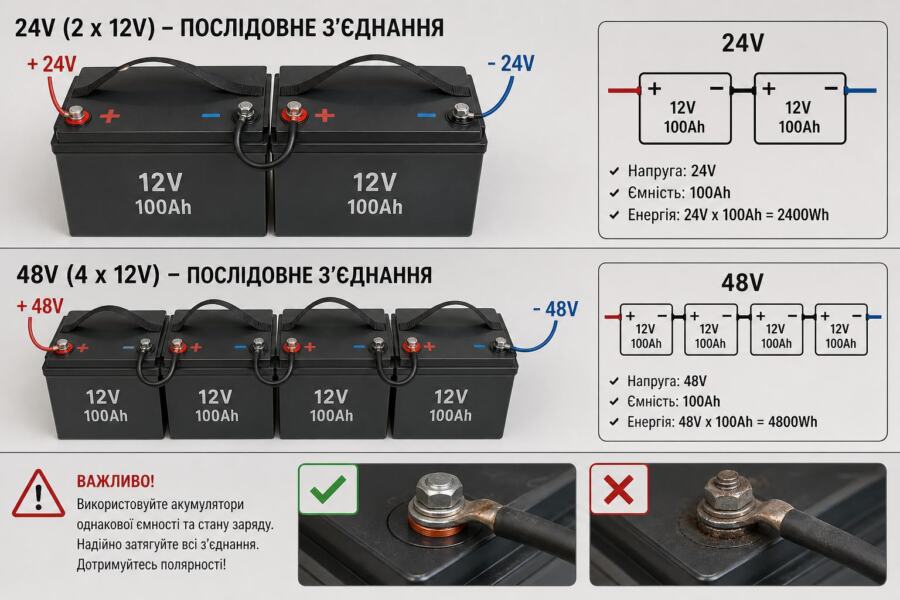
У backup power systems There are two basic ways battery connection: consistent and parallel. The choice of circuit determines the voltage, the available energy, and how long the battery pack will last.
Series connection: adding voltage
In a series connection, the plus of one battery is connected to the minus of the next. If you are assembling a modern lithium iron phosphate battery, this principle remains unchanged.
In this scheme:
– voltage is added;
– the battery capacity in ampere-hours does not change;
– passes through all batteries the same current.
For example, if two 12v batteries on 100 Ah connect in series, we get 24 V and all the same 100 Ah. That is, the energy will double, but not due to the capacity in A·h, but due to the higher voltage.
Parallel connection: adding capacitance
At parallel connection plus with plus, minus with minus. In this case:
– the voltage remains the same;
– battery capacity is summed up;
– the load current is distributed between the batteries.
For example, two 12v batteries on 100 Ah will give in parallel 12 V і 200 Ah. This is convenient if you need to power the inverter for a longer period of time at the same voltage.
What is important to understand in practice
In real-world installation, it's best to think not just in volts and amps, but watt-hours:
– 12 V × 100 A·h = 1200 W·h
– 24 V × 100 A·h = 2400 W·h
– 48 V × 100 A·h = 4800 W·h
That is why the system on 48V often more profitable: with the same power, the current is half as much, which means less losses in the wires and less heating.
Circuit comparison: 12V, 24V and 48V
| Diagram | Number of 12v batteries | Voltage result | Battery capacity | Where used | Pros | Risks |
|—|—:|—:|—:|—|—|—|
| One battery | 1 | 12 V | like a battery | alarms, UPS, small systems | simple circuit | high currents on powerful loads |
| Two in a row | 2 | 24 V | like one battery | inverters, boilers, small homes | lower current, better efficiency | requires identical pair of batteries |
| Four in a row | 4 | 48 V | like one battery | autonomous homes, solar stations | even lower losses, better inverter performance | higher requirements for balance and protection |
How to properly assemble 24V from 12V batteries
Two-battery circuit
To get 24V, take 2 12V batteries of the same type. The connection is simple:
1. plus the first battery connect with minus the second;
2. free minus the first becomes a general disadvantage of the system;
3. free plus the second becomes a general plus 24V.
This is classic. battery connection for an inverter, 24 volt UPS or a small stand-alone system.
What to check before assembly
Don't take just any batteries. series connection of batteries A weak battery drags down the whole pair. That's why I always advise:
– the same type of chemistry: lead-acid with lead-acid, LiFePO4 with LiFePO4;
– the same battery capacity;
– the same brand and model;
– approximately the same age;
– the same charge level before harvesting.
If you put a new battery in one and an old one in the other, the new one will start to "pull up" the old one, and the old one will put the new one in. As a result, the system degrades faster than it seems at the start.
How to assemble a 48V system and not make mistakes
Four battery circuit
For 48V from batteries 12V needed 4 12V batteries in a series circuit:
– plus 1st to minus 2nd;
– plus 2nd to minus 3rd;
– plus 3rd to minus 4th;
– free minus 1st — this is a minus of the system;
– free plus the 4th — this is a plus of the system.
As a result, we get 48 V, but battery capacity remains as if it were one battery.
Why 48V is often better than 24V
In practice 48V provides several serious advantages:
– lower current at the same power;
– lower cable losses;
– less heating contacts and terminals;
– the inverter operates more stably under heavy loads;
– you can take thinner cables, but only within the limits of the calculation.
For example, load 3000 W on 24V pulls close 125 A, and on 48V — approximately 62.5 A. The difference is huge. That's why for a house with a boiler, pump, refrigerator and several sockets, I often recommend 48V, not 24V.
Battery capacity: what it really means
Many people mistakenly think that connecting batteries in series also increases capacity. No, it doesn't work that way.
A simple rule
– successively: volts are added, Hours are not added.;
– in parallel: Hours are added, volts are not added.
Example for 12V 100Ah
If you have battery 12v 100 Ah, then:
– 2 pcs in a row = 24 V 100 Ah
– 4 pcs. in a row = 48 V 100 Ah
– 2 pcs. in parallel = 12 V 200 Ah
This is very important for understanding the real time of operation of the inverter. When a person says: «I installed four batteries, why didn’t it last four times longer?», the answer is simple: it all depends on the circuit. battery connection.
Practical rules for safely connecting batteries
Here are the rules that I use on objects myself and advise others:
1. All batteries must be the same by type, capacity and preferably by date of manufacture.
2. Before installation, equalize the charge: the difference between the elements should not be large.
3. Use same length cables in each chain.
4. Don't take wire "with a margin by eye" - you need it current calculation.
5. Put fuse or a circuit breaker near the positive terminal of each group.
6. Tighten the terminals to the correct torque, without overtightening or "loosely".
7. Be sure to check the polarity with a tester before turning it on for the first time.
8. For lead-acid batteries, ensure ventilation, because gases may be released during charging.
What not to do
– do not mix new and old batteries;
– do not combine different chemicals;
– do not connect batteries with different quiescent voltages without alignment;
– don't do "twists" instead of normal tips;
– do not put a thin cable on a large current.
Common mistakes I see most often
1. Different batteries in the same circuit
This is one of the worst mistakes. If the circuit contains batteries with different battery capacity, different internal resistance or different ages, they will start to work unevenly. As a result, one battery is undercharged, the other is overdischarged.
2. Wrong charger
For 24V need a charger for 24 V, for 48V — on 48 V. If you set an inappropriate charging profile, the battery will either undercharge or overheat.
3. Lack of current protection
In the event of a short circuit, the battery pack can deliver a very high current. Fuse — this is not an «additional option», but a safety element.
4. Long and different length wires
In parallel branches, different cable lengths create different resistances and, therefore, uneven current distribution. Therefore, for large systems, it is better to use tire assemblies or symmetrical connection.
Installation algorithm from Engineer Gennady
Here is a simple and working procedure that reduces the risk of errors:
Determine the required system voltage: 24V or 48V.
Match the same 12v batteries or a ready-made battery pack.
Check each battery for voltage, especially before mass assembly.
Collect series connection of batteries according to the scheme.
Put circuit breaker (or fuse) to the positive power wire.
Install voltage balancer (active or passive) to avoid capacity imbalance between batteries during charging.
Check the reliability of all connections and terminals (they must be tightly tightened to avoid heating).
Connect the finished assembly to the inverter, observing strict polarity: plus to plus, minus to minus.
Turn on the system and perform a test run under light load.
⚠️ Advice from Gennady: Never tighten the terminals “by eye” and do not use wire with a cross-section that is too small. Overheating in a stored power system is your main enemy!