
Useful tips
Gel battery for inverter: proper charging and maintenance


A gel battery for an inverter works reliably only when it is properly charged and not overloaded in daily operation. In everyday life, I often see the same mistake: people buy an expensive battery, put it in a backup power system, and then charge it «as it comes». As a result, the battery loses capacity several times faster than it could. There is no magic here - only physics, chemistry and discipline in the details. In short: gel battery for inverter likes stable voltage, moderate current, proper maintenance mode, and a complete absence of "repair experiments.".
What is a gel battery and why is it suitable for an inverter?
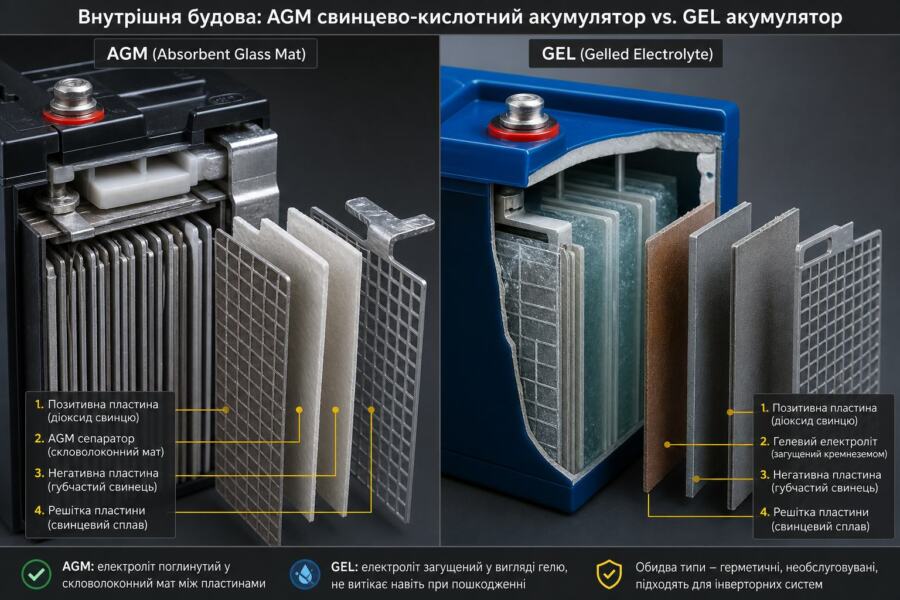
In a gel battery, the electrolyte is not liquid, but thickened to a gel state. This makes it better able to withstand vibrations, loses less water during charging, and works well in cyclic mode. This is important for a backup power system: an inverter can power a house for hours or days, and the battery needs to be regularly discharged and recharged.
But this technology has a strict requirement: gel batteries are very sensitive to overvoltage. If you apply too much voltage, excessive gassing begins inside. Bubbles in the gel do not come out as easily as in the liquid electrolyte, which increases the internal pressure, disrupts the gel structure, and the battery gradually «drys out». That is why battery charging for GEL should be more accurate than for older automotive lead-acid models.
When GEL is really better than other types
The gel option is especially appropriate if:
– required frequent deep discharge without rapid degradation;
– the inverter works as a home UPS or as a source of overnight reserve;
– the battery is in a room where it is important security and minimum evaporation;
– the system has a stable charger with GEL mode.
Proper battery charging: modes, voltage and current
For a 12-volt gel battery, it is important not to just «give a charge», but to go through three phases: main charging, capacity selection and support. If the inverter has a built-in charging module, check if there is a mode there GEL or manual setting.
Charging modes for a 12-volt gel battery
| Mode | Voltage for 12 V Battery | Recommended current | What's happening |
|—|—:|—:|—|
| Main charge (bulk/absorption) | 14.1–14.4 V | 0.1C preferably, maximum 0.2C | The battery quickly gains its primary capacity |
| Support (float) | 13.5–13.8 V | minimal | Self-discharge compensation without "boiling" |
| Equalization | do not apply | — | For GEL this mode is usually harmful |
For the system 24 V all values simply double: basic charging approximately 28.2–28.8 V, recharging 27.0–27.6 V. But I always advise you to look not only at the general numbers, but at the passport of a specific manufacturer. Tolerances may vary slightly in different series.
Practical charging algorithm
1. Make sure the charger is compatible with GEL.
If there is only a "Car" or "Lead Acid" mode without precise limits, this is a risk.
2. Set the correct voltage.
For most 12V GEL — 14.1–14.4 V at the stage of basic charging.
3. Limit the current.
Safe recommendation — 0.1C.
That is, for the battery 100 Ah it is close 10 A.
For 200 Ah — about 20 A.
4. Do not keep the battery at high voltage for longer than necessary.
When the charging current has dropped noticeably, switch to maintenance mode.
5. After full charge, reduce the voltage to float.
This is especially important if the inverter is constantly connected to the grid.
What temperature to consider
As the temperature increases, the battery charges more easily, but it also ages faster. In the cold, on the contrary, chemical reactions slow down. Therefore, ideally, you need temperature compensation: the warmer the room, the lower the permissible charging voltage. If the inverter supports a temperature sensor, use it. This is not an «option for perfectionists», but a real help for the battery life.
Importantly: if the battery case heats up more than 40–45°C, the charge should be reduced or stopped. Overheating is one of the fastest ways to lose capacity.
What mistakes most often kill a gel battery?
Over the years of practice, I have seen dozens of cases where a new the battery was losing its life not because of a "bad brand", but because of improper operation.
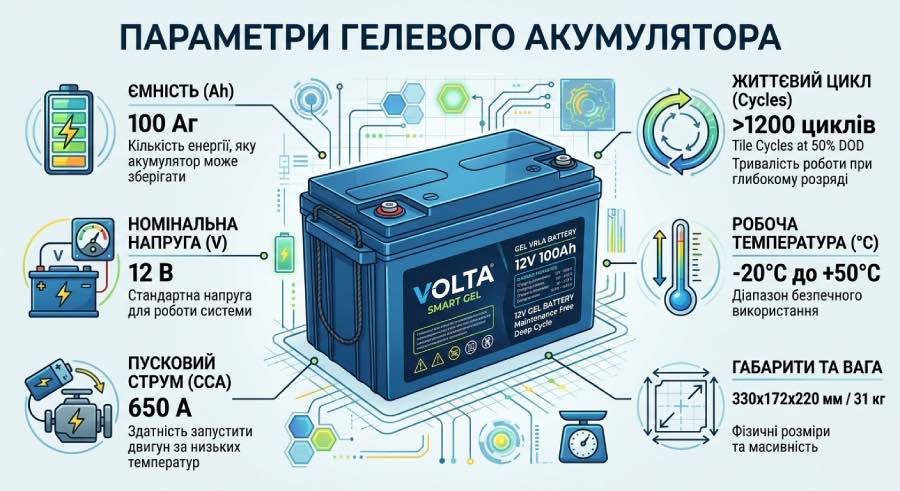
The most dangerous mistakes
1. Charging with too much voltage.
If given 14.8–15.5 V instead of normal 14.1–14.4 V, the gel begins to degrade.
2. Constant high current.
Fast charging to «maximum» is convenient, but it is harmful to GEL. Excessive current increases internal heating.
3. Deep discharge to zero.
This is always bad for lead-acid batteries, and especially so for gel batteries. It is better not to go below 50% regular discharge.
Lower 11.8–12.0 V Under load, this is the zone where you need to stop.
4. Leveling or desulphation is enabled.
Many "smart" chargers have a recovery mode. For GEL, it is often unnecessary or harmful.
5. Charging in the cold without compensation.
At low temperatures, the process is worse. If the battery is in an unheated room, the voltage must be adjusted.
6. Storage in a discharged state.
This is one of the worst-case scenarios. Plate sulfation progresses rapidly, and restoring capacity is then almost impossible.
Battery maintenance: what to do regularly
A gel battery does not require topping up water or unscrewing caps, but that does not mean it is «maintenance-free» in the full sense. Battery maintenance here it is the control of modes, contacts and operating conditions.
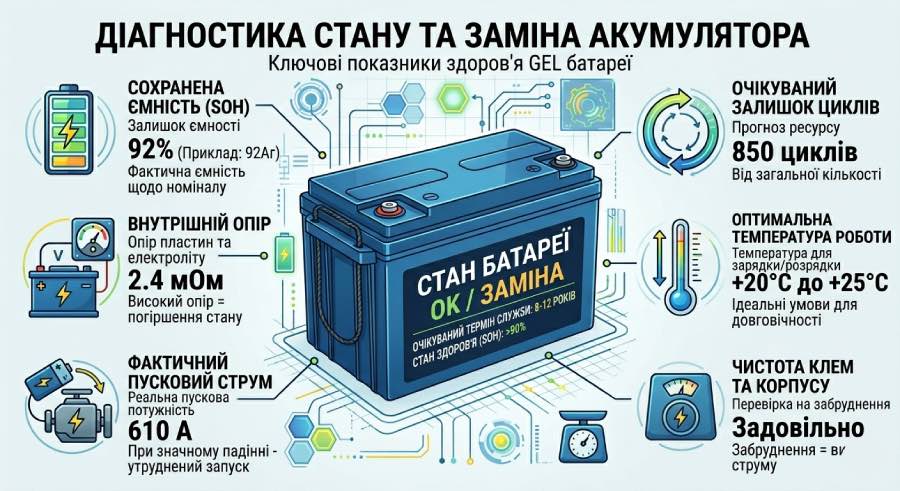
Monthly minimum
Although gel (GEL) batteries are considered sealed and maintenance-free, they require regular maintenance to maintain capacity and extend their lifespan. Include the following procedures in your schedule:
Visual case inspection: Check the battery for visible damage, swelling or cracks. A swollen case often indicates overcharging or overheating, which is a critical signal to immediately check the charging system.
Cleaning from dirt: Wipe the case with a dry or slightly damp cloth. Dust, dirt, and moisture on the surface of the battery can create «microcurrents» (leakage currents) between the terminals, leading to self-discharge.
Checking the terminals: Make sure the contacts are tight. Oxidation (white or green coating) on the terminals significantly impairs conductivity. If you notice any coating, carefully clean it with a soft brush and treat with a special protective spray or technical petroleum jelly.
Voltage control: Use a multimeter to measure the voltage at the terminals in a quiescent state (without load or charging).
For a fully charged, serviceable GEL battery (12V), this indicator should be within 12.7–12.9 V.
If the value is below 12.4 V, the battery needs immediate recharging to avoid sulfation of the plates.
What you absolutely cannot do
To make your battery last as long as possible, avoid these mistakes:
Deep discharge: Do not allow the battery to discharge below 10.5–10.8 V. Gel batteries are very sensitive to deep cycles; it is best to charge them when the charge has dropped to 30-40%.
Charging with an incompatible device: Use only specialized chargers with a «GEL» or «VRLA» mode. Regular car chargers can output too high a voltage, which will cause the gel inside to «boil»—an irreversible process that destroys the battery.
Temperature extremes: Gel batteries are afraid of extreme heat (above +30°C accelerates degradation) and significant frost (at sub-zero temperatures their capacity drops critically and charging becomes ineffective).
Advice: If you do not plan to use the battery for a long time (for example, during the off-season), fully charge it and store it in a cool, dry place. Check the voltage level every 3 months, as the battery has a natural self-discharge even when idle.