
Useful tips
How to choose a battery for an inverter: AGM, GEL or LiFePO4 for home


How to choose a battery for an inverter: AGM, GEL or Lifepo4 for home
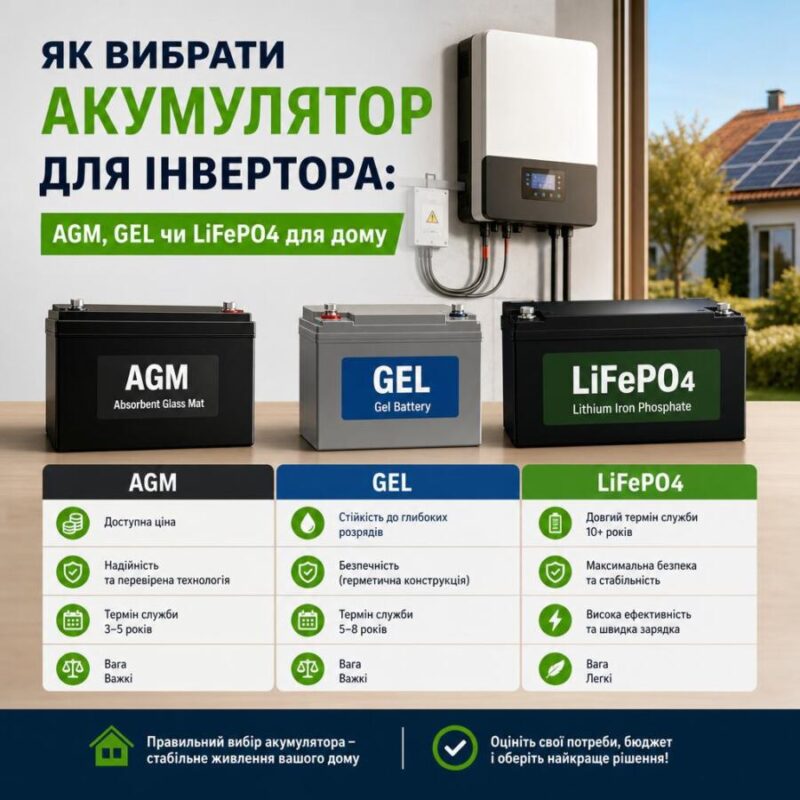
When an inverter is needed not “just in case”, but for real backup power for the house, the choice of battery becomes critical. It is the battery for the inverter that determines how long the refrigerator, pump, lighting, router, boiler or server equipment will work during a power outage. A mistake at this stage is expensive: they buy a battery with a “paper” capacity that sags under load, or install a model that does not like deep discharges and quickly loses its resource.
For home systems, three groups are most often compared: AGM, GEL and Lifepo4. All of them can work with an inverter, but they do it differently. Below we will analyze not only the theory, but also practice: how the battery behaves under current, how the real return differs from the nominal, how to calculate the capacity battery for a specific load and what to choose for a house if you need not the “cheapest”, but the smartest configuration.
What is important to know before choosing a battery for an inverter
The inverter converts the battery's DC voltage to 230 V alternating current. But the battery itself does not “give” energy evenly: its voltage drops with increasing current, and part of the declared capacity is unavailable due to limitations on the depth of discharge, internal resistance, and losses in the inverter.
Key parameters that really affect performance
- Rated voltage — 12 V, 24 V or 48 V. For large loads, 24/48 V is preferable, because lower current means less loss.
- Battery capacity — usually in A·h. But it's not the number itself that matters, but the available energy in kWh.
- Allowable depth of discharge (DoD) — how many percent the battery can give without significant wear and tear.
- Discharge current — whether the battery will withstand starting a pump, refrigerator, or induction load.
- Number of cycles — how many full/partial charge-discharges the battery will survive before noticeable degradation.
- Internal resistance — the lower it is, the smaller the voltage drop under load.
Why the capacity in the passport does not equal the actual autonomy
For example, a 12 V 100 Ah battery has a theoretical energy of:
- 12 V × 100 Ah = 1200 Wh, or 1.2 kWh.
But this does not mean that you can take all 1.2 kWh without consequences. For lead-acid batteries, it is advisable to use only 50% of capacity, and there are also inverter losses, which often amount to 8–15%. As a result, from 1.2 kWh of useful energy, approximately 0.5–0.6 kWh may remain.
For Lifepo4, the picture is better: 80–95% capacities are often available, and the system efficiency is higher. That is, a battery of the same nominal capacity will provide a much longer real-world operating time.
AGM: a compromise between price and simplicity
AGM is a lead-acid battery with absorbed electrolyte. The electrolyte is held in fiberglass separators, so the battery does not require maintenance in the classical sense, is more airtight than liquid analogues and can operate in any position if the manufacturer allows it.
How AGM behaves under load
AGM is good at handling high starting currents. This is useful for:
- refrigerators and freezers;
- circulation and well pumps;
- boilers with fan and electronics;
- routers, lighting, low-power household appliances.
However, there is a nuance in AGM: with deep discharge and prolonged undercharge, plate sulfation develops quickly. If the battery is often operated to 20–30% of residual, and then charged with a weak charger, the resource drops much faster than in the passport.
Advantages of AGM
- Lower starting price.
- Easy compatibility with most inverters.
- Good return of high currents in short pulses.
- Does not require electrolyte topping up.
Disadvantages of AGM
- Fewer cycles compared to GEL and especially Lifepo4.
- Sensitivity to deep discharges.
- Significant weight and dimensions with large capacity.
- Low efficiency with frequent charge/discharge cycles.
When an AGM makes sense
AGM is worth getting if you need it relatively inexpensive battery for home as a backup for rare outages, without daily cycling. For example, when the inverter powers the router, lighting and boiler for 2–4 hours several times a month. In such conditions, AGM can still work normally if regular deep discharges are not allowed.
GEL: stability in cyclic mode, but with limitations
A gel battery is also a lead-acid technology, but the electrolyte is thickened to a gel state. This allows the battery to withstand deeper discharges and generally has a better cycle life than a regular AGM. This is why a gel battery is often chosen for backup power systems and solar stations where the battery is regularly cycled.
How GEL is different in real use
Under constant load, GEL is usually more stable than AGM when it comes to medium currents and slow discharges. But there is an important nuance: it is less able to tolerate high charging currents and incorrect charging modes. If the inverter or controller supplies too much voltage, the gel electrolyte can be damaged, cavities form, and the resource drops.
Advantages of GEL
- Better cycling compared to AGM.
- Less sensitivity to partial discharge.
- Good performance in systems with regular outages.
- Normal stability under medium loads.
Disadvantages of GEL
- More demanding on the charging profile.
- Often worse tolerates large charge currents.
- Noticeably heavier than LiFePO4 with the same useful energy density.
Practical observation: Many people make the mistake of trying to charge a gel battery with a large current, so that “light would be given faster. If for AGM current of 15-20A from the inverter — is the norm, then for GEL it can be critical. They like a slow, gentle charge with a current of no more than 10% from the capacity. If you rush — the gel will simply boil and peel off from the plates.
LiFePO4 (Lithium Iron Phosphate): the technological maximum for the home
If the budget allows, LiFePO4 is the undisputed leader for modern energy independence systems. It is a completely different level of comfort and reliability, which completely eliminates the disadvantages of lead technologies.
Why LiFePO4 is ideal for frequent outages
The main feature of lithium iron phosphate is the charging speed and endurance. When the light is turned on for only 2-4 hours, AGM or GEL simply will not have time to absorb the useful capacity (they need 8-10 hours). LiFePO4 can be safely charged with high currents, and it is restored to 100% in a couple of hours. In addition, the built-in BMS board fully controls the process, protecting the elements from overcharging and overheating.
Advantages of LiFePO4
- Resource intensity: From 3000 to 6000 cycles (versus 300-500 for AGM). That's 10 years of daily use.
- Deep discharge: Safely delivers up to 90-95% of its capacity without degradation.
- Stable voltage: Maintains 12.8V-13.2V levels almost until fully discharged, the inverter will not beep due to “sag”.
- Weight and compactness: 2-3 times lighter than a gel analogue of similar useful capacity.
Disadvantages of LiFePO4
- High initial cost (however, in terms of years of service, this is the cheapest option).
- You cannot charge at temperatures below 0°C (although this is not a problem for a house or apartment).
Battery comparison: AGM, GEL and LiFePO4
To clearly see the difference between the technologies, let's look at their key characteristics:
| Parameter | AGM | GEL | LiFePO4 |
|---|---|---|---|
| Resource (cycles) | 300 – 500 | 500 – 700 | 3000 – 6000 |
| Actual discharge (DoD) | up to 50% | up to 60-70% | up to 90-95% |
| Full charge time | 8 – 10 hours | 10 – 12 hours | 2 – 3 hours |
| Sensitivity to undercharge | High (sulfation) | Medium | Missing |
What to choose for the house?
The choice depends on the usage scenario and your budget:
- Budget reserve (AGM): It is suitable if the lights are rarely turned off, and the system is needed as a backup (boiler, router, lights). The main thing is not to discharge it “to zero”.
- Frequent cyclic shutdowns (GEL): A good mid-range option if outages are regular, but there is time (up to 10 hours) for the battery to slowly recover.
- Autonomy without compromise (LiFePO4): The best solution for tight power schedules. Charges quickly, lasts a long time, and delivers maximum power for any device.