
Useful tips
TOP 7 Best Hybrid Inverters of 2026: An Honest Comparison of Deye, Luxpower, Voltronic and Axon


In 2026, the hybrid inverter finally ceased to be exotic and became a standard solution for any facility with solar panels and a desire to have a stable power supply. After five years of constant outages, an increase in tariffs to 4.5–5 UAH/kWh and changes in net-billing rules, people no longer want to simply «give» surpluses to the network. They need a system that intelligently accumulates energy, works in offline mode and does not turn off during power surges.
Over the past four years, I have personally installed more than 80 hybrid systems — from 5 kW in apartments on the 9th floor to 36 kW three-phase complexes at enterprises. I saw how some inverters Some work for 4 years without a single error, while others start to fail in the second year due to poor cooling or faulty firmware.
That is why this time I will not retell marketing brochures. I will make the most practical analysis of the TOP-7 models. During their operation, a nuance often arises when the inverter lies about the charge level battery, and below we will look at how to deal with this in Ukrainian conditions: Deye, Luxpower, Voltronic Axpert, Axon, Sunsynk, Growatt SPF ES and Megarevo.
2026 brought several important changes. First, almost all serious manufacturers switched to supporting LiFePO4 with new generation CAN-BUS protocols (especially Seplos, JK BMS, Pylontech Force L2). Second, requirements for zero-export accuracy appeared - the tax authorities began to be more interested in systems that "slightly" give to the grid. Third, people finally began to understand that the inverter is the heart of the system, and saving on it is more expensive than on panels.
Let's go through the real technical features, tell you where each inverter breaks down and where it performs well, and give specific recommendations for different scenarios: an apartment, a private house, a summer cottage, and a powerful load with an electric boiler and a car charging station.
Hybrid inverter selection criteria
Most buyers only look at price and power. This is a major mistake. In my experience, real durability and stability are influenced by completely different parameters.
Technical criteria that I pay attention to during installation:
- Quality of power electronics and cooling. A 12 kW inverter under a load of 9–10 kW can heat up to 55–60°C. If the fan is weak or the radiator is small, overheating errors appear after 2–3 years.
- Real overload capacity. The marketing says «200% for 10 seconds.» In reality, Deye holds 160–170% longer than Voltronic.
- Accuracy of the current sensor (CT coil). The biggest problem with budget models. Some Voltronic and Axon I have seen deviations of up to 180–250 W towards the grid. This is critical with connection power limitations of 5–7 kW.
- Working with BMS. 2026 is no longer the time for experiments. The inverter must communicate normally with Seplos v3, JK BMS, Pylontech via CAN. Otherwise, the battery will live half as long.
- Software quality. Application, speed of response to load changes, ability to update firmware "over the air", availability of a local area network (LAN).
- Parallel work. If you plan to expand, it is better to immediately take models that can be parallelized without problems (Deye and Luxpower are the leaders here).
- Noise level. Critical for apartments and houses with inverter in the technical room near the bedroom.
Economic criteria:
- Cost per kW of power, taking into account the actual warranty and service.
- Availability of spare boards and components in Ukraine.
- Price on the secondary market in 3–4 years (Deye hold their price much better).
If inverter meets at least 6 out of 8 points - it can be considered seriously.
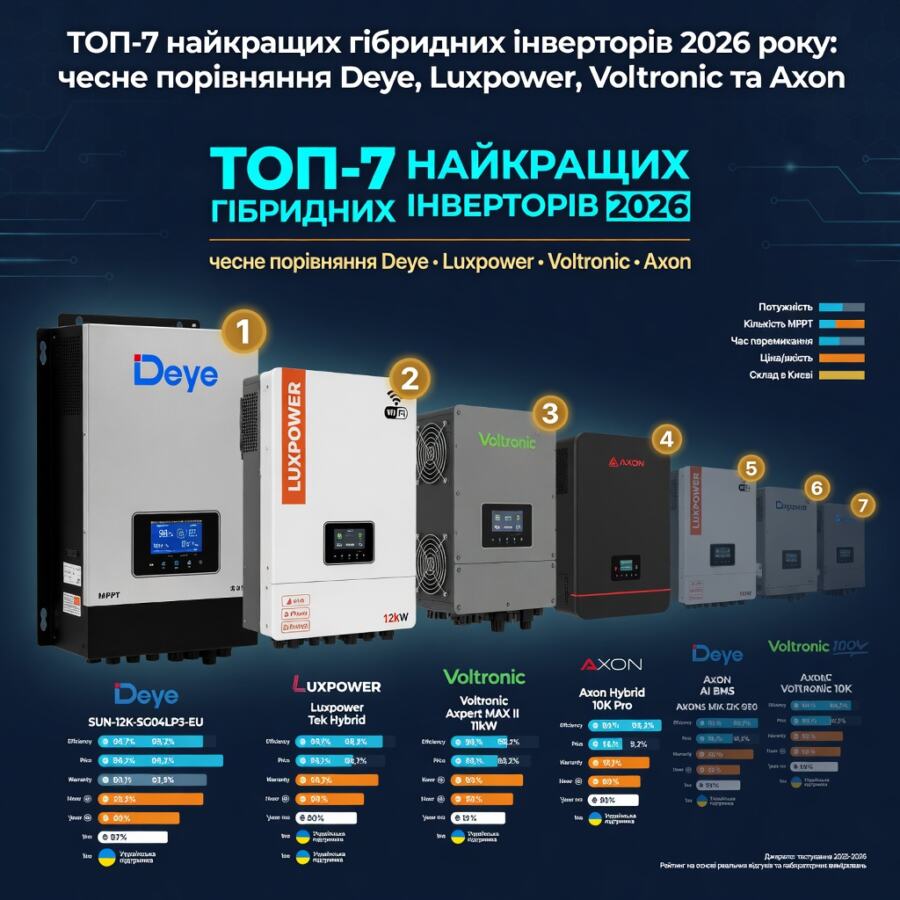
Comparative table of TOP-7 models
| Model | AC power (kW) | Max PV (kW) | MPPT | Battery | Max charge (A) | Efficiency | Parallel | Noise level | Price 2026 (UAH) | Overall score (out of 10) |
|---|---|---|---|---|---|---|---|---|---|---|
| Deye SUN-12K-SG04LP3 | 12 (16 peak) | 18 | 3 | 48V (40-60V) | 240 | 97.6% | up to 16 pcs | average | 91,000 – 98,000 | 9.4 |
| Luxpower SNA 12K | 12 (18 peak) | 18 | 3 | 48V | 250 | 97.4% | up to 12 pcs | quiet | 79,000 – 86,000 | 8.8 |
| Voltronic Axpert MAX E 12KW | 12 (24 peak 10s) | 21 | 3 | 48V | 200 | 96.8% | up to 6 pcs | loud | 68,000 – 74,000 | 7.9 |
| Axon AXH-10K | 10 (15 peak) | 15 | 2 | 48V | 180 | 96.5% | up to 6 pcs | average | 62,000 – 67,000 | 7.2 |
| Sunsync 12K-SG04LP3 | 12 (16 peak) | 18 | 3 | 48V | 240 | 97.5% | up to 12 pcs | quiet | 94,000 – 102,000 | 9.1 |
| Growatt SPF 12000 ES | 12 (36 peak 5s) | 16 | 2 | 48V | 200 | 96.7% | up to 6 pcs | loud | 71,000 – 77,000 | 8.1 |
| Megarevo R12K | 12 (18 peak) | 18 | 3 | 48V | 220 | 97.3% | up to 10 pcs | average | 82,000 – 89,000 | 8.6 |
Prices are approximate for the beginning of 2026, taking into account official import and warranty.
Detailed analysis of each of the 7 models
1. Deye SUN-12K-SG04LP3 Overall rating: 9.4/10
The most popular and most reliable hybrid inverter in Ukraine in 2026.
Pros:
- Excellent quality power electronics and powerful cooling (three fans + large radiator).
- It actually holds 160–170% overload for up to 30–40 seconds.
- Very accurate CT sensor (deviation within 30–50 W).
- Excellent work with BMS (Seplos v3, JK BMS, Pylontech, Ruixu).
- Powerful software: fast application, Wi-Fi + LAN, regular firmware updates.
- The best parallel work on the market (up to 16 units).
Cons:
- A little louder than Luxpower and Sunsynk under heavy load.
- The price is higher than average.
Who is it best for: Private homes 10–20 kW, enterprises, systems with a powerful load (electric boiler + car charging). If you need maximum reliability for 8–10+ years, this is #1.
2. Luxpower SNA 12K Overall rating: 8.8/10
The quietest inverter in this TOP.
Pros:
- Very comfortable noise level (ideal for home).
- Excellent price/quality ratio.
- Good overload capacity.
- Stable operation with modern LiFePO4.
- Quick response to load changes.
Cons:
- Slightly weaker cooling under prolonged load of 11+ kW in the heat.
- Parallel operation up to 12 pcs (less than Deye).
- The service network is smaller than Deye.
For whom: Homes where low noise and good price are important. A great choice for most users in 2026.
3. Voltronic Axpert MAX E 12KW Overall rating: 7.9/10
The most budget option among the powerful 12 kW.
Pros:
- Low price.
- Very high peak power (24 kW for 10 seconds).
- A large number of installations in Ukraine.
Cons:
- Loud (fans are very audible).
- Poor quality cooling components.
- More complaints about overheating errors after the 2nd year.
- Average accuracy of zero-export.
- Problems with BMS in some batches.
For whom: Cottages, temporary facilities, limited budget. Not recommended for permanent residence and critical loads.
4. Axon AXH-10K Overall rating: 7.2/10
A budget Chinese brand that is actively promoted in Ukraine.
Pros:
- Very attractive price.
- Compact.
- Acceptable quality for 10 kW.
Cons:
- Worst CT accuracy of all (often +150–250 W into the network).
- Weak cooling.
- Average firmware quality.
- Problems with parallel work.
- Weak service and low liquidity in the secondary market.
For whom: Apartments with a small load (up to 8 kW) and a tight budget. Not for powerful systems.
5. Sunsync 12K-SG04LP3 Overall rating: 9.1/10
Premium alternative to Deye (actually the same factory, but different firmware and positioning).
Pros:
- One of the quietest in the class.
- Excellent software (very user-friendly interface).
- High build quality.
- Good BMS support.
- Stylish design.
Cons:
- The highest price in the TOP.
- Slightly slower response to sudden load changes compared to Deye.
For whom: People who want premium comfort and are willing to pay more. Great for cottages and smart homes.
6. Growatt SPF 12000 ES Overall rating: 8.1/10
Well-known brand with a large number of installed systems.
Pros:
- Very high peak power (36 kW for 5 seconds).
- Good availability of spare parts.
- Developed service network.
Cons:
- Loud.
- Weaker cooling under prolonged load.
- Older architecture compared to Deye/Luxpower.
For whom: Objects with high starting currents (pumps, compressors, powerful electric boilers).
7. Megarevo R12K Overall rating: 8.6/10
A very promising brand for 2025–2026.
Pros:
- Good build quality.
- Modern electronics.
- Quiet operation.
- Good value for money.
Cons:
- There are still few statistics on durability in Ukraine (less than 2 years of mass operation).
- The service network is developing.
For whom: Those who want a modern inverter for reasonable money and are willing to take a relatively new brand.
Recommendations 2026
My personal ranking by scenarios:
- Maximum reliability → Deye 12K
- Optimal price/quality ratio → Luxpower SNA 12K
- Premium comfort and quiet operation → Sunsync 12K
- Limited budget → Luxpower or Megarevo
- Cottage / rare use → Voltronic or Axon
- Powerful starting loads → Growatt SPF or Deye
The main conclusion: In 2026, saving on an inverter is the worst possible savings. The difference between a budget and a good inverter of 15–25 thousand hryvnias fully pays off in 3–4 years due to stable operation, fewer breakdowns, and longer battery life.
If you want, write your scenario in the comments (power, type of object, budget), and I will suggest a specific model for you.