
Useful tips
Voltage stabilizer or inverter for home: what to choose for your home


Voltage stabilizer і inverter for home are often confused, although they are two different solutions for completely different tasks. If in some cases you need first of all equipment protection from network jumps, in others it is critically important backup power during outages. To avoid wasting money, it's important to understand how each device works, what loads it can withstand, and when one option is truly better than another.
The problem for most homes is the same: the voltage in the network can sag to 170–180 V, to rise to 240–250 V, and during accidents — disappear completely. For sensitive electronics, refrigerator, boiler, pump, router, TV and computer this is not just inconvenient, but potentially harmful. That is why homeowners are increasingly choosing or voltage stabilizer, or inverter for home, and sometimes they combine both solutions.
What is the difference between a voltage stabilizer and an inverter?
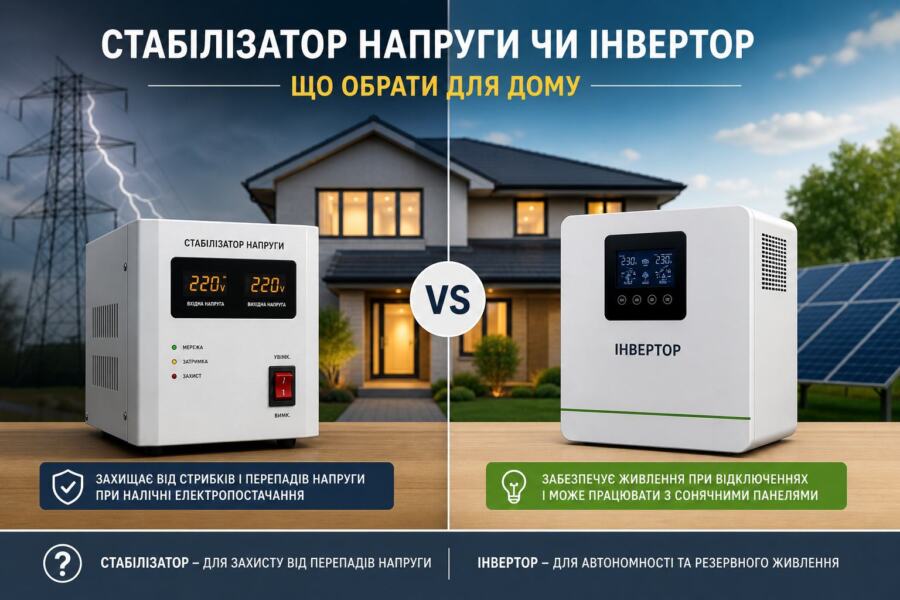
Voltage stabilizer equalizes the input voltage and supplies more or less stable voltage to the equipment 220 V. Its main task is to compensate for sags and surges in the network. It does not generate electricity on its own, but only “pulls” the problematic network up to normal levels.
Inverter for home works differently: it converts direct current from batteries into alternating current 220 V for powering household consumers. That is, the inverter can provide backup power during a complete power outage. If there is a battery, the house does not turn off immediately, but continues to operate for a certain period of time.
In simple words:
- stabilizer saves from poor voltage quality;
- inverter saves from lack of tension;
- for best results they are sometimes used together.
When is a voltage stabilizer needed?
Voltage stabilizer It is advisable where electricity is available, but its quality is unstable. This is a typical situation in private homes, cottages, old lines, remote areas and where there are many consumers in the network in the evening. The voltage may “float”, but not disappear completely.
Most often, a stabilizer is installed for:
- gas boiler and circulation pump;
- refrigerator and freezer;
- TV, router, computer;
- video surveillance systems;
- lighting if it is sensitive to subsidence.
Its main advantage is simplicity. Plug it into the network, connect the load, and it works. For equipment that does not like jumps, this is a good equipment protection without a complicated circuit with batteries.
But a stabilizer won't help if there's a complete power outage in the house. In that case, the equipment will simply turn off along with the network.
When do you need an inverter for your home?
Inverter for home chosen when not only the quality of voltage is important, but also its availability. This solution is especially relevant during regular power outages, accidents, repairs on lines or in houses where continuous operation of some equipment is required.
Inverter with battery makes it possible to feed:
- boiler and heating pump;
- communication system and internet;
- lighting in important areas;
- refrigerator;
- security system;
- some sockets for basic needs.
In the practice of a private house backup power often not needed for the whole house, but only for critical consumers. This is a reasonable approach, because powering the entire house through an inverter is expensive and technically more complicated. It is better to allocate a separate load group.
For example, if your boiler consumes 120 W, pump — 60 W, router — 15 W, and several LED lamps — more 50 W, then the real reserve load can only be 245 W. Such a system does not require a huge inverter, but it does require the right circuit, quality batteries, and protection.
How to choose between a stabilizer and an inverter
The easiest way to choose is to start from the real problem. If the electricity in the house is almost always on, but the voltage is “walking”, you need voltage stabilizer. If you often lose power, then it is more important backup power, and therefore needed inverter for home.
You can orient yourself like this:
- There is voltage, but it is unstable - choose a stabilizer.
- There are frequent or prolonged outages — choose an inverter with a battery.
- There are both surges and shutdowns - consider the combination: stabilizer + inverter.
In the private sector, the second or third option often occurs. The equipment suffers not only from accidents, but also from a constant “nervous” network. Therefore equipment protection It is better to think comprehensively, not point by point.
What power do you need to take?
Mistake number one is to buy a device “with a margin of safety”. The power must be calculated based on the load that will operate simultaneously. For a stabilizer, the total power of connected consumers is taken, taking into account starting currents. For an inverter, it is also important how motors, pumps, compressors and other inductive loads behave.
The practical approach is as follows:
- make a list of all devices that will be connected;
- look at their passport power in Tue or kW;
- for a refrigerator, pump, compressor, consider the starting current;
- add stock 20–30% for stable operation.
For example, if the total load is 800 W, you should not take the device to the limit of its capabilities. It is better to choose a model at least 1.0–1.5 kW with a normal margin. This will extend the life of the equipment and reduce the risk of overheating.
It is additionally important for the inverter to have:
- pure sine wave at the output;
- sufficient starting reserve;
- support for working with batteries of the required voltage — 12 V, 24 V or 48 V;
- automatic switching to backup power.
Comparison of stabilizer and inverter
| Parameter | Voltage stabilizer | Inverter for home |
|---|---|---|
| Main task | Equalizes the voltage in the network | Provides battery power |
| Work without a network | No | Yes |
| Equipment protection | From jumps and slumps | From disconnections, and sometimes from drops in connection with other devices |
| Batteries required | No | Yes |
| Installation complexity | Low or medium | Medium or high |
| Solution price | Usually lower | Higher due to batteries |
| When appropriate | Poor voltage quality, but there is light | Frequent outages and the need for backup power |
Common mistakes when choosing
One of the most common mistakes is to buy voltage stabilizer, when it is really needed inverter for home. A person expects the device to “keep the light on,” but it only equalizes the voltage. After the first power outage, the equipment still goes out.
A few more common mistakes:
- Underestimation of starting currents — especially for refrigerator, pump, vacuum cleaner, compressor.
- Choice without stock — the device works at the limit, heats up and fails more quickly.
- Connecting the whole house to a low-power inverter — overload is almost guaranteed.
- Savings on batteries — cheap batteries lose capacity quickly and give a short operating time.
- Lack of automation and protection — this is a risk for wiring and equipment.
A separate problem is buying equipment without understanding how it works with your network. If the voltage in the house is very low, some stabilizers may simply not be able to pull the load at the declared power. And inverter without a normal charger and correct Adjusting the batteries will also not give the expected result.
What is important to check before buying
Before choosing, it is worth evaluating not only the power, but also the operating conditions. For a home system, the following parameters are important:
- input voltage range;
- stabilization accuracy;
- type of output waveform;
- switching time;
- noise level;
- protection against overheating, overload and short circuit;
- ease of installation and maintenance.
It is critical for the inverter that the output is from pure sine wave. This is especially true for boilers, pumps, refrigerators and other equipment with electric motors or sensitive electronics. A modified sine wave can work with simple devices, but for some household appliances it is undesirable.
For the stabilizer, pay attention to the type of design. There are relay, triac, servo solutions. In everyday life, those models that work quietly, respond quickly and have a sufficient resource with frequent network fluctuations are most often appreciated.
How to build a practical backup power system
If the main problem is disconnection, then the best solution is often built around an inverter. In this scheme, the home inverter powers critical consumers, and the batteries provide autonomy. If necessary, the system can be supplemented with input stabilization or separate protection of sensitive lines.
A practical scheme might look like this:
- Allocate a separate line for the boiler, Internet, lighting, and refrigerator.
- Choose an inverter of the required power.
- Install a battery of appropriate capacity.
- Provide automatic switching to backup power.
- Be sure to install protection: circuit breaker, fuses, proper grounding.
It is important to remember here: backup power — it's not just “buy an inverter and connect a battery.” If you miscalculate the power or capacity of the battery, the system will either hold too little or not start at all under load.
For example, a battery 12 V 100 Ah has a nominal energy of about 1.2 kWh, but the actual useful capacity is less due to losses, depth of discharge and inverter efficiency. Therefore, in practice, you should not calculate “according to the passport” without a margin.