
Useful tips
Solar Panels for Garage: How to Choose the Best System 2026


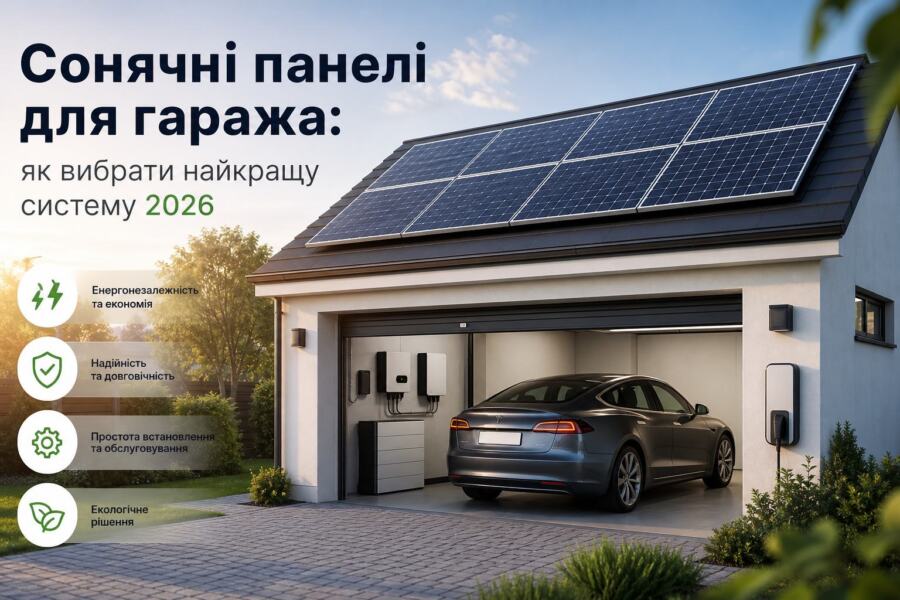
Solar panels for the garage in 2026 are not only a way to reduce electricity costs, but also a real path to autonomous power supply for the garage for lighting, ventilation, charging tools and operating small appliances. If the garage is used as a workshop, repair area or storage, solar energy for the workshop allows you to work stably even during network outages.
For the system to be truly useful, it must be selected not "by eye", but based on the power of consumers, operating mode and installation conditions. An error at the calculation stage often leads to overspending or the panels not covering real needs.
Why does a garage need a solar system?
A garage consumes less electricity than a house, but its needs are often uneven. In the morning and evening, lighting is on, and during the day, chargers, a compressor, a drill, a grinder or a ventilation system are on. That is why solar panels for a garage should be designed taking into account peak loads.
Most often, the system is installed for the following tasks:
- lighting interior space and gates;
- power tool during repair work;
- charging battery equipment;
- operation of the video surveillance and alarm system;
- ventilation or heating support in a small amount.
If the garage is used as a workshop, sanders, dust extraction, pumping equipment and other consumers are added to the list. In this case, the system has a reserve of power, and does not work "closely".
What are the solar power systems for a garage?
Before buying, it is important to understand what type of system you need. It is not always advisable to install a full-fledged network station for a garage - sometimes it is more practical to choose a hybrid or autonomous solution. The choice depends on the availability of the power grid, the schedule of use and the desired level of independence.
| System type | Features | Who is suitable for? | Advantages | Disadvantages |
|---|---|---|---|---|
| Network | Works in parallel with the mains, without a battery or with a minimum reserve | Garages with stable power supply | Lower price, easier installation | Does not provide autonomy during outages |
| Hybrid | Combines solar panels, inverter and battery | For regular workshop and reserve operation | Flexibility, backup power, savings | Higher cost, more difficult to set up |
| Autonomous | Works without a network connection, powers the load from batteries | Remote garages, summer houses, facilities without electricity | Complete independence, stability of work | A reserve of batteries is needed, accurate calculation is important |
For most household garages in 2026, the optimal is hybrid system. It allows you to store energy during the day and use it in the evening, and also does not stop the workshop during network outages.
How to calculate the power of solar panels for a garage
The correct calculation does not start with the panels, but with a list of all consumers. It is necessary to determine which devices are running simultaneously, how many hours a day they are used and what their peak power is. This is what gives a real idea of the required system.
The calculation algorithm is simple:
- Make a list of all the electrical appliances in the garage.
- Indicate their power in watts.
- Multiply the power by the number of hours of operation per day.
- Add 15–25% margin for inverter, cable losses, and inclement weather.
For example, if lighting, tool charging, and small appliances consume 1.5–2 kWh per day, the system should provide not only this amount, but also a reserve for peak loads. For solar energy for the workshop This is especially important because tools often start up for a short time, but with a high starting current.
What components should be in the system?
Solar panels alone do not provide full power. For stable operation, a set of equipment is required, where each element performs its function. If at least one component is selected incorrectly, the efficiency of the entire system drops.
Required elements:
- solar panels — convert light into electricity;
- charge controller — protects batteries from overcharging and excessive discharge;
- rechargeable battery — accumulates energy for night or backup operation;
- inverter — converts direct current into alternating current for household appliances;
- mounting system and cables — ensure safe installation and energy transfer.
For autonomous power supply of a garage, it is worth paying attention to the compatibility of all components, and not just the power of the panels. For example, a weak inverter can limit the operation of even a high-quality solar system systems.
What to look for when choosing panels in 2026
The solar equipment market is changing rapidly, and in 2026, it is important to evaluate not only the price, but also the technical characteristics. For a garage, efficiency, resistance to temperature extremes, dimensions, and manufacturer's warranty are of the greatest importance.
Key selection criteria:
- Panel efficiency — the higher it is, the more energy from a smaller area;
- cell type — monocrystalline panels are usually more efficient for limited space;
- operating temperature — important for garages with less than ideal conditions;
- moisture protection and durability — especially if the roof is cold or unheated;
- warranty and degradation — show how the system will work in 5–10 years.
If the garage roof area is limited, it is better to choose a few more efficient modules than a large number of cheaper panels. This reduces the installation burden and increases overall performance.
Batteries: which ones are suitable for a garage system
For autonomous power supply of a garage, it is the battery that determines whether there will be electricity in the evening and during a power outage. LiFePO4 batteries remain the most practical option in 2026: they withstand more cycles, charge faster and work better in frequent use.
Main battery options:
- LiFePO4 — durable, lighter, more expensive at the start, but more profitable in the long run.
- AGM — cheaper, but have a shorter lifespan and are less able to withstand deep discharges.
- GEL — stable, but sensitive to incorrect charging and less convenient for high loads.
For a workshop with regular tool use, you shouldn't skimp on the battery. It is the battery that affects the comfort, stability, and battery life of the entire system.
Which system to choose for different types of garages
There is no universal solution: a system for a small garage with lamps and battery charging will be different from a workshop complex with a compressor and machine tools. Therefore, it is best to choose a configuration based on the usage scenario.
Practical options:
- For lighting and small needs — 1–2 panels, compact controller, small battery.
- For the garage with tools — average panel power, inverter with reserve, LiFePO4 battery.
- For a full-fledged workshop — a hybrid system with a reserve, a scalable battery pack, and high-quality protection.
- For a remote object — an autonomous system with accurate consumption calculation and a reserve for several days.
If the garage is used infrequently, there is no point in installing a high-power station. In this case, it is better to make a compact but reliable system with the possibility of modernization.
Typical installation errors
Even high-quality solar panels for a garage will not give the expected result if the installation is carried out without following the technical requirements. Most often, problems arise due to incorrect placement, weak fastening or unsuitable cables.
Common mistakes:
- underestimation of consumption and choosing a system that is too weak;
- installing panels in the shade from trees, buildings or antennas;
- savings on the inverter and protective automation;
- use of random batteries without compatibility in parameters;
- lack of capacity reserve for starting currents.
For the system to operate stably, it is important to anticipate not only daily consumption, but also peak moments. This is especially important if there is a compressor, welding equipment or powerful power tools in the garage.
When does a solar system for a garage pay off?
The payback period depends on the cost of the equipment, the amount of energy consumed and whether the system completely replaces the mains power supply. For a small garage, the economic effect may be moderate, but for a workshop or a facility with regular load, the benefit increases significantly.
The following factors affect the payback rate:
- frequency of garage use;
- cost of electricity;
- having an expensive tool that needs to be constantly charged;
- the level of autonomy you want to achieve;
- quality of design and installation.
In many cases, the main value of the system is not only savings, but also reliability. If the garage is a work space, downtime due to lack of electricity can cost more than the system itself.
Frequently Asked Questions (FAQ)
Is it possible to power a garage with just solar panels without a battery?
Yes, but only for very simple scenarios and mostly during the day. For full autonomous power supply garage A battery is needed, otherwise electricity will only be available when there is sun.
What power is suitable for a garage with tools?
A compact system is sufficient for basic lighting and charging, but you need a spare for tools. Typically, for a garage-workshop, you should consider system with inverter and battery, that can handle peak loads, not just average consumption.
What is better for a garage: a network or a hybrid solution?
If only small savings are needed, a grid-connected system is suitable. If backup power, stability and solar energy for the workshop, it is better to choose hybrid solution with battery.
Is it worth installing expensive panels on a small garage?
Yes, if the roof area is limited. In this case, more efficient modules will provide more energy from a smaller area, and therefore the system will work more efficiently and take up less space.