
Useful tips
Home backup power: electricity consumption during a blackout


Home backup power during a blackout — it's not just about the lights in the rooms. It's about the refrigerator, the internet, the pump, the boiler, the router, charging the phones and the ability to live relatively normally when the network disappears for hours or days. The most common mistake of homeowners is to buy the first equipment without considering electricity consumption. As a result, the inverter “does not pull”, battery for UPS discharges too quickly, and the expected comfort turns into chaotic shutdown of some devices.
For backup power to really work, you need to think not “which battery to buy”, but “how much energy does my house consume and what exactly needs to be powered”. This is what determines the type of system, power, battery capacity, autonomy time and even installation safety. For one a compact UPS for the boiler is enough for the house and a router, and for the other you need a powerful inverter for home with battery pack and automatic reserve input.
What is home backup power and why calculate consumption?
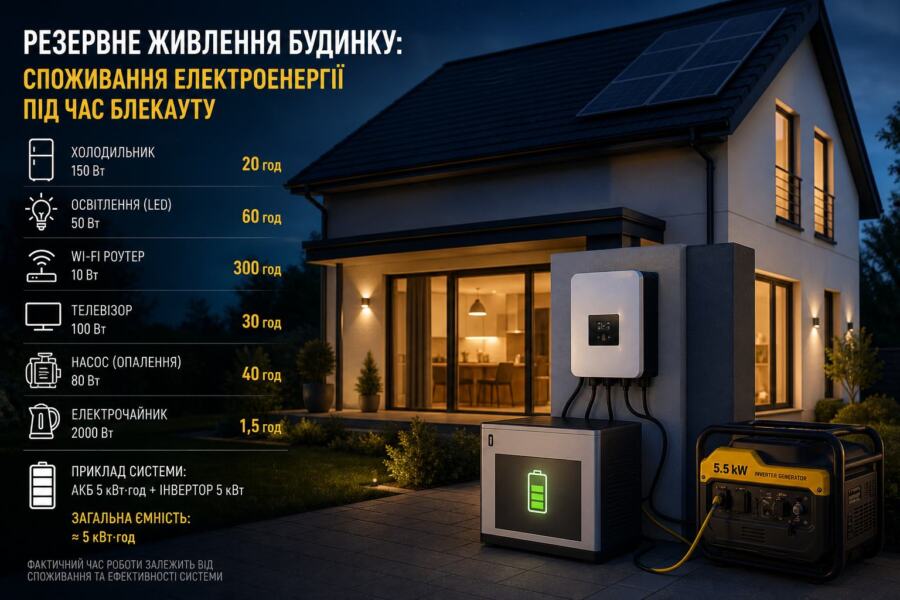
A home backup power system is a system that temporarily provides power to critical or all major appliances during a power outage. It can be:
- UPS for a boiler, router, alarm system or computer;
- Mini UPS for low-current devices;
- inverter-battery system for an apartment or house;
- generator as a separate or backup source;
- combined scheme: inverter + batteries + generator.
The key parameter here is electricity consumption. It shows how many watts and kilowatt-hours your equipment needs to operate. If you don’t take into account the actual consumption, you can buy a battery that will only last for 20–30 minutes instead of 4–6 hours.
For example, if a refrigerator, boiler, router and several LED lamps consume 250–350 W together, then a 1000 W system may be sufficient in terms of power, but not in terms of autonomy. The capacity of the batteries is important here. That is why the calculation starts not with the brand, but with the load.
How to correctly calculate electricity consumption in a home
To choose a backup power supply for your home, you first need to compile a list of critical devices. Not all devices need to be connected to the backup. In a blackout, most often only those things are left without which the house cannot function normally are left.
The basic list usually includes:
- gas boiler;
- circulation pump;
- router and ONU;
- refrigerator;
- lighting in key rooms;
- security system;
- charging phones and laptops;
- sometimes a TV, a well pump, small household appliances.
Next, you need to determine the power of each device. It is indicated on the nameplate, in the passport or on the case. If it says 80 W, this is the approximate consumption during operation. But there is a nuance: some devices have starting currents. For example, a refrigerator or pump can briefly consume 2–5 times more power during startup than in normal operation.
The calculation is done like this:
- Write down all the devices you want to power.
- Specify their power in watts.
- Summarize the simultaneous load.
- Take into account the stock of 20–30%.
- Separately evaluate the required autonomy time.
If accurate data is not available, it is best to measure the actual electricity consumption wattmeter or smart socket. This is especially useful for refrigerators, boilers and pumps: the passport numbers do not always correspond to real work.
Example of calculating backup power for a home
Consider a typical scenario. During a blackout, you need to power the following in your home:
- gas boiler — 120 W;
- router and ONU — 20 W;
- LED lighting — 60 W;
- refrigerator on average — 100 W;
- charging phones — 20 W.
Together we get approximately 320 W. If you take into account the margin, you should focus on a system that works stably under load. 500–700 W. But here it is still important how many hours of autonomy are needed.
Suppose we need 6 hours work. Then the energy will be:
320 W × 6 hours = 1920 Wh, or approximately 1.9 kWh.
Taking into account inverter losses, starting current reserve and reluctance to discharge batteries “to zero”, the actual required capacity will be higher – approximately 2.5–3 kWh useful energy. That is why one small battery for UPS may not give the required working time, even if formally “everything should be fine”.
| Instrument | Average power | Working hours | Energy per period |
|---|---|---|---|
| Boiler | 120 W | 6 hours | 720 Wh |
| Router and ONU | 20 W | 6 hours | 120 Wh |
| Lighting | 60 W | 6 hours | 360 Wh |
| Refrigerator | 100 W | 6 hours | 600 Wh |
| Charging | 20 W | 6 hours | 120 Wh |
| Together | 320 W | 6 hours | 1920 Wh |
Which inverter for home to choose?
A home inverter converts battery energy into 220 V alternating voltage, suitable for household appliances. This is the heart of the backup power system. It is important not to confuse it with a cheap “converter” from the marketplace: household appliances need a device that can withstand the load, has a stable sine wave and protections.
When choosing, look at the following parameters:
- capacity in watts or kilowatts;
- peak power to start a pump, refrigerator or boiler;
- output voltage type — preferred pure sine wave;
- battery operating voltage: 12 V, 24 V or 48 V;
- presence of a charger;
- automatic switching when the network disappears;
- protection against overload, overheating, short circuit.
For a small set of consumers, such as a boiler + internet + lighting, an inverter is often enough. 1–2 kW. For a house with a refrigerator, a pump and several rooms, it is better to look at 3–5 kW. If you also plan to install an electric kettle, microwave, or washing machine, you need a completely different backup architecture.
A separate tip: don’t choose an inverter “close to” it. If the load is 700 W, it is better to have a device with 1200–2000 W than to constantly work at the limit. This increases the resource and reduces the risk of an emergency shutdown.
What should a UPS battery be like and how do they differ?
Battery for UPS — not just a “box of energy.” The type of battery determines how many cycles it can withstand, how quickly it charges, whether it can be deeply discharged, and how safely it works in a residential building.
The most common options:
- AGM — affordable option, suitable for UPS and short-term outages;
- GEL — better tolerates cyclic operation, but sensitive to proper charging;
- LiFePO4 — more expensive, but lightweight, resource-efficient and with a convenient capacity;
- car starter batteries — undesirable option for backup power.
The main mistake is to install a car battery as a “cheap replacement”. It is not designed for regular deep discharges, quickly loses capacity and can fail at the worst possible moment. For a blackout, you need exactly traction or buffer battery, appropriate to the type of system.
Another important point is the calculation of the capacity in A·hour. The formula is simple, but you need to take into account the system voltage and losses. For example, a 12 V 100 A·h battery formally has 1200 W·h, but in reality the useful energy will be less. If you do not want to reduce the resource, you should not discharge lead-acid batteries below 50% regularly.
Which is better: UPS, inverter or generator?
The choice depends on the usage scenario. If you need to pick up power for 10–30 minutes or power low-power equipment, a classic UPS or Mini UPS. If you need autonomy for a few hours, an inverter-battery system is better. If outages last a long time and you need to power many devices, it makes sense to consider a generator or a combined solution.
Short:
- UPS — for quick backup without pause, mainly for boiler, router, server;
- inverter for home — for medium and heavy loads when autonomy is required;
- generator — for long outages and large consumers;
- combination inverter + generator is the most flexible option for the home.
In many homes, the most practical scheme is this: for the first few hours, the inverter with batteries works, and if the blackout lasts longer, the generator starts up, which simultaneously powers the house and charges the batteries. This saves fuel and ensures stability.
Typical errors when calculating backup power
In practice, most problems arise not from “bad equipment,” but from improper selection and installation. The most common mistakes are as follows:
- Starting currents are not counted. refrigerator, pump or compressor.
- They take an inverter without a power reserve.
- Overestimates battery capacity, not taking into account losses and permissible depth of discharge.
- Use wrong battery for UPS, which degrades quickly.
- Too many devices are connected to one backup circuit.
- Save on cables, circuit breakers and fuses.
- The system is installed without ventilation or in a damp room.
It is worth mentioning separately about cheap inverters with a “modified sine wave”. For a simple lamp or charger, this may still work, but for a boiler, pump, some power supplies and a refrigerator, hum, overheating or failure to start often occur. If the system is to power sensitive equipment, it is necessary pure sine wave.
What to pay attention to during installation
Even a well-chosen backup power supply for your home can operate unstable if the installation is not done correctly. Electrical safety is not a formality here, but a basic condition for normal operation.
Practical recommendations:
- Install the inverter and batteries in a dry, ventilated place.
- Use cables of the correct cross-section. The currents between the battery pack and the inverter can be extremely high. A cable that is too thin will heat up a lot, which will lead to large energy losses, incorrect operation of the inverter (it may give a low voltage error) or even fire. The cross-section must clearly correspond to the system power and the length of the cable.
- Tighten all contacts and power terminals securely. A loose connection is one of the most common causes of system failure. A loose connection causes sparking, excessive heat, and can simply melt the battery terminals or burn out the inverter input transistors. Use quality terminals and a crimping tool.
- Be sure to install protective automation. The system should not be connected "directly". A fuse of appropriate rating or a special DC circuit breaker must be installed between the battery and the inverter. The AC input and output (220V) must also be protected against short circuits and overloads.
- Provide space for air circulation. When charging or operating under heavy load, the inverter generates a lot of heat. Its built-in coolers must be able to efficiently dissipate hot air. Do not enclose the equipment in a closed cabinet and leave at least 15–20 cm of free space on each side of the case.
- Control the temperature. Modern lithium (LiFePO4) and gel batteries are very sensitive to temperature extremes. The optimal range for them is from +15°C to +25°C. Installing them in a freezing garage in winter or in a hot attic in summer will significantly reduce the capacity of the batteries and shorten their service life several times (lithium batteries are generally prohibited from being charged at sub-zero temperatures).
- Perform proper grounding. The metal housing of the inverter must be connected to the common grounding circuit of the house. This will protect the automation from static voltage, correctly start the through-zero (if necessary for the operation of sensitive equipment, for example, gas boilers), and protect you from electric shock in the event of an accidental breakdown.
Importantly: If you do not have experience working with power networks and high voltage, it is worth contacting a certified specialist for the final connection and commissioning of the backup power system. Qualified installation is a guarantee of the safety of your family and the durability of expensive equipment.