
Useful tips
Portable Solar Panels 2026: How to Choose the Best 100–400W Model


Portable Solar Panels 2026: How to Choose the Best 100–400W Model
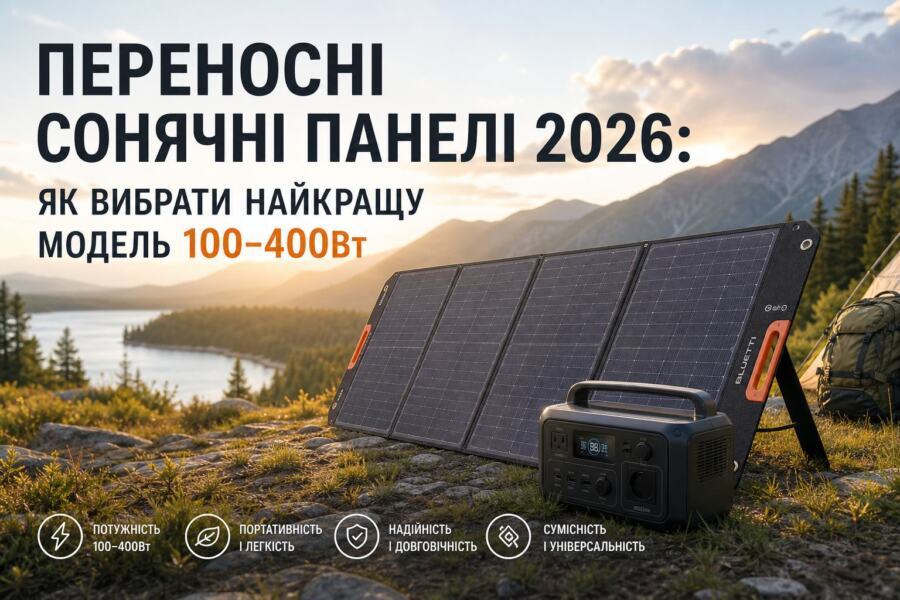
Portable solar panels in 2026 became a practical solution for autonomous power supply on the road, camping, car trips and during emergency power outages. Most often, users choose models in the 100–400 W range, since it covers most household and tourist scenarios. At the same time, the difference between the panels can be significant: from weight and dimensions to actual power, type of cells and compatibility with battery stations.
To buy a truly useful solution, it is not enough to look only at the number in watts. It is important to evaluate how the panel works in cloudy weather, whether it is convenient to transport, how quickly it unfolds, and which controllers and stations it is compatible with. That is why folding solar panels often outperform stationary counterparts for mobile tasks.
What to pay attention to before buying
The first step is to determine what exactly you need the panel for. A compact version is enough to charge smartphones, tablets, and flashlights, but to power a refrigerator, laptop, drone, or charging station, it’s better to look at a power of 200 W or higher. If you need versatility, you should immediately evaluate not only the nominal power, but also the real efficiency of the system.
Next, you should check the type of solar cells. Most often, portable models use monocrystalline cells, which work better in a compact format and have higher efficiency. Also important are protection against moisture, the quality of the seams, the presence of a stand, and the length of the cables.
- Capacity — a basic guideline, but the actual output always depends on the sun, installation angle, and temperature.
- Cell type — monocrystalline models are usually more efficient than poly versions.
- Weight and folding format — critically important for hiking and transportation.
- Compatibility — check the voltage, connectors, and charge controller.
- Case protection — preferably not below a level sufficient for field use.
What power to choose: 100, 200, 300 or 400 W
Different power ranges are optimally suited for different tasks. A 200W solar panel is often considered the best a compromise between mobility and performance: it is not yet too bulky, but is already capable of charging battery stations noticeably faster than 100-watt solutions. For short trips and a minimal set of electronics, 100 watts may be enough, but for autonomous camping or backup power, you should look at 300–400 watts.
The choice also depends on whether you will use the panel with a portable station or directly charge devices via a controller. In the first case, it is important that the panel provides a stable voltage and has the required range of operating parameters. In the second case, connectors, output regulation, and connection security are important.
| Power | What is it suitable for? | Advantages | Limitation |
|---|---|---|---|
| 100 W | Smartphones, power banks, flashlights, short trips | Lightness, compactness, lower price | Slow charging stations, less versatility |
| 200 W | Camping, laptop, mid-range station | Balance of power and mobility | Needs more space to deploy |
| 300 W | Long trips, powering multiple devices | Faster charging speed, better battery life | Greater weight, higher requirements for space and sun |
| 400 W | Backup power, auto tourism, energy-intensive systems | Maximum performance among portable solutions | Less portable, higher price |
Foldable Solar Panels: Benefits for Traveling and Camping
Folding solar panels Designed specifically for mobile use. They are easy to put in the trunk, carry to a camping site, or quickly deploy in the sun without complicated assembly. For people who often change locations, this is more practical than rigid modules.
They are especially convenient for those who need autonomous power on the go. Portable panels for hiking should be not only lightweight, but also durable: with durable fabric, splash protection and high-quality hinges or stands for setting the angle. If the model can be securely fixed to a backpack, the ground or a car, its real value increases significantly.
- Rapid deployment without tools and assembly.
- Convenient transportation thanks to the compact folding format.
- Flexibility of use on a hike, fishing, or on a road trip.
- Compatibility with charging stations for powering equipment in the field.
How to evaluate real efficiency, not just a number in watts
The power on the label does not always equal the power you will get in the field. In reality, the result is affected by temperature, cloudiness, season, orientation to the sun and losses in cables and controllers. That is why two panels with the same characteristics can charge completely differently.
In order not to be mistaken, you should look at the following parameters:
- Efficiency — the higher it is, the better the panel converts light into electricity.
- Operating voltage — should match your station or controller.
- Current at maximum point — important for charging speed.
- Cable losses — especially noticeable on long connections.
- Behavior in partial shade — useful for forests, mountains, and urban development.
What additional features are really useful?
Many models have options that affect not marketing, but the convenience of daily use. For example, built-in stands help you set the right angle to the sun, which directly increases productivity. Protection from dust and moisture is important on hikes, where the weather can change in a matter of minutes.
It is also worth paying attention to the delivery set. The presence of adapters, compatible connectors and a high-quality case will save time and money. If the panel is planned for travel, it is better not to save on trifles, which then determine the convenience of each trip.
- Stand or legs for the optimal angle.
- Protective case for carrying and storage.
- Adapter set for different stations and devices.
- Reinforced seams and loops for regular use.
- Parameter indication, if the model supports it.
Practical choice scenarios in 2026
If you are looking for a solution for short trips to nature, a lightweight 100-120 W format may be sufficient. For daily charging of a station, laptop and small appliances, a 200 W model is often optimal. For longer trips, autonomous camping and backup power in case of network outages, it is better to focus on 300-400 W.
The most practical approach is to choose a panel for real consumption, rather than buying with a large margin “just in case”. A model that is too large may be inconvenient to transport, and one that is too weak will not cover your needs. The balance between power, weight and method of use is the main selection criterion.
- For hiking — compactness, minimal weight, quick assembly.
- For camping — 200–300 W and stable compatibility with the station.
- For car trips — 300–400 W, durable case and long cables.
- For backup at home — compatibility with energy storage and stable operation under load.
Frequently Asked Questions (FAQ)
What portable power is best for most users?
Most often, the optimal choice is 200 W. This is a universal option for charging a portable station, laptop, smartphones and some household appliances on the go.
Why are foldable solar panels better than rigid ones?
They are easier to transport, take up less space, deploy faster, and are more convenient for hiking, camping, and road trips.
Will a 100-watt panel be enough for camping?
Yes, if you only need to charge small electronics and power banks. For powering a station or active use of a laptop, it is better to choose a more powerful model.