
Useful tips
Perimeter security: reliable yard protection and street alarm


Perimeter security is not just a sensor on the fence or a siren at the gate. It is the correct logic of detecting an intruder before he reaches the door, windows or garage. For a private house, this is especially important: most attempts to break in do not start from the premises, but from the yard, terrace, driveway, utility room or side passage.
Practice shows: if the system reacts only when the intruder is already inside the building, you lose precious time. On the other hand, a well-designed street alarm system allows you to receive a signal even at the border of the plot, which means more time to react, turn on the lighting, and notify the owner or security service.
For the private sector, summer cottages, cottages and even small commercial facilities, the most effective solution is often linear infrared sensors combined with a siren, spotlights and backup power. It is important not only to buy the equipment, but also to place it correctly, taking into account the terrain, vegetation, animal behavior, weather conditions and possible sources of false alarms.
Yard protection should not be "symbolic", but technically well thought out: cutting off dead zones, controlling approaches, correct power supply, protecting communications, and competent integration with other security elements. This is what ensures real, not decorative, security.
What is perimeter security and why does it work better than point security?
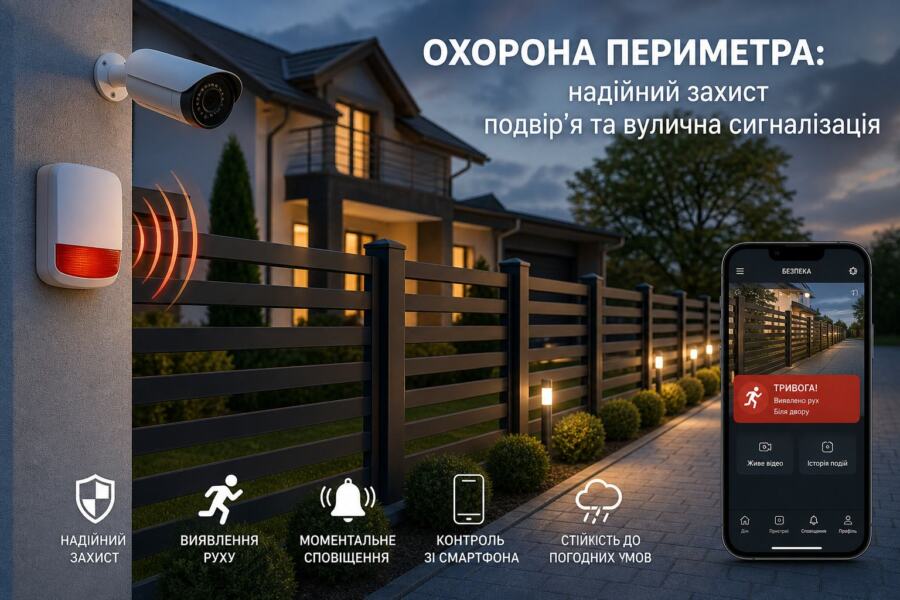
Perimeter security is a set of devices that control the external boundary of a property: fence, gate, entrance, paths around the house, back of the property, stairs, first floor balconies. The main idea is simple: instead of catching an intruder already inside the house, the system captures him as he approaches.
In the private sector, point protection is often underestimated. People put a camera on the facade, a few motion sensors inside and consider the object protected. But the camera is easy to bypass, and internal sensors are triggered only after penetration. If a well-thought-out street alarm system is in place, the scenario is different: an infrared barrier or other sensor detects the perimeter crossing, the light and siren turn on, a message is received, and the intruder most often abandons his intention.
Perimeter security is especially useful on large areas where there is a detached garage, gazebo, outbuildings, or areas that are not visible from windows. On such sites, it is physically impossible to keep everything in sight at all times. Then you need automatic border control, and not just hope for chance.
Properly constructed yard protection works in tandem with lighting, video surveillance, and backup power. In strong winds, snow, or when the power goes out, the system should not «go blind» or shut down. That is why the technical architecture is no less important than the brand of a single device.
Linear infrared sensors: how they work and where they are used
Linear infrared sensors are paired devices: a transmitter and a receiver form an invisible IR beam that passes between them. When a person, animal or object crosses this beam, the system detects a violation. This is one of the most accurate ways to control passage through a certain line, which is why such sensors are often used for perimeters.
Their advantage is that they do not react to "movement somewhere nearby", like a conventional volume sensor, but to the physical crossing of the controlled area. If the optics are set correctly, you can get very reliable control of passages, gates or narrow sections along the fence. For street signaling is one of the best options, especially when you need to minimize false alarms.
In practice, linear IR barriers are placed at a height that corresponds to the security scenario. For example, for a private yard, you can use one beam at knee level or several levels at once: the lower one - against crawling or penetration by animals, the middle one - against the passage of a person, the upper one — to increase reliability. For long passages and gates this is very effective.
But there is a caveat: linear infrared sensors require precise installation. Incorrect alignment, shaky supports, tree branches falling into the beam, or constant shaking of the structure due to the wind lead to false alarms. That is why installation «by eye» often ends in disappointment. For stable operation, a rigid base, protected cable routing, and verification of operation in various weather conditions are required.
| Solution type | What controls | Advantages | Limitation |
| Linear infrared sensors | Intersection of a ray on a specific line | High accuracy, low false alarms, good for walkways and gates | Requires precise alignment, sensitive to vibrations and obstructions in the beam area |
| Motion sensors for the street | Traffic in the viewing area | Easy installation, wider coverage | More false alarms due to animals, vegetation, weather |
| Cameras with analytics | Visual event detection | Event recording, control from a smartphone | Good light is needed, analytics are no substitute for a physical barrier |
In many projects, linear infrared sensors are used as the first line of defense, and cameras are used for visual confirmation. This is a very practical approach: the sensor triggers an event, the camera starts recording, and the spotlights provide a high-quality picture. This creates a complete perimeter security system, not just a set of separate gadgets.
What should be the street alarm for a private house?
Street signaling operates in much more difficult conditions than indoor ones: temperature changes, rain, snow, condensation, insects, birds, dust, direct sunlight, wind. Therefore, each element must have an appropriate degree of protection and be designed specifically for the external environment. For street equipment, the minimum desired level is IP65 or higher, and sometimes IP66, if the installation is open and without a canopy.
Another important aspect is power supply. A system without a backup is helpless during a power outage. In real life, it is at such moments that the risk of incidents often increases. Therefore, perimeter security should be powered by a power supply unit, and ideally - by a backup source, UPS or battery module. For the central unit, siren, communication and sensors, autonomy should be provided for at least several hours, and better - for a day, depending on the facility.
A typical kit for a private home includes a controller or security panel, street sensors, siren, flashing beacon, gate contacts, service door opening sensors, cameras, and backup power. It is not necessary to install everything at once, but the system should be designed with a margin for expansion.
In practice, it is convenient to start from critical points: the main entrance, the gate, the back of the yard, the area behind the garage. This is where "blind" spots most often appear. If you block them first, the effect of protecting the yard will be much higher than from a dozen sensors scattered without logic.
Common installation errors and how to avoid them
The most common mistake is to install sensors without analyzing the terrain. If the yard has a slope, ledges, arches, thick bushes or an uneven fence, the beam may be partially blocked by plants or objects. As a result, the system will either be silent or will start to sound an alarm for no reason. Before installation, you need to walk the route of a potential intruder and literally imagine where he can hide, jump over, climb or bypass the control zone.
The second mistake is over-reliance on one device. One camera or one the sensor does not provide reliable protection courtyard. External security should be multi-layered: an infrared barrier records the intersection, a camera confirms the event, a spotlight disorients, and a siren attracts attention. If one element fails, another will provide backup.
The third mistake is saving on cable and fastening. On the street, weak fastening quickly gives a backlash, and a bad cable degrades from the sun and moisture. For a stationary system, it is better to use a high-quality cable with appropriate insulation, sealed connections and protection against mechanical damage. In places where line damage is possible, it is advisable to lay the cable in a pipe or corrugation with a sufficient margin of safety.
The fourth mistake is ignoring animals. If a dog runs in the yard or cats come in at night, you need to immediately plan the sensor heights and trigger logic modes. In some cases, the lower level needs to be raised or combined with other types of sensors. Otherwise, the street alarm will become a source of constant noise, not protection.
The fifth mistake is the lack of regular inspection. Any perimeter security system requires maintenance: cleaning the optics, checking the mounts, testing the autonomous power supply, inspecting the siren, and monitoring the battery status. Even a very high-quality system can lose some of its functions after six months without inspection.
How to integrate perimeter security with lighting, cameras and power
The best result is not given by one device, but by a properly constructed scenario. When linear infrared sensors detect an intersection, not only does the siren sound. At the same time, a bright light is turned on, the camera enters recording mode, and the owner receives a push notification or call. It is this synchronization that turns a regular street alarm into a full-fledged security system.
Lighting is of great importance. A sharply turned on spotlight not only improves visibility for the camera, but also psychologically scares off the intruder. In most real-life situations, a person checking the security of the area does not expect an instant reaction. Therefore, well-adjusted light often works as the first factor in refusing to break in.
The power supply should be designed taking into account peak loads. For example, a siren may consume little, but the floodlight, communication module and camera at the moment of activation create a total load that the power supply must withstand. If a UPS or battery backup is used, it is necessary to check whether it is able to ensure the operation of at least key nodes during 12 V or 24 V, depending on the system.
Special attention should be paid to signal transmission. If the facility has weak mobile communication or unstable Internet, it is worth considering a backup channel or a local alarm scenario. For security, it is important that the system does not "go silent" due to external network problems. Reliability is always about redundancy.
Practical design tips for a house, cottage and ground floor apartment
For a private house, it is best to start by analyzing the route of entry. A criminal rarely climbs through the center of the yard. More often, he uses the shady side, a place behind the garage, a plot near the outbuilding or a narrow passage along the fence. These are the locations that should be controlled first. Perimeter security should block real access routes, not just «beautiful» vantage points.
For a summer cottage, it is important to take into account seasonality. In summer, greenery becomes an obstacle, and in winter, snow, snow-covered paths and icing. Therefore, sensors and cameras should be mounted so that they are not covered or covered by branches. If the object is not used constantly, autonomous power supply and remote control become critically important.
For an apartment on the ground floor or a private sector with low windows, an external one is also appropriate. protection. Here, street alarms work around the perimeter of a balcony, loggia, porch, or approaches to windows. But you shouldn't place sensors right where they will be constantly affected by traffic, trees, or random people. It's better to raise the sensors higher and build the protection logic taking into account real risks, not theoretical schemes.