
Useful tips
Buy a LiFePO4 battery: comparison with nickel-cadmium


If you are planning buy LiFePO4 battery, the first thing to understand: this is not just “another battery”, but a completely different approach to energy storage. In backup power, in solar systems, in boat motors, in camping and even in industrial installations, the choice between LiFePO4 і nickel-cadmium battery determines not only the working time, but also safety, resource, weight, cost of ownership and ease of use. From practice, I will say it directly: most people compare only the price on the label, and then wonder why one battery serves 3–5 years, and the other one is 10+ years and works more stably.
What types of batteries are most often compared with each other?
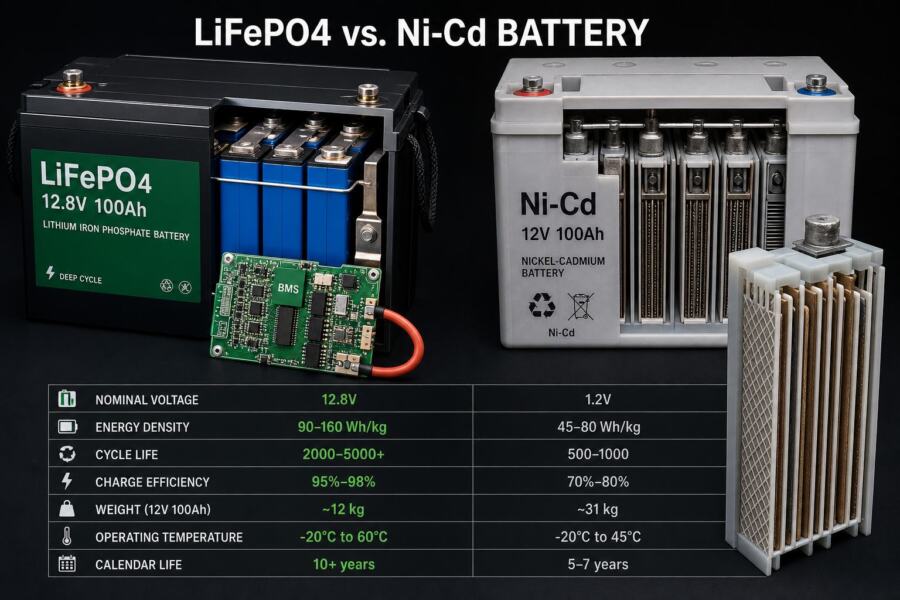
When it comes to battery types, in everyday life the following groups are most often found:
– Lead-acid — cheap, but heavy, with limited life and sensitivity to deep discharge.
– Li-ion — have high energy density, but require very careful control of charge and temperature.
– LiFePO4 is a type of lithium battery with increased thermal stability and long cyclic life.
– Nickel-cadmium battery — an older but still viable technology, especially in industrial and special applications.
Why am I for I am taking the comparison exactly. LiFePO4 і nickel-cadmium battery? Because these are two technologies that are often considered to work reliably in difficult conditions. But in real life they are very different in behavior, maintenance and final benefit.
How LiFePO4 works and how it differs from NiCd
LiFePO4: stability, resource and safe chemistry
LiFePO4 — is a lithium iron phosphate battery. Its main advantage is — stable crystal structure cathode. It is this that makes the battery more thermally stable than classic lithium-ion systems based on cobalt.
What this means in practice:
– operating voltage of one cell is about 3.2 V;
– full charge occurs before 3.55–3.65 V on the cell;
– the resource is often 2000–6000 cycles, and in good conditions even more;
– the battery tolerates deep discharges well, if any BMS;
– self-discharge is low, so the battery holds a reserve charge for a long time.
Nickel-cadmium battery: endurance, but with drawbacks
Nickel cadmium battery is built on a different chemistry. It is known for its high mechanical strength, ability to work in cold weather, and tolerance to rougher operating conditions.
Its strengths:
– withstands low temperatures better than many lithium solutions;
– can withstand high discharge currents;
– less critical to charging errors than some other chemistries.
But there are also significant disadvantages:
– memory effect;
– lower specific energy intensity;
– availability cadmium, which is toxic;
– higher self-discharge;
– worse economy in the long run.
Comparison of LiFePO4 and Nickel Cadmium Battery
Below is a practical table, without marketing or embellishments.
| Parameter | LiFePO4 | Nickel-cadmium battery |
|—|—:|—:|
| Rated voltage of the element | 3.2 V | 1.2 V |
| Working resource | 2000–6000+ cycles | 1000–2000 cycles |
| Specific energy intensity | High | Low |
| Weight at the same capacity | Smaller | Larger |
| Self-discharge | Low | High |
| Memory effect | Virtually absent | Є |
| Overheating safety | Higher | Good, but chemicals are toxic |
| Working in cold weather | Requires caution when charging below 0°C | Often tolerates cold better |
| Environmental friendliness | Better | Worse due to cadmium |
| Cost of ownership | Lower in the long run | Often higher due to resource and losses |
Where LiFePO4 wins hands down
If you want buy LiFePO4 battery for a home, inverter or solar station, here's where it's really stronger than NiCd:
1. Less weight and dimensions
For the same usable energy, LiFePO4 is usually lighter. This is important for mobile systems, boats, motorhomes and portable stations.
2. More usable capacity
LiFePO4 can be discharged deeper without the harsh penalty of lead-acid systems. It also provides more predictable performance compared to NiCd.
3. No pronounced memory effect
You can partially charge and discharge the battery without significant loss of available capacity. This is convenient for cyclic operation.
4. Better economy in the long run
Yes, the starting price may be higher than some older solutions. But if you consider cost of one cycle, LiFePO4 almost always wins.
5. Stability in reserve
If the battery is “on standby”, LiFePO4 holds its charge better and loses less capacity over time.
Where a nickel-cadmium battery may still be appropriate
I won't say that nickel cadmium battery “dead.” He still has a niche.
Advantages of NiCd in real conditions
– well tolerated hard modes work;
– can be useful where cold resistance is required;
– sometimes convenient in old equipment, where the system is designed specifically for this chemistry;
– less sensitive to simple errors when compared to some lithium batteries without a normal controller.
But there is an important limit
If you collect new backup power system, buying NiCd is rarely the best solution. The reason is simple:
cadmium is toxic, the battery is heavier, the resource in practice is often worse in terms of the “price/useful energy” ratio, and the technology itself is morally obsolete for most household tasks.
What to look for if you want to buy a LiFePO4 battery
To avoid buying a “beautiful box” instead of a normal battery, check the following things:
1. Availability of a quality BMS
This is mandatory. BMS protects against overcharging, overdischarging, overcurrent and often overheating. Without it, LiFePO4 is no longer a normal system, but a risk.
2. Operating discharge current
Look not only at capacity in A·h, but also on the permissible current in amperes. For an inverter or motor, this is critical.
3. Charging temperature mode
Importantly: LiFePO4 cannot be charged at temperatures below 0°C without heating or special protection. It can discharge, but charging in the cold damages the cells.
4. Cell balancing
In multi-cell batteries, it is important to have a proper balancing system. Otherwise, one cell will “fail” before the others, and the entire unit will lose its life.
5. Real, not advertised capacity
Look carefully to see if the capacity is indicated. by 100% DoD, or is this a “marketing” figure? A bona fide manufacturer provides clear measurement conditions.
6. Warranty and origin of cells
If you decide buy LiFePO4 battery, take not only “by passport”, but also by the reputation of the assembler. Good cells and weak assembly are still a weak battery.
Practical tips for installation and operation
During installation, I always advise you to follow simple but important rules:
– put the battery in dry, ventilated place;
– protect it from direct sunlight and overheating;
– use cables of the correct cross-section to avoid voltage drops;
– be sure to put fuse near the positive terminal;
– do not mix old and new batteries in the same unit;
– do not charge LiFePO4 “like lead” without inverter or charger settings.
Common mistakes I see the most
– they buy a battery “by eye”, without calculating the load;
– inverter starting currents are not taken into account;
– ignore charging temperature;
– they take a cheap assembly without a proper one BMS;
– they hope that all batteries behave the same in reserve.
What is more profitable for the home, solar and backup power
For most everyday tasks, the answer is already obvious: LiFePO4. Especially if the system is used daily or often goes into a “charge-discharge” cycle. For solar power plants, boiler backup, lighting, routers, refrigerators and communications, this is now the most rational choice.
Nickel cadmium battery can only be considered where there is already a specific infrastructure for it or work is required in very strict conditions, and the owner consciously accepts environmental and operational shortcomings.
In short:
– for a new modern project — LiFePO4;
– for old special equipment or individual industrial tasks — sometimes NiCd;
– for home reserve — almost always LiFePO4.
Practical conclusion from Engineer Gennady
If you need a reliable, safe and long-lasting source of energy, I would recommend buy LiFePO4 battery and not skimp on the controller, BMS and proper installation. In real operation, it provides less hassle, better resource and higher predictability. Nickel-cadmium battery — this is a narrow technical niche, not a universal solution for the home. The main rule is simple: the battery should not be “cheap”, but correctly selected for your workload and operating mode.
Frequently Asked Questions (FAQ)
Can a nickel-cadmium battery be completely replaced with LiFePO4?
Yes, in most household and backup systems — Yes, but you need to check the voltage, currents and compatibility of the charger.
Is LiFePO4 afraid of deep discharge?
Smaller than many other types, but It is not worth regularly discharging “to zero”. The average mode works best with a normal capacity reserve.
Is it true that a nickel-cadmium battery is better for cold weather?
For charging and working in the cold it is indeed often more durable, but this does not make it better overall due to toxicity and lower efficiency.
What is the resource of LiFePO4 in real life?
With normal assembly and proper operation, often 2000–6000 cycles. In reserve, this can mean many years of operation without noticeable degradation.