
Useful tips
Pure sine or modified sine wave inverter: which is safer for equipment?


Pure sine wave inverter і modified sine wave — these are not just different technical terms, but two fundamentally different ways of powering household appliances from a battery, generator or system backup power. It is the shape of the output voltage that determines whether the boiler will operate without errors, whether the pump will not overheat, whether the transformer will not hum, and whether the life of the electronics will not decrease. For an ordinary person, the difference often seems insignificant, but in practice it determines the safety, stability, and durability of the equipment.
The most common question arises when choosing UPS for boiler, an inverter for an apartment, an autonomous power supply for a router, a refrigerator, a circulation pump or a computer. Some models are cheaper and produce modified sine wave, others are more expensive, but form pure sine. The difference between them is not only in price. In some cases, saving on the converter turns into noise, failures, overheating and even equipment failure.
What is a sine wave and why is it important?
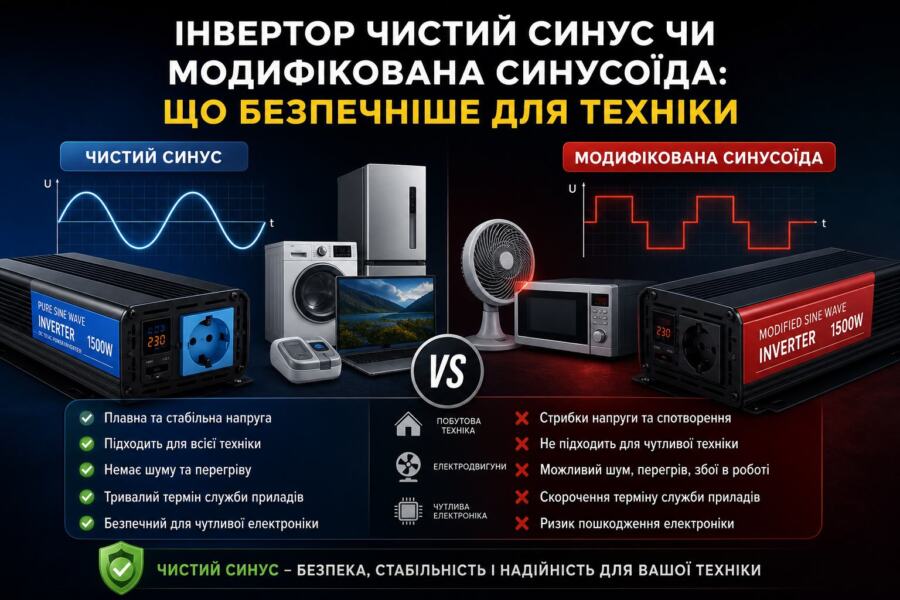
In a conventional electrical network, the voltage has the shape of a smooth wave — this is a sinusoid. Most household appliances, especially those with electric motors, transformers, pumps, power supplies, and sensitive electronics, are designed to handle this waveform. When a device receives the “correct” voltage, it operates more quietly, more stably, and with less heat.
Pure sine wave inverter creates a voltage as close as possible to the mains voltage. This means that a smooth wave is formed at the output, which is suitable for almost all equipment. Modified sine wave — is a simplified signal that resembles a stepped or rectangular shape. This option is cheaper to produce, but less compatible with many devices.
A simple analogy: a pure sine wave is a flat road, and a modified sine wave is a road with potholes and steps. The car will drive in both cases, but in one mode it will be comfortable and safe, and in the other - with additional load on the suspension and engine.
Pure sine inverter: when it is absolutely necessary
Pure sine wave inverter It is worth choosing when the equipment is sensitive to the voltage waveform or works with an inductive load. Such equipment includes:
- gas boilers with electronic control board;
- circulation pumps;
- refrigerators and freezers with compressors;
- medical equipment;
- televisions, monitors, servers, routers;
- audio systems and amplifiers;
- part of an electronically controlled power tool;
- some charging stations and controllers.
The issue is particularly critical for UPS for boiler. Most modern boilers contain electronics, sensors, fans, a pump or ignition system, and all of these components can malfunction from a simplified signal form. At best, the boiler simply will not start. At worst, it will regularly give errors, overheat, or reduce the life of the board.
Another important point is that some boiler manufacturers directly indicate in the instructions: for backup power, only pure sine wave inverter. If the documentation contains such a requirement, it is not worth saving.
Modified sine wave: where it is permissible and where it is undesirable
Modified sine wave — is a compromise option. Its main advantage is a lower price. Such inverters are often purchased for simple tasks where the waveform is not critical. For example, for incandescent lamps, some chargers, resistive loads or undemanding equipment.
But there is an important caveat: the fact that the device “started up” does not mean that it is working normally. Increased noise, heating, vibrations, reduced efficiency and reduced resource may not appear immediately. This especially applies to:
- pumps;
- boilers;
- refrigerators;
- devices with transformers;
- laser printers;
- some power supplies and chargers.
In everyday life, people often see only one result: “it works or it doesn’t work.” In reality, something else is more important — how exactly does it work. If the equipment heats up more, buzzes, gives errors, or “twitches,” this is a signal that the voltage form is not suitable for it.
Comparison: pure sine or modified sine wave
| Parameter | Pure sine wave inverter | Modified sine wave |
|---|---|---|
| Voltage form | Smooth, close to the network | Stepped, simplified |
| Compatibility with technology | Almost universal | Not suitable for all devices |
| Operation of boilers and pumps | Recommended | Often undesirable or risky |
| Noise and heat | Minimum deviations | Possible hum, vibrations, overheating |
| Price | Higher | Lower |
| Recommendation for backup power | Yes, especially for sensitive equipment | Only for simple loads |
Why a modified sine wave can be dangerous for technology
Danger does not always mean an immediate failure. More often, the problem accumulates gradually. When an electric motor or transformer is supplied with modified sine wave, energy losses increase, heating increases and the operation of magnetic elements deteriorates. For electronics, this means additional ripple, startup errors and power instability.
Typical consequences:
- hum transformer or pump;
- boiler failure during startup;
- increased heating of the power supply;
- display errors;
- inverter protection tripping;
- reduction in compressor or fan life.
There is also a less obvious problem: some modified sine wave chargers can charge more slowly or be unstable. As a result, there is a backup power, but it is less useful than expected.
UPS for the boiler: why you can't go wrong here
When to choose UPS for boiler, the main mistake is to look only at the power and autonomy time. This is important, but no less critical is the form of the output voltage. For most modern boilers, it is necessary pure sine wave inverter or a UPS with a correct sine wave at the output.
A boiler is not just a “heater.” It simultaneously works with:
- electronic board;
- circulation pump;
- fan;
- ignition system;
- security sensors;
- flame controls.
If even one of these nodes receives poor-quality power, the system can crash. Sometimes the problem manifests itself a few minutes after switching to autonomous power, and sometimes only in frost, when the load is maximum.
Practical example: the owner installed an inexpensive UPS with modified sine wave for a gas boiler. During the day everything looked fine, but at night the boiler started restarting, the pump was buzzing, and a power error appeared on the display. After replacing with pure sine wave inverter The problem disappeared. That is, there was no breakdown - but there was unstable power supply, which could have caused the board to fail.
How to choose the right inverter for backup power
When choosing equipment for backup power It is important to look not only at the price, but also at the real performance parameters. Here are some things to consider:
- Output voltage shape — for boilers, pumps and sensitive equipment, only pure sine is desirable.
- Capacity — should be with a margin, not “close”.
- Starting power — especially important for engines and compressors.
- Battery system voltage — usually 12 V, 24 V or 48 V.
- Switching time — critical for some boilers and electronics.
- Availability of protections — from overload, short circuit, overheating.
- Charger quality — important for battery life.
For a small boiler, a router and a few LED lamps are often enough for a compact system on 12 V or 24 V. If the system has a pump, refrigerator, or greater autonomy, it is better to consider a more serious configuration with a reserve of current and operating time.
Common mistakes when choosing an inverter and UPS
In practice, most problems arise not from poor equipment, but from improper selection. The most common mistakes are as follows:
- Buying “by the yard” without taking into account the shape of the sinus. There is power, but the boiler is not working.
- Out of stock. If the equipment consumes 200–250 W, you should not buy a device “for exactly 250 W”.
- Ignoring inrush currents. Pumps and compressors start with a short but high load pulse.
- Incorrect battery connection. They confuse the polarity, put in thin wires, save on terminals.
- Using a car battery without understanding the operating mode. Starter batteries do not like deep discharge.
- Ignoring ventilation. The inverter heats up under load and needs cooling.
Another common mistake is using cheap extension cords, adapters, and weak contacts. When the system is running on battery power, any poor contact translates into losses, heat, and voltage drops. And for boiler or pump This is already a risk of unstable work.
How to understand that a modified sine wave is not suitable for the technique
There are several characteristic signs that indicate incompatibility:
- instrument buzzing stronger than from the network;
- appears overheating case or power supply;
- the boiler starts every other time or gives an error;
- the pump operates unevenly;
- the monitor or router reboots;
- The charger becomes abnormally hot.
If at least one of these signs is present, you should not “suffer”. It is better to immediately proceed to pure sine wave inverter, than to repair the equipment later. This is especially true when it comes to heating, refrigeration equipment and devices that must operate 24/7.
Practical tips on electrical safety
System backup power should be not only comfortable, but also safe. There are a few rules that you should always follow:
- Do not connect the inverter “on the knee” through random wires and twists.
- Use cables of appropriate cross-section., especially at currents of tens of amperes.
- Put a fuse near the battery.
- Absolutely avoid using a plug-to-plug cable.«. Trying to supply voltage to the house by plugging the inverter into a regular outlet with a double-ended cable with plugs at the ends ("dad-dad") is deadly dangerous. If you accidentally forget to turn off the input circuit breaker and city voltage appears in the network, a reverse short circuit will occur. The inverter will instantly explode or burn, causing a fire. In addition, if such a plug is accidentally pulled out of the outlet while the system is operating, its open contacts will have a voltage of 230 V.
- Set the standby input switch. To safely switch a house or apartment to autonomous power, use only a special three-position switch (I-0-II) in the electrical panel. It provides physical separation of lines and prevents simultaneous connection to the central network and to the inverter.
- Ensure proper grounding and neutral configuration. Housing inverter must be connected to the grounding circuit. Many modern gas boilers are phase-dependent and do not work without a clear zero (which is not present in the isolated network of most household inverters). For their correct operation and the correct functioning of the protective automation (PRD), the system must be configured by a specialist who organizes the correct "through" or artificial zero scheme in accordance with the manufacturer's instructions.
- Consider fault currents and selectivity of automation. The short-circuit current from an inverter (e.g. 3–5 kW or even 8–10 kW) is much lower than from the city grid. A conventional circuit breaker with a common characteristic C (for example, C16) during operation from the reserve may simply not work instantly. Instead of cutting off the line, the cable will start to melt or the inverter itself will overload. For lines powered by a reserve source, it is recommended to install circuit breakers of the type B, which are much more sensitive.
- Maintain the temperature range for batteries. Do not block the ventilation holes of the equipment - a lot of heat is generated under load and during charging. If you use modern lithium batteries (LiFePO4 or Li-ion), remember: it is strictly forbidden to charge them at temperatures below 0°C. This leads to irreversible destruction of the cells and the risk of their spontaneous combustion. The equipment should not be placed on a freezing balcony or in a damp, unheated basement.
- Make clear markings and ensure access to the shield. All circuit breakers and switches responsible for backup power must be signed. Every adult family member should know where the main switch is located so that in the event of an emergency (smell of burning plastic, sparking) they can immediately de-energize the system. Finding the right switch in the dark should not turn into a dangerous quest.
To save or not?
Backup power is not a temporary compromise, but a complete engineering system for your home, on which the safety of property and life depends. Buying an inverter with modified sine wave justified only in one case - if the system is built exclusively for lighting with LED lamps, powering simple heating elements (electric plates, heaters without microcircuits) or charging gadgets via factory power supplies. If the plans include ensuring autonomous operation gas boiler, refrigerator, computer equipment or pumps, the only correct and safe solution is pure sine wave inverter. Such an investment fully pays off with stable operation of the devices, the absence of emergency errors, and the preservation of expensive home equipment.