
Useful tips
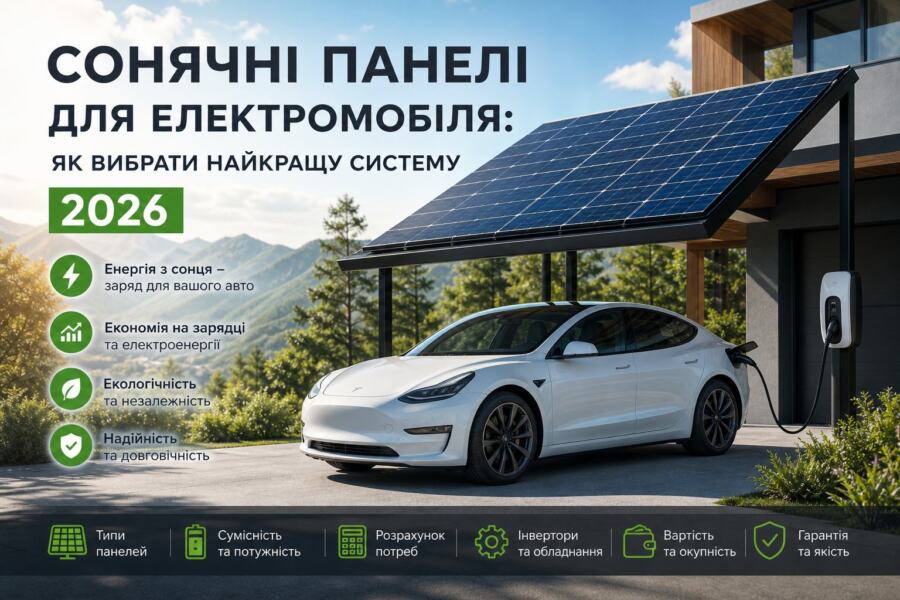
Solar Panels for an Electric Car: How to Choose the Best System 2026


Solar panels for electric cars in 2026 are no longer an experiment, but a practical solution to reduce charging costs. The increase in panel efficiency, the emergence of compact inverters and home storage have made EV charging from the sun more affordable for private homes and businesses. But the choice of system depends not only on the power of the panels, but also on the charging method, the schedule of car use and the available space on the roof or plot.
For the system to work effectively, it is important to immediately determine the goal: to partially cover daily consumption, charge the car every day, or create an autonomous scheme with a battery. For some, the optimal homemade electric car charging with mains and solar nutrition, for others - complete solar station for Tesla or other EV with priority on self-generation.
What are the systems for charging an electric car from the sun?
Before buying, you need to understand that solar panels alone will not charge a car without a controller, inverter, and charging station. It is the combination of these elements that determines whether the system will be convenient, safe, and cost-effective. In 2026, three approaches are most often used.
- Mains-powered system without battery — the sun covers part of the consumption during the day, and the excess goes to the network or is used by the house.
- Hybrid system with battery — allows you to store energy and charge EVs at a convenient time, even after sunset.
- Standalone system - suitable for facilities without a stable network, but requires greater investment and accurate load calculation.
For most car owners hybrid works best option: during the day the system powers the house and the charging station, and in the evening it uses the stored energy. This is especially important if the electric car is parked at home at night, and home electric car charging must be performed without overloading the network.
How to choose the power of a solar station for an electric vehicle
The system capacity should be calculated based on the actual mileage, energy consumption of the car and charging mode. The average electric car consumes approximately 15–20 kWh per 100 km, but the exact value depends on the model, driving style and season. If a car drives 1,000 km per month, it needs approximately 150–200 kWh of electricity.
For this amount of consumption, a small 3–5 kW system may not be enough if you also need to cover household needs. It is often advisable to plan a system of 5 to 10 kW for a private house, and even more for an active EV user, especially if it is a question of solar panels for electric cars with daily charging and operation of household appliances.
- 3–5 kW — basic coverage for low mileage or partial refueling of the car.
- 5–10 kW — the most practical format for most private homes with EVs.
- 10+ kW — for high consumption, two cars or high autonomy.
What to look for in technical specifications
In 2026, the choice should not be limited to just the watts of the panel. Efficiency, inverter type, compatibility with the charging station and the ability to manage the load are also important. If the system is not selected correctly, some energy will be lost and charging will be unstable.
| Component | What to check | Why is this important? |
|---|---|---|
| Solar panels | Power, efficiency, temperature coefficient, warranty | Determine the amount of generation and stability of operation in hot weather |
| Inverter | Type: networked, hybrid, autonomous; maximum power | Converts energy and ensures compatibility with EV charging |
| Battery | Capacity, cycle life, depth of discharge | Allows you to charge your car at night and smooth out peak consumption |
| Charging station | Power, control mode, intelligent load balancing | Guarantees safe EV charging from the sun |
| Mounting system | Roof type, pitch angle, wind and snow resistance | Affects durability and real generation efficiency |
Advantages and limitations of charging an electric car from the sun
The main advantage is obvious - reduced electricity costs. However, the savings do not appear immediately: first you need to invest correctly in equipment and installation. If you choose the system correctly, it will work for 20+ years and gradually compensate for the initial costs.
There are also limitations. In winter, generation drops, especially in regions with short daylight hours, so full autonomy without a network is often unprofitable. That is why for most users the best option is a hybrid system, which combines solar energy, the grid and storage.
- Savings on charging — especially during daily mileage.
- Less dependence on tariffs — some of the energy is produced by ourselves.
- Increasing energy independence — useful during outages or peak loads.
- A more difficult start — calculation, installation, and compatible equipment are required.
Solar station for Tesla and other electric cars: is there a difference?
From a technical point of view, a solar station for Tesla is not fundamentally different from a system for other electric vehicles. What is important is not the brand of the car, but the parameters of the on-board charger, the permissible AC charging power and the usage scenario. If Tesla is charged at home at night, either sufficient grid power or a battery that has accumulated daytime generation is required.
For other EVs, the logic is the same: first, the daily consumption is determined, then the generation volume, and then the inverter and charging station are selected. The versatility of the solution is one of the reasons why solar panels for electric cars are becoming popular among owners of various brands.
Practical scheme for choosing a system in 2026
To avoid overpaying, you should follow a clear algorithm. First, estimate your annual and monthly mileage, then the available area for the panels and the possibility of installing a battery. After that, you can choose a configuration for a specific charging mode.
- Step 1: Determine the average mileage and daily consumption of the car.
- Step 2: Check how much solar energy can actually be collected on your site.
- Step 3: decide whether you need autonomy or whether a networked hybrid mode is enough.
- Step 4: choose a charging station with power control and load balancing.
- Step 5: build capacity reserves for seasonal losses and future system expansion.
Which system to choose for a private house?
For most households, the most rational is a hybrid kit: solar modules, a hybrid inverter, a medium-capacity battery and a smart charging station. This configuration allows you to charge the car during the day from direct generation or in the evening from the battery, without overloading the network. If the car is used irregularly, you can limit yourself to a network station without a battery.
The key principle is simple: home electric car charging It should be integrated into the home's energy system, not run separately. That's when solar electricity really starts to save money and increase comfort.
Frequently Asked Questions (FAQ)
Is it possible to fully charge an electric car using solar panels alone?
Yes, but this requires sufficient installed capacity, a hybrid or stand-alone inverter, and preferably a battery. This is much easier in the summer than in the winter when generation is lower.
How many kW solar panels are needed for daily charging EV?
For average mileage, a 5 to 10 kW station is often required, but the exact calculation depends on the car model, region, seasonality, and whether you also need to power your home.
Which is better: EV charging from the sun without a battery or with a battery?
Without a battery, the system is cheaper, but the energy is used mostly during the day. With a battery, it is more expensive, but you get greater flexibility, the ability to charge overnight, and better protection against peak tariffs.