
Useful tips
Portable solar station 2026: how to choose for tourism and camping


Portable solar station 2026: how to choose for tourism and camping
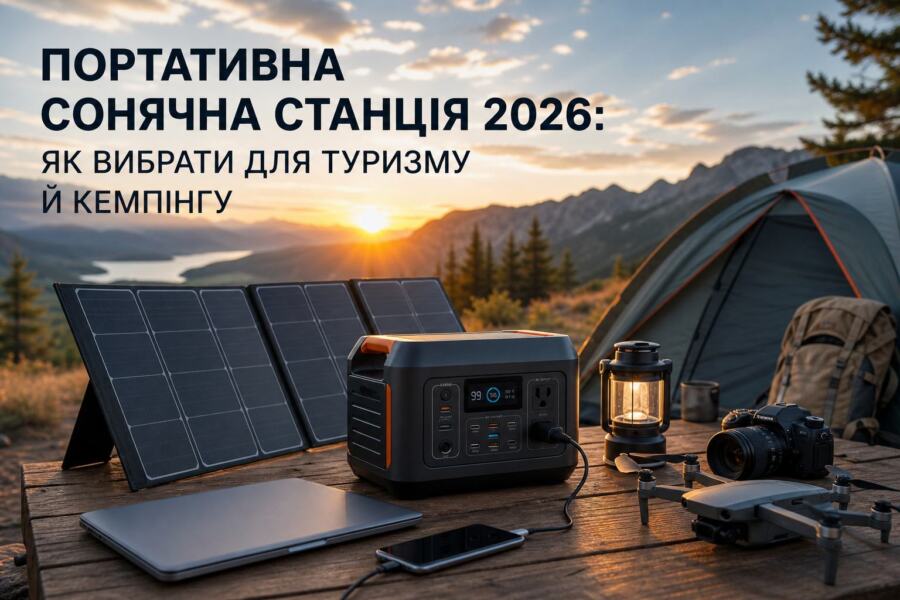
Portable solar station in 2026, it is not just a backup power source, but a practical tool for autonomous travel, camping, fishing and nature trips. It allows you to charge smartphones, flashlights, photo and video equipment, laptops, and in some cases - to power a mini-fridge, pump or small heater.
That solar station for tourism was really useful, it should be selected not based on advertising, but on real needs. Important not only battery capacity, but also the inverter power, charging speed, weight, battery type and compatibility with solar panels.
What is a portable power plant and who needs it?
Portable power plant is a compact power unit with a built-in battery, inverter, charge controller, and a set of outputs: USB, USB-C, DC, 220 V. Unlike a classic power bank, it is capable of powering not only gadgets, but also more energy-intensive devices.
For tourism and camping, such a station is especially useful if you:
- you are traveling by car, van or camper;
- you are staying in a tent without access to electricity;
- you work remotely and need power for your laptop;
- you shoot content in the field or outdoors;
- want to have backup power in case of a power outage.
In 2026, demand is growing for hybrid models that can be charged from an outlet, a car, and a solar panel. This makes them convenient for long trips without being tied to infrastructure.
Key selection parameters for tourism and camping
The most common mistake is to buy a station «with a margin», focusing only on the number in watt-hours. For hiking and camping, a balance between capacity, weight and real autonomy is important. A model that is too powerful may be inconvenient to carry, and one that is too weak will not cover basic needs.
1. Battery capacity
Capacity determines how much energy the station can store. For short trips, 200–500 Wh is enough, for camping for 2–4 days it is better to consider 500–1000 Wh, and for long-term autonomous recreation - even more.
- 200–300 Wh — charging phones, action cameras, flashlights;
- 500–700 Wh — laptop, drone, lighting, router;
- 1000+ Wh — refrigerator, pump, several devices at the same time.
For most tourists, the average capacity is optimal: it is sufficient for everyday tasks and does not turn the equipment into a heavy load.
2. Inverter power
The inverter converts battery power into 220 V for household appliances. If you plan to connect only gadgets, 300–600 W is enough. For a coffee maker, electric stove, or compact refrigerator, models from 1000 W and above are required.
Pay attention to peak power, because some devices consume more power when started than when in operation. This is critical for motors, pumps, and compressor equipment.
3. Battery type
In 2026, lithium-ion and LiFePO4 batteries are most often used for travel solutions. The latter are more expensive, but have a better resource, higher safety, and more stable operation during cyclic charging.
| Battery type | Advantages | Disadvantages | Who is suitable for? |
|---|---|---|---|
| Lithium-ion | Lighter, often cheaper, compact | Shorter life, more sensitive to heat | Short trips, infrequent use |
| LiFePO4 | High resource, safer, stable | Higher price, sometimes heavier weight | Camping, regular trips, autonomous travel |
4. Weight and dimensions
If the station needs to be carried by hand, weight is critical. For hiking, it is better to choose compact models weighing up to 5–7 kg. For car camping, stations weighing 10–15 kg are more acceptable, if they provide significantly greater autonomy.
Before buying, you should honestly answer yourself: you will carry the station in a backpack or transport it in the trunk. These are two different choice scenarios.
5. Charging speed
A modern camping power station should charge not only from the mains, but also from the sun and the car. The higher the allowable input power, the faster you can replenish your energy supply. This is especially important in camping conditions, where access to a socket is limited.
Practical guidelines:
- from an outlet - for full charging overnight or a few hours;
- from the car - for recharging on the go;
- from solar panel - for autonomous work in the camp.
What solar panel is needed for the station?
That portable solar station worked effectively, you need to match it with a compatible panel by voltage, power and connector type. In real conditions, the nominal power of the panel almost always differs from the actual one due to cloudiness, tilt angle, temperature and season.
For tourism, the most convenient are folding panels that quickly deploy and take up minimal space. For camping in a single camp, you can choose stiffer panels with higher efficiency if there is a stable place for installation.
- 100–200 W — light tourist trips, charging a small station;
- 200–400 W — optimal for camping and long-term autonomous recreation;
- 400+ W — for large stations and energy-intensive scenarios.
It is important to consider that a solar panel rarely provides the rated power. Therefore, it is better to have a small reserve, especially if you plan to charge the station not only in perfect weather.
Which connectors and outputs matter?
For tourism, simply having a 220 V outlet is not enough. You need a practical set of outlets so that you don't have to lug around adapters and unnecessary chargers. The most convenient station is one that covers all the main connection scenarios.
Useful minimum:
- USB-A — for simple gadgets and cables;
- USB-C PD — for fast charging of smartphones, tablets, laptops;
- DC outputs — for flashlights, car refrigerators, routers;
- 220 V — for household appliances;
- car connector — for powering equipment in a camper or car.
USB-C PD in 2026 is practically mandatory: it provides fast charging without separate adapters and is convenient for modern electronics.
What else to pay attention to before buying
In addition to technical specifications, there are several practical aspects that directly affect the comfort of use. They are often ignored, although they are precisely what determines the comfort of real-world trips.
- Noise level — especially if the station has active cooling.
- Case quality — impact resistance and protection against moisture are important for outdoor activities.
- Display availability — helps monitor charge, consumption and remaining operating time.
- Ability to work while charging — useful for continuous power supply.
- Service and warranty — important for expensive models with LiFePO4.
If you plan to use the station on a wet morning, near water, or in dust, pay attention to the protection of the case and the quality of the connections. This is not a secondary detail, but a factor in durability.
Comparison of typical usage scenarios
Below is a simplified comparison to help you quickly understand which solar station for tourism will suit you.
| Scenario | Recommended capacity | Optimal power | Comment |
|---|---|---|---|
| Short hike | 200–300 Wh | 300–500 W | Lightweight, compact, for gadgets and flashlights |
| Weekend camping | 500–700 Wh | 600–1000 W | Suitable for laptop, lighting, drone |
| Self-contained camp for a few days | 1000+ Wh | 1000–2000 W | Can power a refrigerator and several devices |
Practical tips for choosing in 2026
The market is becoming more technological, but the basic principles remain simple: buy a station for a specific task, not «for all occasions.» For tourism, compactness and fast charging are important, for camping, energy reserve and compatibility with a solar panel are important.
Make a list of your devices and calculate your approximate daily consumption. This will help you avoid overpaying for excess power and running out of power at your campsite.
Before buying, check:
- actual capacity and battery type;
- maximum and peak power of the inverter;
- input power for solar charging;
- number and types of outputs;
- weight, dimensions and ease of carrying;
- reviews about stability under load.
If you plan to use it regularly, it is better to immediately choose a model with a long-lasting LiFePO4 battery and a well-thought-out protection system. Such portable power plant lasts longer and more predictably under conditions of frequent charging cycles.
Frequently Asked Questions (FAQ)
Can I charge a portable solar station with just a solar panel?
Yes, you can, if the panel is compatible in voltage and power and there is enough sunlight. However, in cloudy weather, charging will be slower, so for reliability it is advisable to have additional charging from the mains or a car.
What capacity is best for a camping power station?
For most camping scenarios, a capacity of 500–700 Wh is optimal. If you plan to power a refrigerator or multiple devices at once, you should consider 1000 Wh or more.
Is a portable power station suitable for powering a laptop?
Yes, most modern models are great for laptops, especially if there is a USB-C PD output or a stable 220V inverter. Before buying, it is important to compare your laptop's power consumption with the station's parameters.