
Useful tips
Gasoline generator for home: how to choose the right power


Gasoline generator for home — this is not just a “backup power source”, but a technique that should meet the real needs of the home, and not be bought “with a margin of safety”. The most common mistake is to take a model based on the principle “the more power, the better”, and then get unnecessary fuel costs, noise and difficulties with connection. Correctly selected backup generator It works stably, does not overload and really saves during power outages.
To make a safe and practical choice, it is important to understand which devices need to operate simultaneously, which ones create starting loads, and why. 3 kW generator for one house it may be an ideal solution, but for another it may be insufficient. Particular attention should be paid to the heating supply, because boiler generator must provide not only power, but also stable voltage and correct waveform.
Where to start choosing power
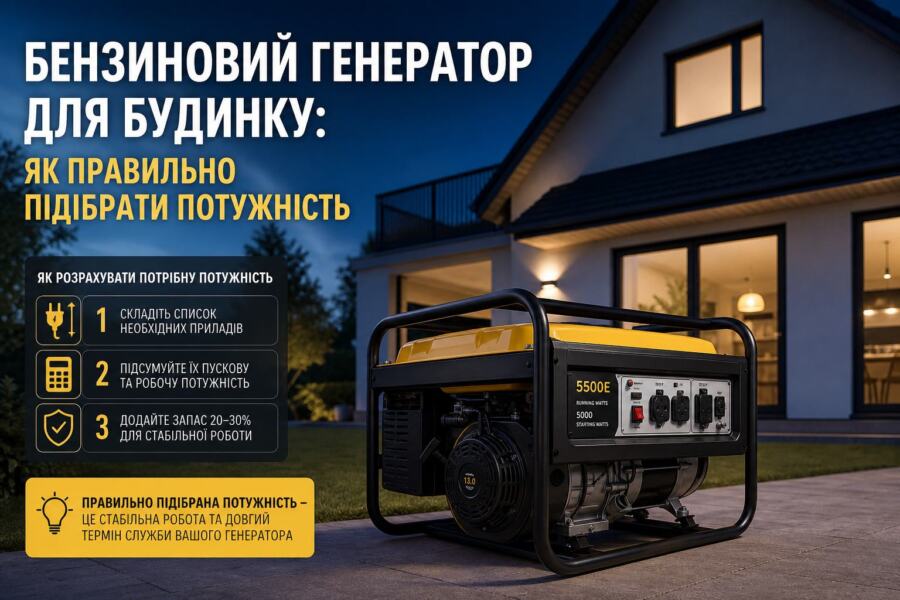
The selection does not start with the generator, but with the list of consumers. You need to understand what exactly you want to power during a power outage: just the lighting and boiler, or also a refrigerator, pump, router, TV, gadget charging and kitchen appliances. If you count “by eye”, it is easy to make a double mistake.
For practical calculations, three load groups are taken:
- Regular consumers — work for a long time: boiler, lighting, router, refrigerator.
- Short-term consumers — the following appliances turn on from time to time: pump, washing machine, microwave.
- Starting loads — at the moment of start-up, they consume more than in normal mode: refrigerator compressor, pumps, motors.
It is the starting currents that most often “knock down” the weak gasoline generator for home. For example, a refrigerator may have a working capacity of about 150–250 W, but for a short time during startup, it may require several times more. Therefore, the total power in the calculation must always be with a margin.
How to correctly calculate the required power
The algorithm is simple:
- Write down all the devices you plan to connect at the same time.
- Look at their passport power in watts.
- Add a margin for starting currents for motors and compressors.
- Lay more 20–30% reserve so that the generator does not work at the limit.
Example: You need to feed:
- gas boiler — 120 W;
- router — 15 W;
- light in several rooms - 100 W;
- refrigerator — 200 W of operating power, with a starting margin of up to 800–1000 W;
- pump — 400 W, but with a start-up of up to 1200 W.
In total, in working mode, this is about 835 W, but taking into account the starting torques, you no longer need a “small” generator, but a model at least 2.5–3 kW. Otherwise, when running simultaneously refrigerator and pump The voltage will drop, the automation may turn off the boiler, and the generator itself will start working at the limit.
When is a 3 kW generator enough?
Generator 3 kW — one of the most popular options for a private house, summer cottage, or small cottage. It is often chosen when you need to provide basic needs, rather than completely replace the city network.
This power is usually enough for:
- heating boiler;
- lighting in several rooms;
- router and chargers;
- refrigerator;
- sometimes a small pump or a television.
But it is important to understand the difference between working and maximum power. Cheap models can honestly have 3 kW only at peak, and in continuous mode - less. For a home, it is better to focus on the nominal power that the generator is able to produce for a long time without overheating.
If it is planned to power only critical consumers, backup generator 3 kW is often optimal in terms of price, fuel consumption and noise level. However, if you want to turn on an electric stove, a boiler or several powerful pumps, this may not be enough.
What to consider for a boiler generator
Generator for the boiler — a separate topic, because heating automation is often sensitive to the quality of the power supply. The problem is not only in power. Some boilers “do not like” generators with unstable voltage or a rough sinusoid shape.
What to pay attention to:
- Voltage stability — it is desirable that deviations are minimal.
- Pure sine wave — especially important for modern boiler electronics, circulation pumps and automation.
- Grounding — it must be organized correctly, otherwise there is a risk of work errors or danger to people.
- Compatibility with phase dependence — some boilers are sensitive to the correct connection of phase and neutral.
A typical situation: the generator seems to be working, but the boiler shows an error and does not start. The reason may be that the voltage “floats”, the frequency is unstable, or the electronics do not perceive the waveform. In such cases, not only replacing the generator helps, but also correct connection, and sometimes the use of additional stabilizing equipment.
Comparison of typical load scenarios
| Scenario | What feeds? | Recommended generator power | Comment |
|---|---|---|---|
| Minimum reserve | Boiler, router, LED lighting | 1.5–2 kW | Suitable for basic needs if there are no powerful engines |
| The most common option | Boiler, refrigerator, light, communication | 2.5–3 kW | Optimal for most private homes |
| Extended reserve | Boiler, pump, refrigerator, some sockets | 3.5–5 kW | A margin is required for starting currents and simultaneous operation of several devices |
| Increased workload | Lots of equipment, workshop, pump group | 6 kW and more | Better for larger homes or if more autonomy is needed |
What mistakes are most often made when choosing
Errors when purchasing gasoline generator for home are repeated very often. Some of them are not obvious, but they are the ones that later create problems in operation.
- Starting currents are not taken into account. — the generator is working, but when the pump or refrigerator starts, it goes into protection mode.
- Confusing maximum and rated power — the numbers look nice in the store, but in reality the generator is weaker.
- They take too little stock. — the equipment is working at its limit, the engine life is decreasing.
- Ignoring the boiler — then it turns out that the heating is not being started by the generator.
- Noise and fuel consumption are not taken into account — a powerful unit may be inconvenient for a constant backup.
- The house is connected incorrectly — without an input switch or ATS, it is dangerous for people and the network.
Another common mistake is to buy a generator with a reserve of 2-3 times more than you need. It would seem safe, but in practice such a choice leads to unnecessary costs for fuel, maintenance and storage space. The generator should not be “as big as possible”, but wisely chosen.
Gasoline generator or other backup power source
For short-term and periodic outages gasoline generator for home often more convenient than diesel: it's cheaper to start, easier to start, lighter and usually quieter. But petrol models aren't always the best for long hours of daily work.
Their strengths:
- quick start;
- relatively affordable price;
- compactness;
- convenience for backup use.
Weaknesses:
- higher fuel consumption compared to some other solutions;
- shorter service life with very intensive operation;
- the need for regular maintenance;
- sensitivity to fuel quality and storage.
If the outages are short, and you need it reserve generator for home, the gasoline option often looks the most rational. If long autonomous modes or frequent daily use are planned, it is worth separately evaluating diesel solutions or other energy supply systems.
What to look for in technical specifications
In addition to power, there are several other parameters that directly affect the operation of a generator in everyday life.
- Launch type — manual, electric start or automatic.
- Voltage stabilization system — the higher the quality, the better for sensitive equipment.
- Fuel tank capacity — affects the duration of battery life.
- Noise level — especially important for the private sector and night work.
- Weight and mobility — if the generator has to be moved.
- Availability of overload protection — a useful function that saves the engine and equipment.
You don't always need the most powerful model for your home. Sometimes it's more important that the generator is economical, maintains the voltage properly, and doesn't create problems for the boiler and electronics.
How to safely connect a generator to your home
Connection is no less important than the choice itself. It is dangerous to connect a generator to the home network “through the outlet” or using homemade cables. This can cause voltage to be fed back into the network, which is dangerous for electricians, neighbors, and your equipment.
For safe work use:
- toggle switch or input switch;
- ATS, if automatic backup startup is required;
- the correct cable of the appropriate cross-section;
- overload and short circuit protection.
If the generator is planned as a permanent backup generator, it is advisable to think over the connection scheme at the purchase stage. Otherwise, you can buy good equipment, but not get the expected result from it.
Practical scenarios for a private home
To understand how much power you need, it's helpful to look at typical scenarios.
Scenario 1: minimum reserve
The boiler, internet, a few lamps and phone charging are working. A compact solution is often enough here, and 3 kW generator there will even be a reserve.
Scenario 2: household comfort
A refrigerator, sometimes a pump, a TV, and small household appliances are added. In this case, it is better to focus on 3–4 kW or more, depending on the starting currents.
Scenario 3: Almost network-like autonomy
You need to power a large part of the house, including powerful appliances. This may require 5–7 kW and competent load distribution to avoid overloading (Incomplete: max_output_tokens)