
Useful tips
Buy a traction battery: the difference between a starter battery and a VBP


If you need buy traction battery, and not just "any 12 volt one", it is important to first understand, How is it different from starter and uninterruptible power supply batteries?. In practice, I have seen the same mistake more than once: people take a cheaper option, put it in an inverter, electric tractor, children's electric car or backup power system - and after a few months they get a capacity drop, overheating or a sharp decrease in resource. This is because different batteries are designed for different operating modes, and the physics inside them is not at all the same.
Why you can't put "any battery" on any task
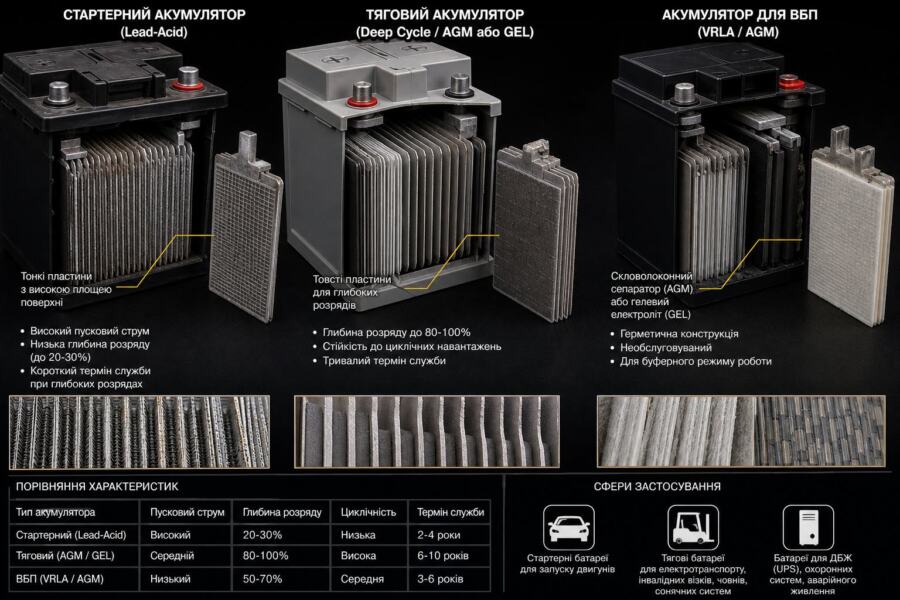
A battery is not just a «tank of electricity.» Its behavior is determined by plate thickness, active mass area, internal resistance, permissible depth of discharge і charging mode. It is these parameters that distinguish starter battery, deep cycle battery and batteries for uninterruptible power supplies.
Basic working principle
– Starter The battery is needed to to briefly deliver a large current: start the engine.
– Traction the battery must to give off current for a long time and withstand regular discharge/charge cycles.
– UPS/UPS battery works in mode constant recharge and rare, but sometimes quite deep discharges.
Relatively speaking, a starter is a sprinter, a traction battery is a marathon runner, and a battery for an uninterruptible power supply is a duty battery that is on duty most of the time and only occasionally switches to operating mode.
Starter battery difference: what's inside and how it affects the resource
Plate design
In a starter battery, the plates are thinner and their area is designed for high starting current. This allows you to give, for example, 400–800 A in a few seconds. But a thin plate is less able to withstand frequent deep discharges. If such a battery is regularly placed below 50% capacity, it quickly sulfates and loses its resource.
У traction battery the plates are thicker, the active mass is stronger, the design is more durable deep discharge and repeated cycles. That is why it is more expensive, but it lasts much longer in cyclic mode.
What does this mean in practice?
Starter battery difference manifests itself not only in the starting current, but also in the number of cycles:
– starter battery: often 100–300 cycles with shallow discharge;
– traction battery: 500–1500 cycles and more, depending on the technology;
– battery for UPS: usually 300–700 cycles, but only in the correct support mode.
Buying a traction battery: when is it really the right decision?
It is worth buying a traction battery when your equipment or power system daily or regularly drains the battery significantly, and not just for a few seconds. This is typical for:
1. Electric transport — carts, golf carts, electric scooters, children's electric cars.
2. Solar systems - autonomous power supply with inverter.
3. Backup power with long outages where the battery lasts for hours.
4. Mobile systems — boats, camping, portable power units.
Signs that you need a traction battery
– Planned deep discharge lower 50%.
– The battery will work daily.
– Important resource in cycles, not just the starting current.
– Loading is in progress long, and not a short pulse.
If the battery is only needed to start the car, a traction battery will be unnecessary and will not provide any practical benefit. On the contrary, it may be heavier and more expensive without any benefit.
Batteries for UPS: how do they differ from traction batteries?
Majority batteries for UPS — this VRLA AGM or GEL batteries that are designed for the mode standby: they are constantly charged and waiting for an emergency power outage. They have a different optimization than traction models.
The main difference in operating mode
– UPS battery loves constant recharge and rare shorter discharges.
– Traction battery carries more frequent and deeper cycles.
– Starter The battery generally does not like deep discharges.
If you put a regular UPS battery in a system where it discharges every day to 30–40%, the resource will decrease. If you put the starter in an uninterruptible power supply, it also will not last long due to constant cycles.
Comparison table: starter, traction and uninterruptible power supplies
| Parameter | Starter battery | Traction battery | UPS battery |
|—|—:|—:|—:|
| Primary purpose | Engine starting | Long-term energy output | Backup power |
| Recoil current | Very high short-term | Moderate, long-term | Moderate |
| Depth of discharge | Preferably up to 20–30% | Maybe 50–80% | Usually 20–50% |
| Number of cycles | Small at deep discharges | High | Average |
| Plate thickness | Thin | Thick | Medium |
| Resource in cyclic mode | Low | Best | Good in standby mode |
| Weight | Relatively less | Often bigger | Average |
| Price | Lower | Higher | Average |
How to choose a deep cycle battery without making a mistake
1. Look beyond the Ah, but also on the mode of use
Capacity in 100Ah does not guarantee anything in itself. It is important, exactly how the battery will give this energy. For an inverter, solar station or load for several hours, it is necessary deep cycle battery, not just a big starter unit.
2. Check the allowable depth of discharge
If the manufacturer allows the use of up to 80% capacity is a good sign for cyclic operation. If the battery is designed only for superficial cycles, the resource will quickly drop.
3. Specify charging voltages
For 12-volt For lead-acid batteries, typical guidelines are as follows:
– charging mode: 14.2–14.7 V;
– buffer mode: 13.5–13.8 V;
– you cannot keep the battery on overcharge for a long time beyond the recommended values.
Improper charging is a common cause of premature death of even a good battery.
4. Pay attention to the temperature
At low temperatures, the capacity drops. In extreme cold, the available energy can be reduced by 20–40% and more. Therefore, for a street, garage, or uninsulated room, it is important to consider not only the type of battery, but also the conditions of its placement.
5. Evaluate weight as an indirect technical parameter
For lead-acid models, more weight often means more active mass and better cyclic performance. A battery that is too light in the same capacity class should be a cause for concern.
When is a traction battery better and when is it not?
A traction battery is better if:
– needed regular work under load;
– there is deep discharges;
– important long life cycle;
– the system operates autonomously or in motion.
You shouldn't overpay for a tow truck if:
– only the engine needs to be started;
– the battery will be in reserve mode almost all the time;
– you are looking for a battery for short emergency outages in a UPS.
In this case, sometimes it makes more sense to take a quality battery for uninterruptible power supplies, than to drag a more expensive cyclical option into the system.
Typical errors in selection and operation
1. Confusing the starter and traction battery
This is the most common mistake. The starter cannot withstand systematic deep discharge.
2. Put the UPS battery in a cyclic system
It will work, but the resource will quickly decrease.
3. Wrong charger selection
If the charging does not match the battery type, undercharging or overcharging occurs.
4. Discharge the battery to zero«
For lead-acid batteries, this is almost always harmful. Full deep discharge shortens life.
5. Capacity reserve is not taken into account
If the system consumes 600 W within 4 hours, you need to calculate not "by eye", but taking into account inverter losses, temperature and permissible depth of discharge.
Practical advice from Engineer Gennady
If you need a battery for autonomous operation, inverter, electric vehicles or frequent outages, don't chase cheapness - it's better to buy right away buy traction battery with a normal reserve for cycles. If the task is only a short reserve for lighting, a router or a boiler, then often a high-quality one is enough battery for UPS. And leave the starter for what it was created for: short powerful start, not a deep discharge.
Conclusion
The difference between these three types of batteries is simple: starter gives a large current for a short time, traction works for a long time and withstands deep cycles, and batteries for uninterruptible power supplies optimized for backup mode and constant recharging. If you make a mistake with the choice, you can lose not only money, but also reliability of the entire system. Therefore, before buying, always look not at the name on the case, but at the actual operating mode, permissible depth of discharge, charging parameters and number of cycles.
Frequently Asked Questions (FAQ)
Can a starter battery be used as a traction battery?
Only temporarily possible. For regular use deep discharge it doesn't fit and will quickly lose resource.
Is the UPS battery suitable for the inverter?
Yes, if the load is small or the operating mode is close to the reserve. But for frequent and deep cycles it is better to take deep cycle battery.
How long does a traction battery last?
Depending on technology and mode - approximately 500–1500 cycles and more. Everything is decided by the depth of discharge, charge and temperature.
What is more important when choosing: capacity or type?
First battery type, then capacity. If the type is selected incorrectly, even large Ah will not save the system.