
Useful tips
Swollen UPS battery: main causes and safe check


A swollen UPS battery is not just an unpleasant defect in the case, but a signal that dangerous processes have already started inside: gas formation, overheating, destruction of the plates or violation of the charging chemistry. In my practice, such cases most often end not with “it will work a little longer”, but with a sharp drop in capacity, electrolyte leakage or failure at the worst possible moment. Therefore, the main rule here is simple: do not try to “force” such a battery into operation, you first need to understand the cause and check it safely.
Why does the UPS battery swell?
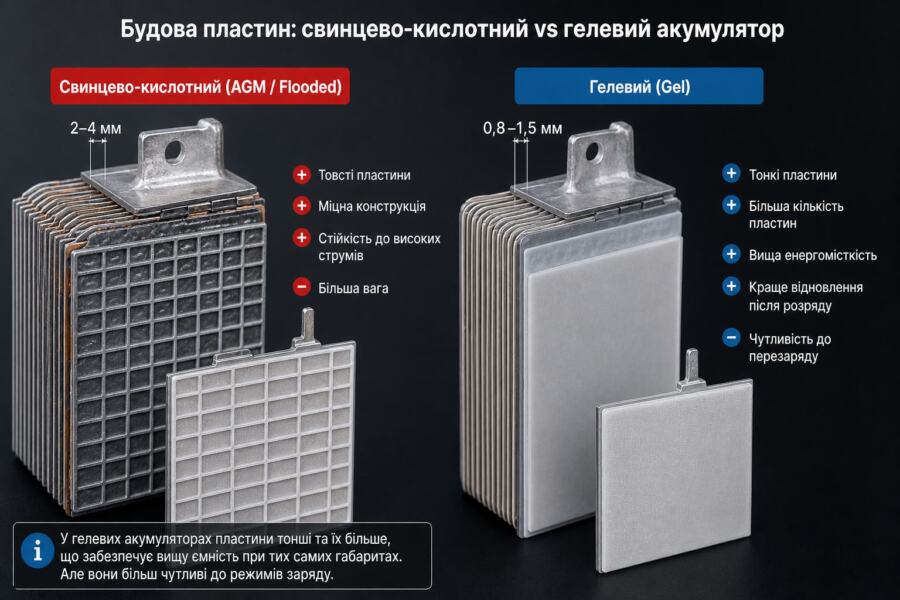
In most cases, swelling is not due to a single factor, but rather a combination of problems. For lead-acid batteries, in particular gel battery for inverter, temperature, charging voltage and operating mode are critical.
Overcharging and incorrect charger settings
The most common reason is overcharged charging voltage. When a UPS or inverter supplies more current to a battery than the rating allows, the electrolyte begins to decompose, releasing gas. In sealed batteries, the gas has nowhere to escape, so the internal pressure increases and the case swells.
For reference:
– for the majority 12 V GEL batteries, the absorption voltage should usually not exceed 14.1–14.2 V;
– for float-mode is often enough 13.5–13.8 V;
– alignment mode (equalization) for GEL, as a rule, prohibited.
If the inverter is configured “universally” for AGM, and gel battery installed, this is often the cause of bloating.
Overheating and poor ventilation
Charging and discharging are always accompanied by heating. If the battery is in a closed niche, near a radiator, in a cabinet without ventilation, or right next to an inverter, the temperature rises. And with temperature, both the speed of chemical reactions and the internal pressure increase.
Every +10 °C to operating temperature can significantly reduce the life of a lead-acid battery. That is, a battery that would normally last 4–5 years can lose capacity twice as fast in the heat and without ventilation.
Deep discharge and sulfation
Frequent discharges to zero are another reason battery malfunctions. After a deep discharge, lead sulfate crystals form on the plates. If the battery is not charged in time, this process becomes almost irreversible.
The consequences are as follows:
– internal resistance increases;
– the battery heats up during charging;
– the charging current is not converted into useful energy, but into heat and gas;
– the body gradually deforms.
Internal short circuit or factory defect
Sometimes swelling is caused by internal damage to one of the cells: shedding of the active mass, a short circuit between the plates, or a separator defect. In this case, the battery may look “still alive” from the outside, but it does not accept a charge normally, the voltage drops, and the case begins to swell after just a few cycles.
Frost and improper storage
If a discharged battery is left in the cold, the electrolyte can freeze. When it freezes, it expands, damaging the plates and the case. Then, when charging, such an element often behaves unstably: it heats up, gasses, and quickly fails.
How to safely check a blown battery
I'll start with the main thing: A swollen battery cannot be punctured, compressed, disassembled, or put to the test without protection.. There may be hydrogen, oxygen and acid residue inside. Even sealed batteries can release corrosive gases if damaged.
What to do right away
1. Disconnect the UPS or inverter from the mains.
2. Disconnect the load.
3. Put on gloves and safety glasses.
4. Provide airing rooms.
5. Do not place the battery near a heat source, sparks, or open flame.
6. Do not continue charging if the case is already noticeably deformed.
Verification procedure
I recommend this simple and safe algorithm:
1. Inspection of the hull. Check for swelling, cracks, leaks, traces of acid, corrosion on the terminals.
2. Temperature check. If the case is warm without load, this is a bad sign.
3. Scent. A strong sour or “chemical” smell indicates gassing or a leak.
4. Voltage measurement with a multimeter. The no-load voltage only gives part of the picture, but with serious subsidence The battery is already problematic.
5. Checking the inverter charging settings. Compare them with the battery data sheet.
6. If there is a professional tester, check internal resistance. A sharp increase in resistance often confirms hidden degradation.
Importantly: If the case is already swollen, do not perform a severe stress test. Such a battery may behave unpredictably.
Main signs and what they mean
| Symptom | What it could mean | Actions |
|—|—|—|
| Case is swollen | Gas formation, overcharging, overheating | Stop charging, replace the battery |
| Battery gets very hot | High internal resistance, internal defect | Disconnect, do not operate |
| Pungent “acid” odor | Leakage or gassing | Ventilate, wear protection, do not use |
| There is voltage, but the UPS turns off quickly | Loss of capacity, sulfation | Diagnostics and replacement required |
| Terminals oxidized, white coating | Poor contact or leakage | Clean, check the cause of the damage |
| Battery not charging | Plate degradation, internal fault | Replacement without delay |
Can I continue to use a swollen battery?
Short answer: No. Even if the battery still “holds” for a few minutes, this does not mean that it is safe. In sealed lead-acid batteries, swelling is already beyond the limits of normal operation.
What is dangerous about this:
– risk of depressurization;
– electrolyte leak;
– damage to the inverter or UPS;
– possibility of fire upon subsequent recharge;
– acid attack during an attempt to parse.
This is especially true in situations where 100ah battery as part of a home backup power system. Such a battery is capable of delivering significant current, so if there is an internal defect, the consequences can be very unpleasant: from burnt terminals to damaged equipment.
Gel battery for inverter: how to avoid swelling
Gel battery for inverter loves stability. It does not like high voltages, overcharging, or “squeezing” to zero. For long service, it is important to follow a few rules.
Practical settings and operating mode
| Parameter | Recommendation for most GEL | Comment |
|—|—:|—|
| Absorption voltage | 14.1–14.2 V | Check by passport |
| Float voltage | 13.5–13.8 V | For long downtime |
| Equalization | Do not use | This is often harmful for GEL |
| Operating temperature | 20–25°C | Overheating drastically reduces the resource |
| Depth of discharge | Desirable up to 50% | The deeper, the fewer cycles |
What else really prolongs the resource?
– Do not place the battery close to a wall or in a closed box without ventilation.
– Use cables of sufficient cross-section, so that there is no heating at the connections.
– Be sure to put fuse near the battery.
– Do not store the battery in a discharged state for a long time.
– Check every few months resting voltage and the condition of the terminals.
– If the backup system operates daily, plan routine replacement in advance, not after an accident.
Features of 100Ah battery in home system
The most common option for backup power is 100ah battery on 12 V. Formally it is close 1.2 kWh nominal energy, but in real use only a portion is available if you want to preserve battery life.
In practice this means:
– when discharged to 50% you will get approximately 0.6 kWh useful energy;
– if the load is high, the battery ages faster;
– if the charging current exceeds the recommended value, the case may heat up;
– in conjunction with the inverter, it is important that the charging voltage corresponds to the type of battery, and not “just 12 volts”.
For a home UPS, people often wonder: “The battery looks like it’s new, but it’s already swollen.” In practice, this almost always means that it or recharged, or overheated, or systematically discharged too deeply.
What to do after detecting a defect
If you see swelling, do this:
1. Stop use immediately.
2. Disconnect the battery from the system.
3. Check the inverter or UPS settings.
4. Determine the cause: charging voltage, temperature, depth of discharge, battery age.
5. Dispose of the old battery in recycling center or a service that accepts lead-acid batteries.
6. Before installing a new battery, eliminate the root cause, otherwise it will repeat the fate of the previous one.
Practical conclusion from Engineer Gennady
A swollen body is not a cosmetic issue, it is emergency symptom. In most cases, the reason is simple: improper charging, overheating or deep (Incomplete: max_output_tokens)