Useful tips
Why is the inverter noisy under load: solution

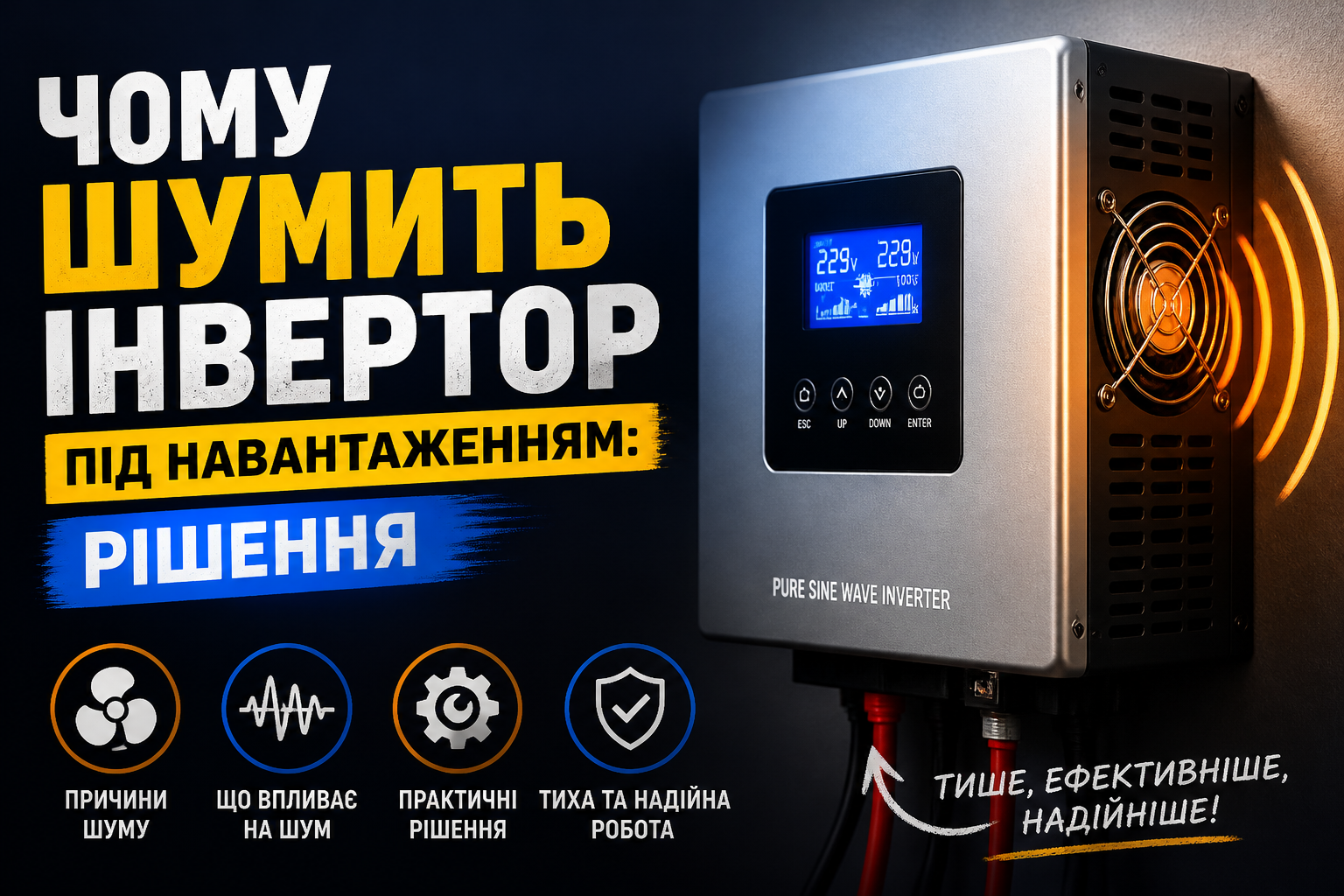
Why is the inverter noisy? under load is a question that often arises after connecting a powerful household appliance, pump or power tool. A moderate hum and fan sound are usually normal: as the current increases, the power components heat up, so the cooling system increases its speed. However, a crackling, whistling, strong vibration or a sudden change in tone may indicate an overload, power problems or a malfunction.
Why does the inverter make noise when the load increases?
The most common source of noise is the fan. In many models, it is triggered by temperature or power consumption. The higher the load, the more intensive the cooling. Dirty blades, worn bearings, or blocked ventilation holes make it noticeably louder.
The second possible factor is electromagnetic oscillations of the transformer, chokes and coils. Under high current, they can emit a low-frequency hum or a high-pitched squeak. A uniform, quiet sound is acceptable, but a pronounced rattling sometimes indicates a loose mount or a component casting defect.
Another reason is incorrect power selection. Refrigerators, pumps and compressors briefly consume several times more than their rated power when they start up. The inverter works at the limit, the fan accelerates sharply, and the power unit starts to hum.
| Sign | Probable cause | What to check |
|---|---|---|
| Uniform air noise | Fan operation | Temperature and free air flow |
| Buzzing only when starting the appliance | High starting current | Peak load power |
| Body rattle | Resonance or loose mounting | Mounting, screws, mounting surface |
| Whistle with error signal | Overload or low voltage | Batteries, cables and protection indicators |
Why is the inverter noisy due to the battery and wiring?
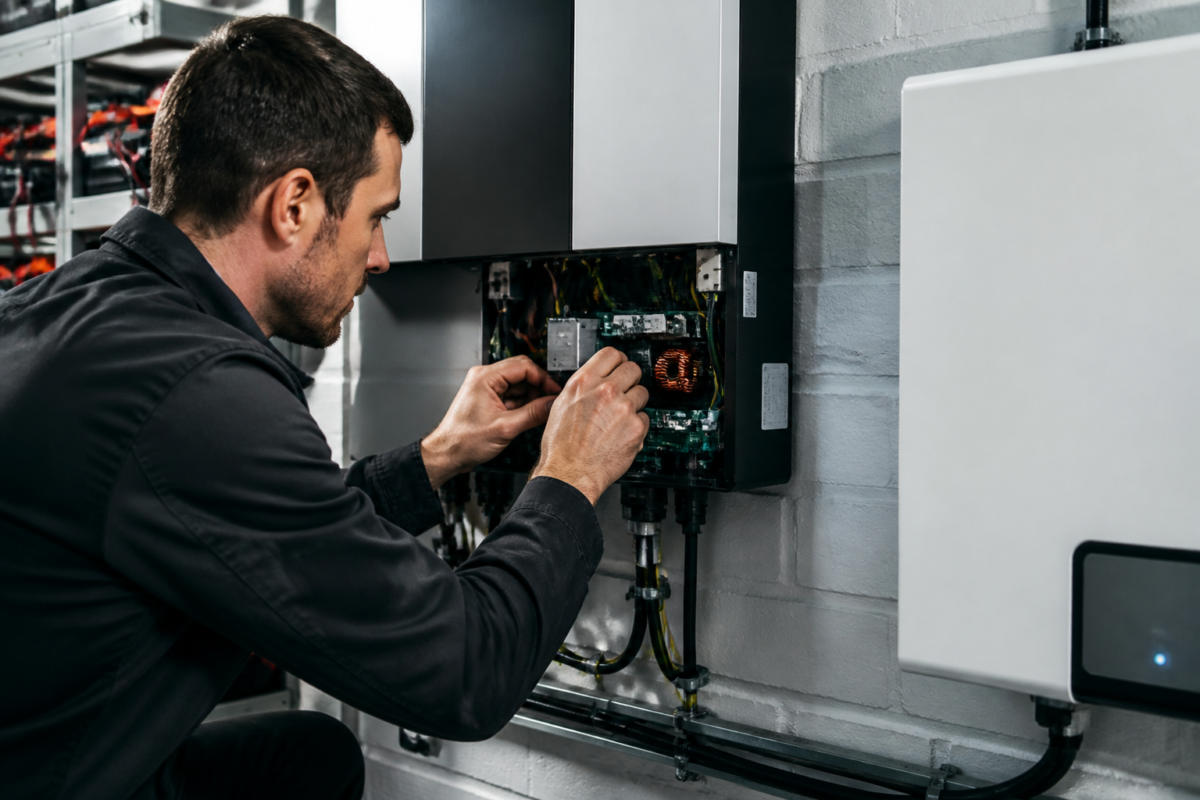
Input voltage sag causes the converter to draw more current to maintain output power. This increases heat and cooling noise. The cause may be discharged or worn battery, insufficient cable cross-section, wires that are too long or oxidized contacts.
The approximate input current can be estimated using the formula: I = P / (U × η), where P — load power, U — battery voltage, η — Inverter efficiency. For example, for a 1000 W load, 12 V system, and 90% efficiency, the current would be about 93 A. At this value, thin cables heat up quickly and create a significant voltage drop.
| Load | System | Estimated current at efficiency 90% |
|---|---|---|
| 500 W | 12 V | 46 A |
| 1000 W | 12 V | 93 A |
| 1000 W | 24 V | 46 A |
How to reduce noise without risking equipment
First of all, you should disconnect some of the consumers and check whether the sound changes. If the inverter becomes quieter, the load is approaching its operating limit. For stable operation, it is desirable to have a power reserve of at least 20–30%, and for motors, take into account the starting current separately.
The device must be installed on a solid, non-flammable surface, leaving ventilation gaps according to the instructions. It is impossible to close the grilles or mount the inverter in a sealed cabinet. Dust is removed only after complete de-energizing, without disassembling the power unit, unless this is provided by the manufacturer.
Dangerous signs include the smell of overheated insulation, sparking, chaotic cracking, an excessively hot case, and regular emergency shutdowns. In such cases, the equipment should be immediately disconnected from the load and power source, and the diagnostics should be entrusted to a specialist.
Practical advice: Record the sound on your phone along with the input voltage and load power. This will help distinguish between normal fan operation and a malfunction and simplify service diagnostics.