
Useful tips
Parallel connection of batteries of different capacities: rules

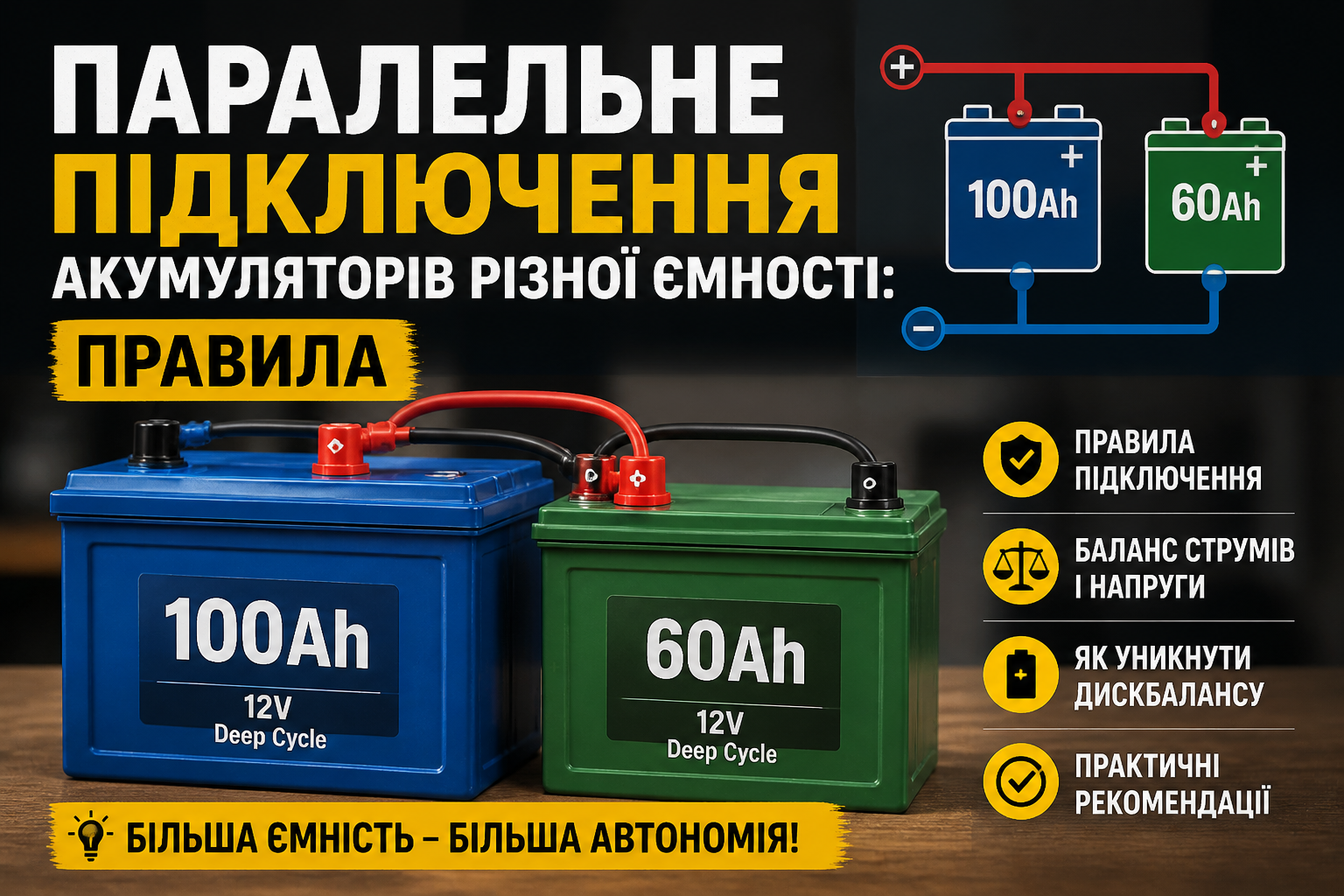
Parallel connection of batteries allows you to increase the total capacity of the battery pack without changing its nominal voltage. It is permissible to combine sources of different capacities, but only if they have the same chemistry, similar technical condition, and proper preparation. Otherwise, equalizing currents, uneven loading, and accelerated aging occur between the batteries.
How parallel connection of batteries works
In a parallel circuit, the positive terminals of the batteries are connected together, as are the negative terminals. The voltage of the block remains at the level of a single battery, and the nominal capacities are added. For example, 12 V batteries of 60 Ah and 100 Ah form a 12 V block with a theoretical capacity of 160 Ah.
| Parameter | Battery 1 | Battery 2 | General block |
|---|---|---|---|
| Rated voltage | 12 V | 12 V | 12 V |
| Capacity | 60 Ah | 100 Ah | 160 Ah |
| Nominal energy reserve | 720 Wh | 1200 Wh | 1920 Wh |
Current distribution depends not only on capacity. Internal resistance, temperature, length and cross-section of cables, condition of contacts and charge level are also factors. A battery with lower internal resistance can receive or deliver disproportionately high current.
Rules for safe parallel connection of batteries
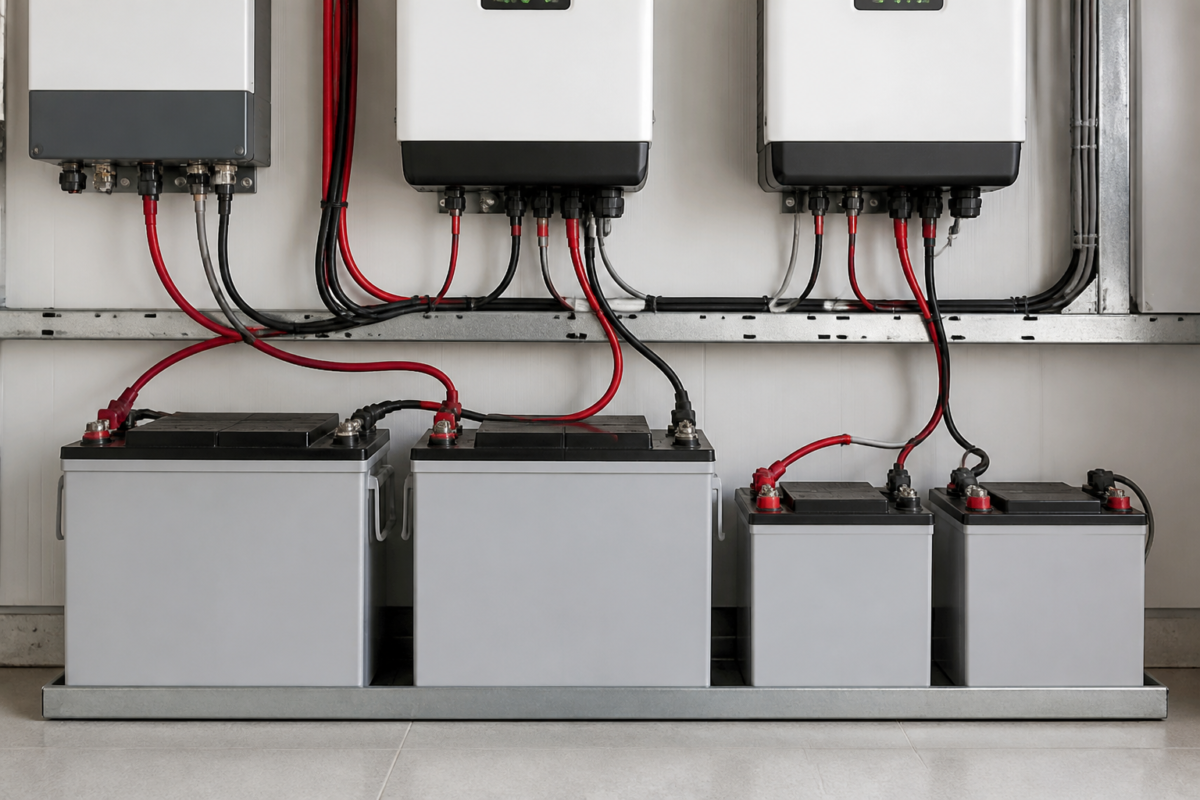
Before connecting, you need to check several key parameters:
- Same nominal voltage. You cannot connect 12 V and 24 V batteries in parallel.
- Same chemistry. Lead-acid, AGM, GEL, LiFePO4 and other types have different charging characteristics. Even with the same voltage, they should not be mixed.
- Close to actual voltage. Before switching, the batteries are charged separately and equalized. For 12-volt lead-acid models, the desired difference is no more than 0.1 V, for lithium - even less, according to the manufacturer's requirements.
- Compatible technical condition. An old battery with increased internal resistance will impair the performance of a new one. A significant difference in age and number of cycles is undesirable.
- Protection of each branch. A separate fuse or circuit breaker, designed for the cable and permissible current, is installed near the positive terminal of each battery.
The cables from each battery to the common bus should have the same cross-section and, preferably, the same length. This reduces the difference in resistance. If there are no buses, the load is connected «diagonally»: the positive wire is taken from the first battery, the negative one from the last. This scheme contributes to a more even distribution of current.
Limitations for batteries of different capacities
A smaller capacity does not necessarily mean that the battery will be recharged: in a parallel block, the voltage for all branches is the same. The main risk lies in the differences in internal resistance, permissible current and the condition of the batteries. The charger parameters should be selected according to the total capacity, but taking into account the maximum charging current of the weakest battery.
For lithium batteries, each module must have a compatible BMS that allows parallel operation. Some control systems can crash during equalization or create a situation where all the current briefly goes to one module.
After installation, it is worth measuring the current in each branch with current clamps under the same load. If one battery gives noticeably more than the others, you need to check the terminals, cables, internal resistance and state of charge. A practical rule: first equalize the voltage, then connect through fuses, and carry out the first charging and discharging under temperature and current control.